ARP String Synthesizer (1975)
A shimmering pad swells beneath a cutting lead, two distinct souls trapped in one wooden chassis.
Overview
This instrument remains one of the most elusive artifacts from the golden age of analog synthesis. Documentation shows it was a hybrid model combining the lush, polyphonic textures of the Solina String Ensemble with the monophonic lead capabilities of the ARP Explorer. While the Solina provided a rich, orchestral bed of violins, trumpets, and cellos, the added Explorer circuitry allowed a player to cut through that ensemble with a sharp, tunable VCO lead. Owners report that this dual architecture created a powerful performance tool, capable of backing a full band with strings while soloing over the top without needing external gear.
Manufacturing records indicate the unit was built in Bodegraven, Netherlands by Eminent B.V., then re-branded for the American market under the ARP logo. This collaboration bridged the Dutch organ technology with American synth design, resulting in a machine that offered full polyphony alongside traditional voltage control. The chorus effect, inherent to the Solina section, delivers a phase-shifting animation that makes the string section sound thicker and more alive, a characteristic that defines the disco and progressive rock sounds of the late seventies.
Surviving units are exceptionally rare. Supposedly only about 100 were ever produced, making this hybrid far scarcer than the standard Solina String Ensemble found in many studios. Collectors note that the rarity stems from the complex integration of two distinct synthesis engines into a single control panel. When functional, the instrument offers a unique workflow where string ensembles and monophonic leads coexist without patching, a convenience that was ahead of its time but costly to manufacture.
Specifications
| Manufacturer | ARP Instruments Inc. (Built by Eminent B.V., Netherlands) |
| Production Years | 1975 (Hybrid Model) |
| Original Price | Not documented in available research |
| Keyboard | 49 Keys |
| Polyphony | Full Polyphonic (Strings) / Monophonic (Lead) |
| String Voices | Violin, Viola, Cello, Contra-Bass, Horn, Trumpet |
| Lead Oscillator | VCO (from ARP Explorer architecture) |
| Effects | Built-in Chorus/Ensemble Effect |
| Controls | Crescendo (Attack), Sustain Length (Decay), Volume Sliders |
| Outputs | Gate and Trigger Outputs (Polyphonic Keyboard) |
| Chorus Switch | On/Off (SE-II Architecture) |
| Technology | Divide-Down Oscillators (Strings) + VCO (Lead) |
| Case Material | Wood or Wood-like Panels |
| Production Count | Approximately 100 Units |
| Power Supply | Internal (Voltage Rails for Analog Circuits) |
| Tuning | Global Tuning Knob |
| Architecture | Hybrid (Solina String Ensemble + ARP Explorer) |
Key Features
Hybrid Synthesis Architecture
The defining characteristic of this model is the marriage of divide-down string technology with voltage-controlled lead synthesis. The Solina section uses top-octave divide-down oscillators common in electronic organs of the era to achieve full polyphony across the keyboard. This ensures that every key pressed triggers a string voice without the need for multiple discrete oscillators. layered beneath this is the ARP Explorer monophonic synthesizer circuit, which introduces a true VCO for lead lines. Service technicians observe that this combination allows for complex arrangements where a player can hold a string chord while playing a bass line or lead melody simultaneously, a capability that standalone string machines lacked.
Animated Chorus Effect
The built-in chorus effect is not merely an add-on but a core component of the string voice identity. Research indicates the effect is achieved by passing the sound through three modulated delay lines that cause a phase-shifting effect. This makes the resulting string sound especially lush and shimmery, masking the static nature of the divide-down oscillators. On their own, the individual string voices are quite unrealistic and not particularly usable, but when combined as an ensemble with the chorus engaged, the texture becomes thick and animated. Owners report that the chorus circuit is the heart of the instrument's appeal, providing the motion necessary to mimic a real orchestral section.
Performance Control Layout
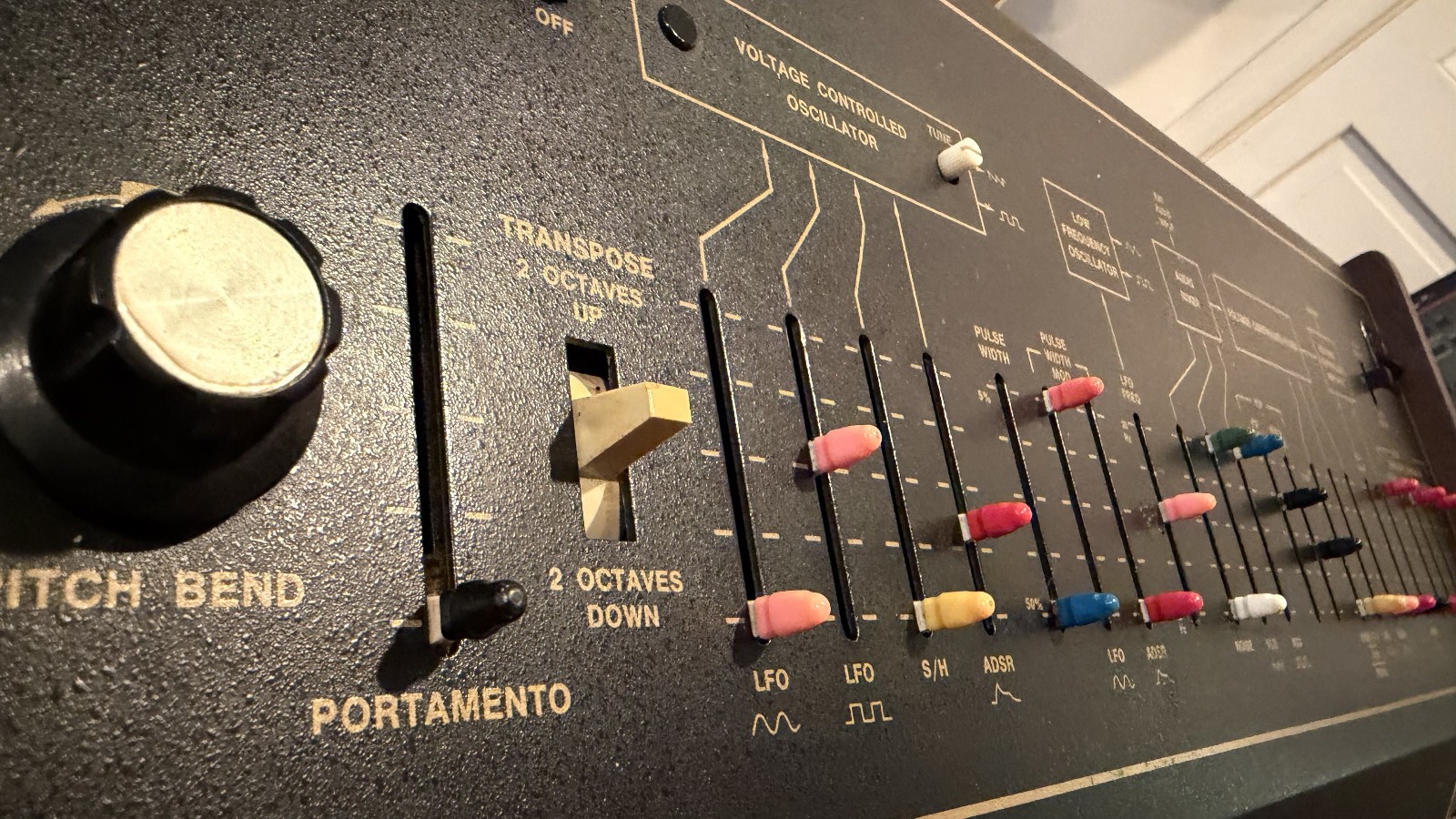
The control panel reflects a discrete layout designed for immediate performance adjustments. Sliders for Crescendo (attack) and Sustain Length (decay) allow players to shape the envelope of the string section without navigating complex menus. The global tuning knob ensures the divide-down oscillators stay aligned with the monophonic VCO, critical for keeping the hybrid voices in harmony. Documentation shows the keyboard provides Gate and Trigger outputs from the polyphonic section, allowing external sequencers or drum units to sync with the string performance. This integration of control voltage outputs alongside preset string voices positioned the instrument as a hybrid between a preset organ and a modular synthesizer.
Historical Context
ARP Instruments dominated the American synthesizer market throughout the 1970s, competing directly with Moog Music. While ARP focused on voltage-controlled modular and semi-modular systems like the 2500 and 2600, the demand for polyphonic instruments grew among touring musicians who needed reliable tuning and full chords. The Solina was created by the Dutch company Eminent in 1974, derived from the string section of Eminent's 310U Organ. ARP bought the rights to re-brand the Solina for the US market, leveraging their distribution network to place these string machines in studios across North America.
This specific hybrid model represented an attempt to bridge the gap between the string ensemble market and the lead synth market. Competitors like the Polymoog and ARP Omni were emerging, offering polyphony but often lacking the specific orchestral texture of the Solina. By integrating the Explorer lead engine, ARP aimed to provide a single solution for keyboardists who previously had to stack a string machine on top of a monophonic synth. The industry moment favored instruments that could reduce rack space while maintaining sonic versatility, though the complexity of this hybrid limited its production volume compared to the standard Solina Ensemble.
Collectibility & Value
Market availability is extremely limited due to the production count of approximately 100 units. Prices by condition vary significantly, but collectors note that functional hybrids command a premium far above standard Solina String Ensembles. A working unit in good cosmetic condition often reaches five-figure sums due to the scarcity and the dual synthesis capability. Buyers should verify that both the string section and the Explorer lead section are operational, as repairs on the hybrid interface are complex and require specialized knowledge of both Eminent and ARP circuit designs.
Common failures mirror those of the Solina String Ensemble, particularly within the chorus circuit and power supply. The chorus ICs are known to fail, resulting in a static string sound without the characteristic shimmer. Power supply capacitors age over decades, leading to voltage instability that affects tuning stability across the divide-down oscillators. Service technicians observe that restoration costs can be high due to the need to source specific analog components for the Eminent section alongside ARP-specific parts for the lead engine. Before buying, check the global tuning knob for smooth operation and ensure the Gate and Trigger outputs fire correctly, as these are critical for integrating the instrument into a modern modular setup.
Ownership quirks include the heavy weight of the wooden chassis and the heat generated by the analog power rails. The wood panels age well aesthetically but can warp if stored in fluctuating humidity. Honest warnings suggest that unless the buyer has access to a technician familiar with 1970s Dutch analog organ circuitry, maintenance should be budgeted alongside the purchase price. This sounds gorgeous but it will try to catch fire if you don't recap it, a sentiment echoed by many long-term owners of similar vintage analog gear from this period.
eBay Listings


As an eBay Partner, we earn from qualifying purchases. This helps support our independent vintage technology research.
Related Models
- Elka Rhapsody (1978-1981)