ARP Solina String Ensemble (1974–1980)
That lush, undulating wall of strings that defined 70s radio? It probably came from this walnut-paneled box with the wobbly chorus and the keys that feel like a school piano.
Overview
Plug in the ARP Solina String Ensemble, hit a chord, and suddenly the room fills with a sound like warm honey poured over velvet—thick, rich, and impossibly wide. It doesn’t just play strings; it breathes them. The moment you hear that slow-sweeping, slightly unstable chorus, you’re transported: Gary Wright’s “Dream Weaver,” Vangelis’ starfields, the ghostly pads behind “Video Killed the Radio Star.” This isn’t a synthesizer in the modern sense. It’s a string machine—a dedicated, fully polyphonic analog/digital hybrid built to simulate an orchestra section with minimal fuss and maximum vibe.
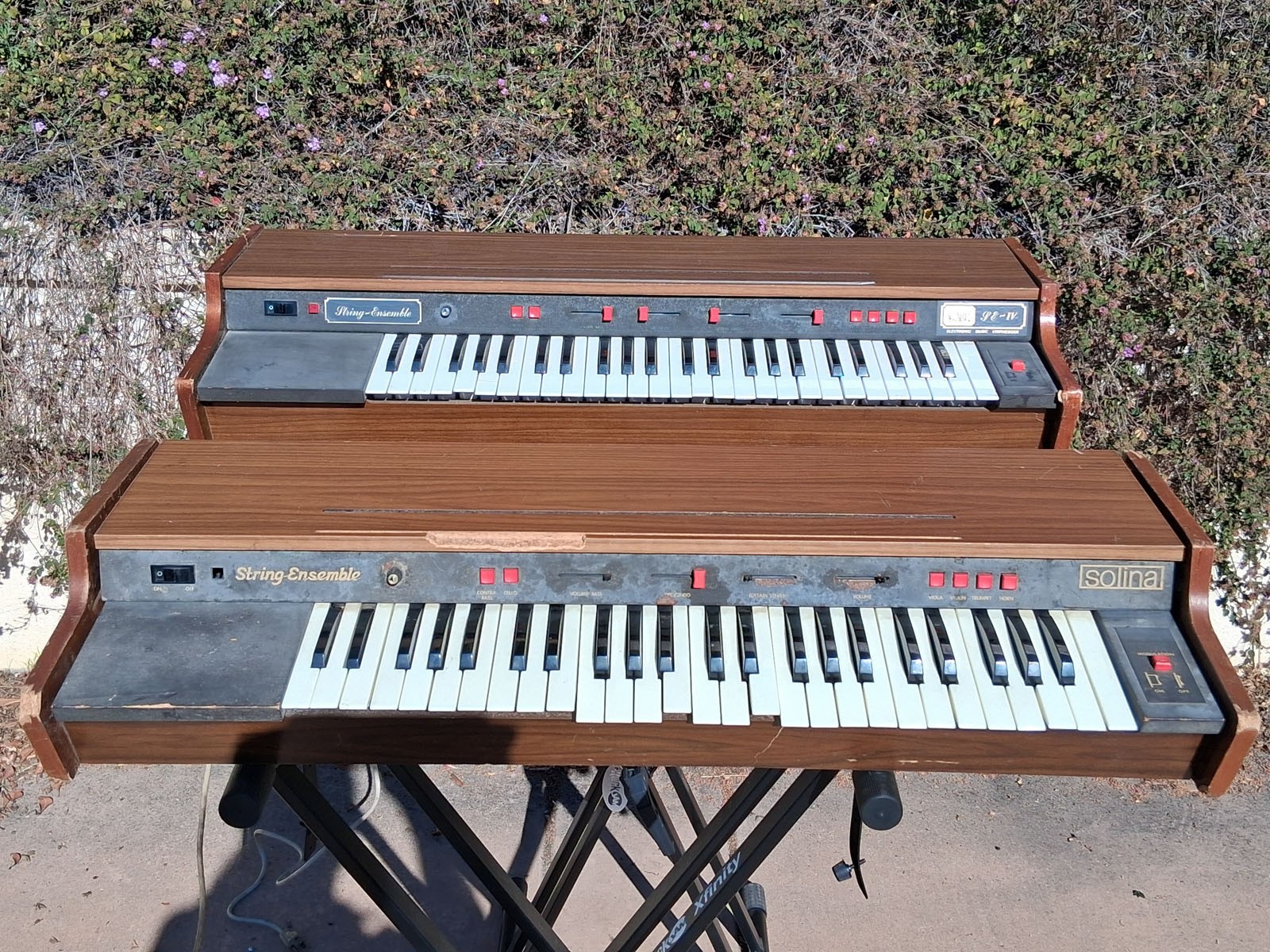
Originally designed by Dutch organ maker Eminent BV and later rebadged and distributed in the US by ARP (yes, *that* ARP), the Solina was never meant to be a modular powerhouse or a lead synth. It was a session player’s tool, a touring keyboardist’s secret weapon, and a studio workhorse for producers who wanted orchestral depth without hiring 40 musicians. The keyboard’s 49 keys are velocity-free and unweighted, but that doesn’t matter—this is about sustained chords, swells, and textures. The real magic lives in the ensemble effect, a BBD-based chorus that modulates each note independently, creating that signature shimmering, almost seasick wobble. It’s not perfect. It’s not stable. And that’s exactly why it sounds so alive.
While ARP’s name carried weight in the synth world thanks to the 2600 and Odyssey, the Solina was a different beast—a licensed product rather than an in-house design. But ARP’s involvement helped it gain traction in the US market, where its warm, slightly nasal tone stood out from competitors like the Yamaha SY-2 or the Roland RS-202. It wasn’t the first string machine, but it became one of the most iconic, thanks to its aggressive marketing, widespread adoption, and that unforgettable sound. Four versions were released over its lifespan: the SE-I (mono, fixed chorus), SE-II (chorus on/off switch), SE-III (true stereo output), and SE-IV (with LED indicators for section selection). Most players hunting today want a late-model SE-III or IV for the stereo spread and added control.
The front panel is sparse: six preset voices (Violins, Violas, Cellos/Basses, Trumpets, Horns, and Flutes), a “Brilliance” switch for high-end lift, and the all-important “Modulation” button that engages the ensemble effect. There’s no filter envelope, no LFO routing, no patch memory. But you do get basic envelope control via Attack and Release sliders—rare for a preset string machine of this era—which lets you shape how the sound swells in. That modulation button? It’s the heart of the machine. Engage it, and the sound instantly blooms, doubling in width and gaining that slow, hypnotic drift. Bypass it, and the tone collapses into something thin and static, like a power strip hum. The keyboard’s build is solid—real wood casing, chunky knobs—but the internal electronics are fragile by today’s standards, and decades of thermal stress have left many units barely functional without restoration.
Specifications
| Manufacturer | ARP (distributed), originally Eminent BV |
| Production Years | 1974–1980 |
| Original Price | $1,995 (1976) |
| Keyboard | 49 keys, non-weighted, non-velocity-sensitive |
| Polyphony | 49-note (fully polyphonic) |
| Oscillator Type | Digital divide-down oscillator with analog filtering and amplification |
| Presets | 6: Violins, Violas, Cellos/Basses, Trumpets, Horns, Flutes |
| Ensemble Effect | Analog BBD-based chorus with modulation depth control |
| Modulation Switch | On/Off (SE-II and later) |
| Brilliance Switch | On/Off (boosts high frequencies) |
| Envelope Controls | Attack and Release sliders |
| Outputs | 1x Mono (SE-I), 2x 1/4" (Left/Right, SE-III and later) |
| Inputs | 1x 1/4" sustain pedal |
| Power Supply | Internal 120V AC (US models), 220V AC (EU models) |
| Weight | 42 lbs (19 kg) |
| Dimensions | 38.5" W × 13.5" D × 6" H (97.8 × 34.3 × 15.2 cm) |
| Construction | Wooden cabinet with walnut veneer, metal chassis |
| Version Variants | SE-I (mono, fixed chorus), SE-II (chorus switch), SE-III (stereo), SE-IV (LED indicators) |
Key Features
The Ensemble Effect: Where the Magic Lives
The BBD (Bucket Brigade Device) chorus circuit is the soul of the Solina. Unlike a standard chorus pedal that modulates the entire signal, the Solina applies slight pitch variation to each note individually, creating a dense, organic phasing that mimics the natural tuning inconsistencies of a real string section. The result is a sound that never sits still—slowly rotating, breathing, pulsing. It’s not just stereo imaging (though the SE-III’s left/right separation enhances this); it’s temporal depth. When you play a chord, each voice drifts in and out of phase, generating a living, undulating pad. This effect is so integral that many players leave it on permanently. The SE-II and later models added a switch to bypass it, but doing so reveals how naked the raw tone really is—thin, reedy, almost like a reed organ. The modulation isn’t subtle, and it wasn’t meant to be. It’s the difference between a recording and a performance.
Preset Voices with Analog Character
While the Solina offers only six preset voices, they’re not mere samples or static waveforms. The machine uses a digital divide-down oscillator (like an organ) to generate all pitches, but each voice passes through its own analog filter and VCA stage, giving it warmth and variation. The Violins are bright and cutting, perfect for disco stabs; the Cellos/Basses have a throaty growl that works beautifully under funk grooves; the Horns and Trumpets are brassy but not shrill, with a slight nasal quality that cuts through a mix. The Flutes are surprisingly expressive—airy and soft, ideal for ambient beds. None of these sounds are realistic in a classical sense, but they’re emotionally convincing. They don’t imitate an orchestra so much as evoke one, like a watercolor impression of a symphony.
Envelope Control in a Preset Machine
Most string machines of the 1970s locked you into a fixed attack and release. The Solina breaks that mold with dedicated Attack and Release sliders—rudimentary by synth standards, but revolutionary for a preset ensemble keyboard. This allows players to shape the envelope from soft, slow swells (perfect for cinematic intros) to tight, staccato chords (ideal for rhythmic funk or reggae). The range isn’t huge, but it’s enough to make the Solina feel more expressive than its peers. Combined with the modulation button, these controls let you dial in anything from a ghostly pad to a punchy rhythmic element. It’s still not a synth you’ll solo on, but it’s far from static.
Historical Context
The mid-1970s were a turning point for keyboardists. Synths were gaining popularity, but true polyphony was still rare and expensive. Instruments like the Yamaha CS-80 or Sequential Circuits Prophet-5 were years away or prohibitively costly. Meanwhile, producers wanted orchestral textures without the logistics of hiring session players. The string machine filled that gap—a self-contained, affordable, plug-and-play solution for lush backing parts. The Solina wasn’t the first (the Freeman String Symphonizer and Eminent’s own 2002 predated it), but it was the one that broke through.
ARP’s branding gave it instant credibility in the US market, where the ARP name was synonymous with cutting-edge synthesis. While the Solina was technically an Eminent product, ARP’s distribution and marketing pushed it into studios and touring rigs across rock, funk, and disco. It became a staple in prog rock (Styx, Yes), electronic pioneers (Jean Michel Jarre, Vangelis), and even early new wave (The Buggles). Its sound defined an era—not because it was the most advanced, but because it was accessible, reliable (enough), and sonically distinctive.
Competitors like the Roland RS-202 and Korg PE-1000 offered similar functionality, but the Solina’s chorus effect and slightly brighter tonality gave it an edge in mix clarity. The Yamaha SY-2 had a warmer tone but lacked the Solina’s stereo spread and modulation control. By the time true polyphonic synths arrived in the early 1980s, the string machine era was winding down, but the Solina’s legacy was already cemented. It wasn’t replaced—it was sampled, emulated, and mythologized.
Collectibility & Value
Today, a working ARP Solina String Ensemble is a prized find, but it’s not for the faint of heart. Prices vary wildly based on model, condition, and functionality. A non-working SE-I might go for $800–$1,200, while a fully restored SE-III or IV with stereo output can fetch $2,500–$3,500. The difference isn’t just cosmetic—stereo output is essential for modern use, and later models are more stable and serviceable. SE-II and later models are preferred for their chorus on/off switch, which adds performance flexibility.
The biggest issue? Reliability. These units are over 40 years old, and the electronics are prone to failure. The most common problems include failing electrolytic capacitors (especially in the power supply), dried-out BBD chips (which kill the chorus effect), and cracked solder joints from thermal cycling. The modulation circuit is particularly fragile—many units either have a weak chorus or none at all without recap and chip replacement. Service technicians observe that nearly every Solina needs at least a partial recap to function reliably, and a full restoration can cost $400–$800 depending on parts and labor.
Before buying, test every preset, check both outputs (if stereo), and verify that the modulation effect is strong and even across the keyboard. Listen for crosstalk, hum, or dead notes. The keys should return smoothly, though some stickiness is common and usually fixable. Avoid units with water damage, warped cabinets, or replaced power supplies—these are red flags for deeper issues. Original condition is valued, but a well-documented restoration is often more desirable than a “mint” unit that doesn’t work.
Despite the maintenance burden, demand remains high, driven by producers seeking authentic 70s textures and the resurgence of analog warmth in modern genres like synthwave, vaporwave, and nu-disco. The Solina’s sound is difficult to replicate with samples—its instability, its slight imperfections, the way the chorus interacts with room acoustics—all contribute to its character. For many, owning a real unit is about more than sound; it’s about connection to a pivotal moment in music history.
eBay Listings
As an eBay Partner, we earn from qualifying purchases. This helps support our independent vintage technology research.