ARP Odyssey (1972–1981)
A synth that doesn’t just make noise—it argues with you, bites back, and somehow still becomes your favorite collaborator.
Overview
Plug in an Odyssey, flip the power switch, and wait. No sound. No friendly beep. Just silence and a blinking red LED if you’re lucky. You twist knobs, press keys—nothing. Then, after ten minutes of frantic patching and double-checking cables, it hits you: the gate isn’t routed. The envelope isn’t assigned. The oscillators are muted in the mixer. This isn’t a design flaw—it’s a rite of passage. The ARP Odyssey doesn’t hand you sounds; it demands you earn them. And once you do, it rewards you with one of the most aggressive, articulate, and alive monosynth voices ever built.
Born in 1972 as ARP’s answer to the Minimoog, the Odyssey wasn’t trying to be the same. Where Moog offered warmth and roundness, the Odyssey came sharp, bright, and unapologetically clinical. It was the scalpel to the Minimoog’s butter knife—precise, cutting, capable of surgical strikes in a mix. It wasn’t always easier to use, but it was always more confrontational. Musicians who loved it didn’t just play it; they wrestled it into submission. Herbie Hancock used it to slice through jazz-fusion arrangements with laser precision. Kraftwerk harnessed its cold, metallic timbres for early electronic statements. The BBC Radiophonic Workshop wheeled one around Maida Vale on a trolley like a prized weapon, fighting over who got to use it next.
At its core, the Odyssey is a duophonic analog subtractive synth—two VCOs, a filter, an LFO, two envelopes, and a mixer that lets you blend in noise or ring modulation. That last part is key: the ring modulator doesn’t just add metallic clangor—it transforms the synth’s character entirely. Play a fifth, and the harmonic series fills in the missing third like magic. Play dissonance, and it responds with snarling, inharmonic chaos. It’s not just a feature; it’s a personality trait.
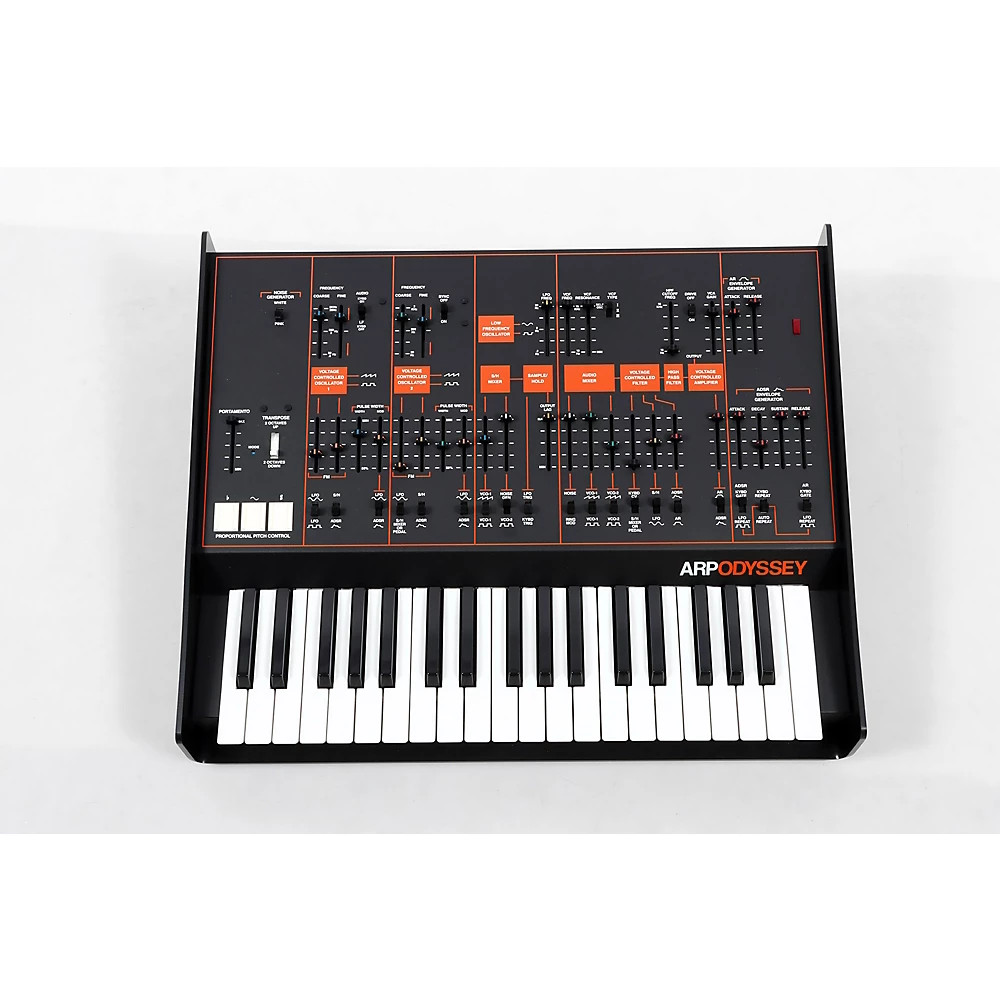
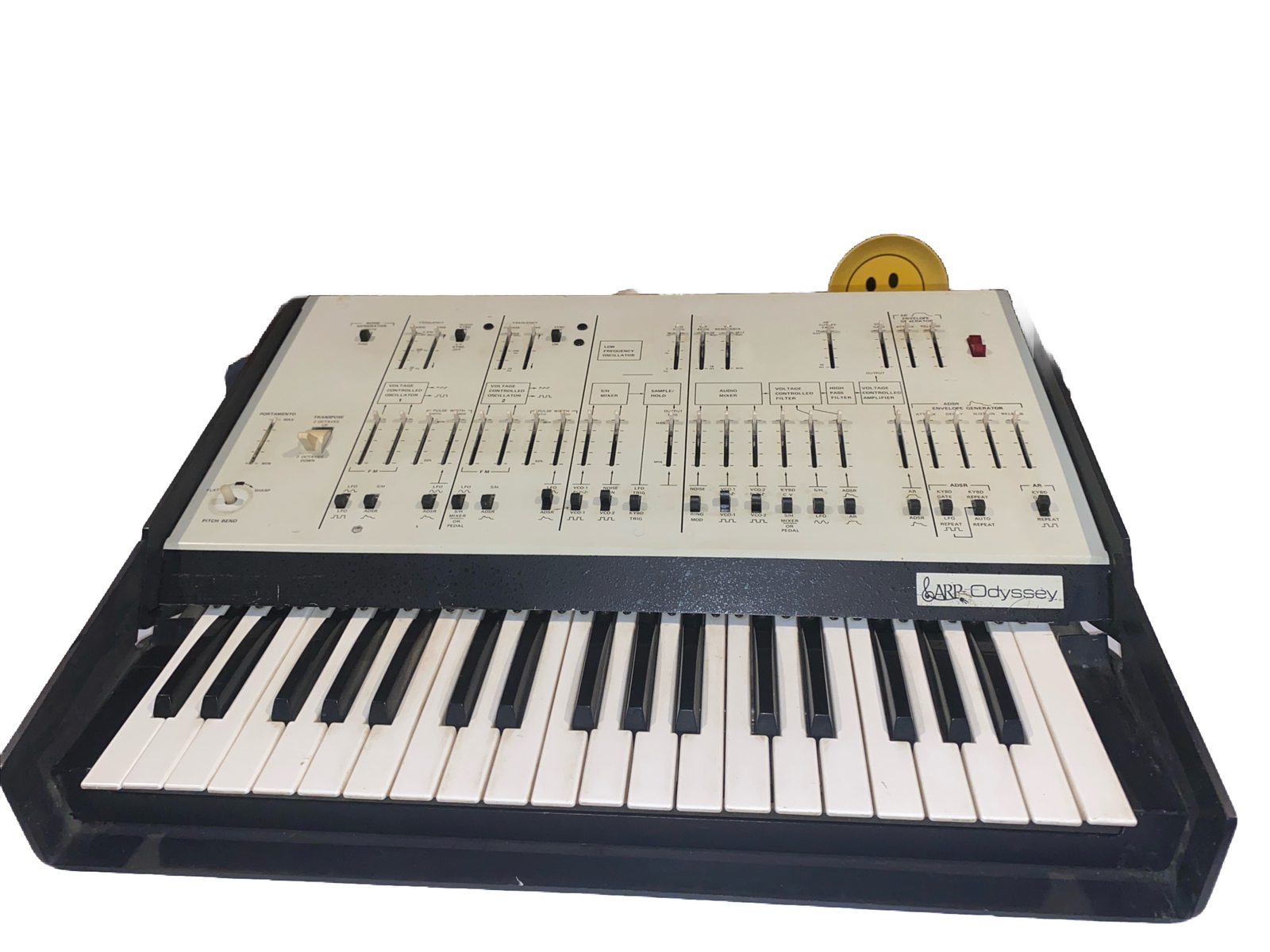
Three major revisions mark its production run: the white-and-blue “Mark I” (1972–1975), the black-and-gold “Mark II” (1975–1978), and the black-and-orange “Mark III” (1978–1981). Each tweaked the filter design, keyboard action, and control layout. Purists argue over which sounds best, but the truth is they’re all distinct characters—like siblings raised in the same house but with different temperaments. The Mark I’s 4012 filter is punchy and immediate. The Mark II’s 4075 filter is smoother, more musical. The Mark III’s updated build quality and steel chassis made it more roadworthy, even if some say it lost a bit of the earlier models’ rawness.
And then there’s the keyboard. Let’s be honest: it’s not great. It’s light, shallow, and clacky—more like a typewriter than a musical instrument. But it’s also fast. Once you adapt to its quirks, you realize it’s built for speed, not expression. This isn’t a synth for delicate phrasing; it’s for staccato attacks, rapid-fire solos, and stabbing basslines that cut through a mix like a switchblade.
Specifications
| Manufacturer | ARP Instruments, Inc. |
| Production Years | 1972–1981 |
| Original Price | $1,398 (1972) |
| Keyboard Size | 37 keys (F–F) |
| Keyboard Type | Non-weighted, velocity-sensitive (aftertouch on later models) |
| Polyphony | Duophonic (two-note, split oscillator assignment) |
| Oscillators | 2 VCOs (Sawtooth, Square/Pulse, PWM) |
| Noise Source | White or Pink Noise, switchable |
| Ring Modulator | Internal, between VCOs |
| Filter Type | 24dB/oct Low Pass, 6dB/oct High Pass (varies by revision) |
| Filter Revisions | Mark I: 4012; Mark II: 4075; Mark III: 4075 |
| LFO | Triangle, Square, Sample & Hold waveforms |
| Envelopes | Two: AR and ADSR (switchable) |
| Modulation | Pitch Bend (rotary on Mk I/II), Proportional Pitch Control (PPC) on Mk III |
| Outputs | 1/4" Main Out, 1/4" Headphone Out (on reissues) |
| Inputs | External Audio In, CV/Gate In, S-Trig, LFO Out, Envelope Out |
| MIDI | Not original; added in Korg reissues |
| Weight | 35 lbs (15.9 kg) |
| Dimensions | 35.5" × 13.25" × 5.25" (90.2 × 33.7 × 13.3 cm) |
| Power | 100–120V AC, 60 Hz (original); 100–240V AC (reissues) |
Key Features
The Filter That Fights Back
The Odyssey’s filter isn’t just a tone shaper—it’s a co-conspirator. Depending on the revision, it behaves differently, but all versions share a certain aggression. Turn up the resonance, and it doesn’t just whistle—it screams. The Mark I’s 4012 filter is the most raw, with a snarling top end that cuts through any mix. The Mark II and III’s 4075 filter is slightly tamer, with a smoother sweep and less high-end bite, but still capable of self-oscillation that can slice glass. What makes it special isn’t just the sound—it’s the way it interacts with the ring modulator and noise source. Patch in white noise, crank the high pass, and you’ve got a percussive snare that doesn’t need a drum machine. Blend in ring modulation with a detuned square wave, and you’re in sci-fi territory before you’ve even touched the LFO.
Duophony Done Dirty
Call it duophonic, call it pseudo-polyphonic—whatever you call it, the Odyssey’s two-voice trick is more clever than it first appears. You can’t play full chords, but you can split the two oscillators across two notes, letting you play fifths, fourths, or octaves with real harmonic tension. It’s not polyphony in the modern sense, but it’s expressive in a way that pure monophony isn’t. When paired with the ring modulator, those intervals generate sum and difference tones that fill out the sound in unpredictable ways. Play an open fifth, and the harmonic series often generates a perfect third, turning your two-note stab into a de facto triad. It’s physics as a sound design tool—and it’s brilliant.
LFO as Weapon
The Odyssey’s LFO isn’t just for vibrato. It’s a chaos engine. Route it to pitch, and you get classic wobble. Route it to filter cutoff, and you’ve got pulsing, rhythmic sweeps. But the real magic is Sample & Hold—especially when clocked by the envelope trigger. Set it to randomize the pitch of one oscillator on every note, and you get a detuned, unstable quality that sounds like a synth losing its mind. It’s not subtle, but subtlety was never the Odyssey’s goal. This is the kind of modulation that defined early electronic music—unpredictable, organic, and full of character.
Historical Context
The early 1970s were a battlefield for synth supremacy. Moog had the Minimoog, a portable powerhouse that dominated live stages and studios. ARP had the 2500 and 2600—modular beasts beloved by innovators but too complex for most. The Odyssey was ARP’s bid for the mainstream: a performance synth that could go toe-to-toe with the Minimoog but offer something different. It succeeded. While the Minimoog was the velvet glove, the Odyssey was the iron fist. It appealed to players who wanted precision, aggression, and a bit of danger in their sound.
Competition wasn’t just from Moog. Oberheim was building SEM-based systems. Yamaha was experimenting with digital control. But the Odyssey carved its niche by being immediate, loud, and confrontational. It didn’t try to be everything—it tried to be the best at what it did. And in the hands of artists like Jean-Michel Jarre, Chick Corea, and Ultravox’s Billy Currie, it became a signature voice of the era.
The three revisions reflect ARP’s constant tinkering. The Mark I established the sound. The Mark II refined the build and playability. The Mark III, with its steel chassis and PPC pitch control, was built for the road. But by 1981, ARP was collapsing under financial pressure, and the Odyssey was discontinued. It left behind a legacy not of mass adoption, but of intense devotion.
Collectibility & Value
Today, the Odyssey is a prized vintage synth, but it’s not without its pitfalls. Prices vary wildly by revision, condition, and service history. A fully restored Mark I in white-and-blue can fetch $4,500–$6,000. Mark IIs in black-and-gold are slightly less, $4,000–$5,500, while Mark IIIs in black-and-orange hover around $3,500–$4,800. But those prices assume full functionality, stable tuning, and no major repairs needed.
And that’s the catch: these machines are old. Capacitors dry out. Power supplies fail. The original electrolytics are long past their lifespan, and a neglected Odyssey can drift wildly or refuse to power on at all. Recapping is not optional—it’s essential. A proper service, including recapping, calibration, and keybed cleaning, can run $600–$1,000. That’s not a repair; that’s entry-level ownership.
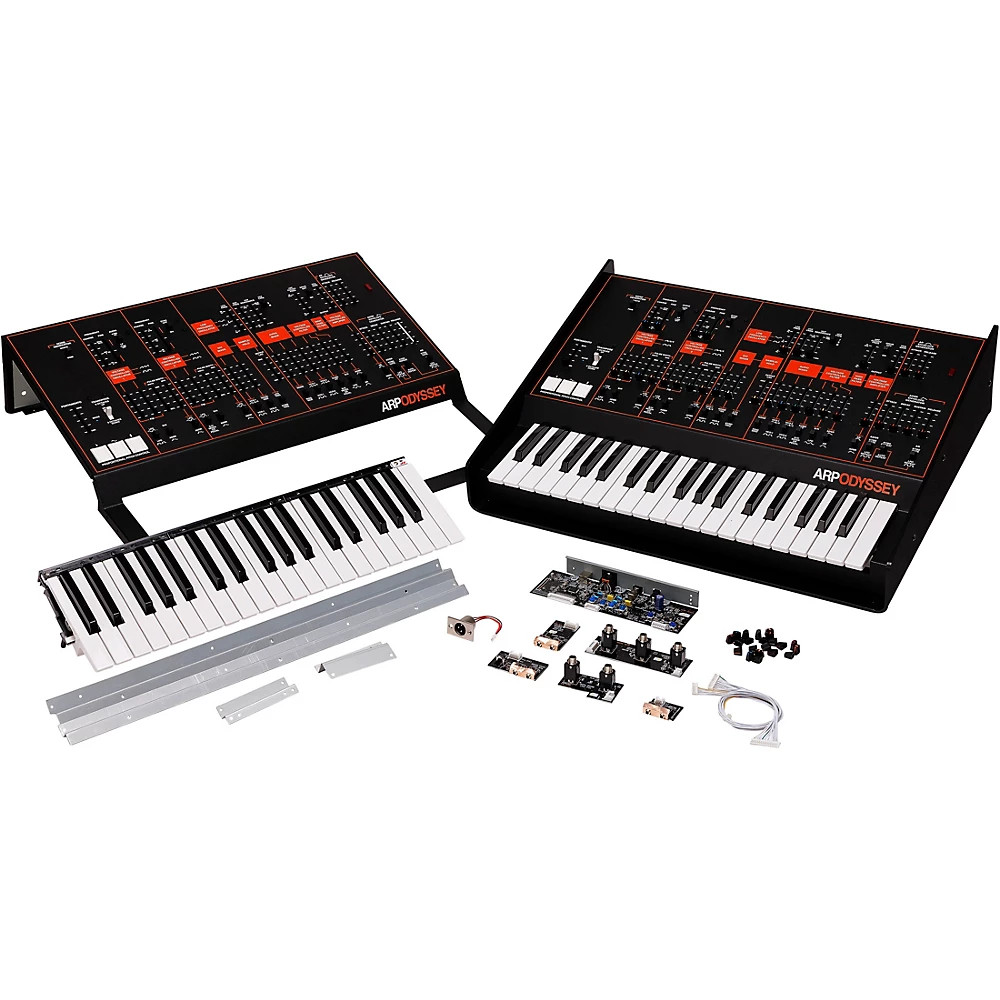
The keyboard is another weak point. The plastic key bushings wear out, leading to wobbly keys and inconsistent triggering. Replacing them requires disassembly and sourcing NOS or reproduction parts. Some owners retrofit modern keybeds, but purists frown on the practice.
Buying advice? Test everything. Check for stable tuning across the keyboard. Verify that both oscillators track properly. Test the ring modulator, noise source, and envelopes. Make sure the filter sweeps cleanly and self-oscillates. Listen for crackles in the pots—cleaning helps, but worn pots may need replacement. And above all: make sure it powers on without smoke.
For those wary of vintage fragility, the Korg reissues (2015–present) offer a compelling alternative. Faithful in layout and sound, they add MIDI, USB, and a headphone jack. The “FS” full-size model even replicates the original’s dimensions and weight. They don’t age, they don’t drift, and they won’t cost you a fortune in repairs. But they lack the original’s imperfections—the slight instability, the tactile quirks, the sense that you’re playing a machine with a mind of its own.
eBay Listings

As an eBay Partner, we earn from qualifying purchases. This helps support our independent vintage technology research.
Service Manuals & Schematics
- Service Manual — archive.org
- Service Manual — archive.org
- Service Manual — archive.org
- Service Manual — archive.org
- Owner's Manual — archive.org