ARP Explorer (1974–1978)
One knob turns down the noise, and suddenly the 1970s snap into focus—this is analog grit with a backbone of surgical precision.
Overview
Turn on an Explorer, and you’re not just powering up a synth—you’re waking up ARP’s quiet rebellion. While the Odyssey grabbed headlines and the 2600 built legends, the Explorer was the dark horse: a no-frills, single-oscillator workhorse that slipped under the radar but delivered more sonic muscle than its preset siblings ever could. It doesn’t scream for attention, but once you start tweaking, it reveals a kind of raw, immediate character that feels more like a lab-built prototype than a mass-market instrument. That’s because, in a way, it was. The Explorer I (Model 2900) wasn’t just another preset box—it was ARP’s first step away from the Pro-Soloist’s rigid sound library and toward real synthesis freedom, a bridge between the era of “flute” and “strings” presets and the fully programmable machines that followed.
It’s easy to underestimate the Explorer at first glance. Thirty-seven keys, no memory storage, no arpeggiator, no modulation wheel—just sliders, switches, and a control panel that looks like it was designed by an engineer who hated clutter. But that simplicity is its strength. Unlike the Pro-Soloist, where you could only tweak presets within narrow bounds, the Explorer lets you dive into the guts. You’re not selecting a sound—you’re building it, one waveform and filter sweep at a time. And because it uses the same 4027-1 VCO as the ARP 2600, it sings with that unmistakable ARP clarity: bright, present, and just the right side of aggressive. The oscillator feeds into octave dividers that generate suboctaves, which can be mixed with the main wave to create a deceptively thick monophonic tone—remarkable for a synth with only one oscillator.
Its filter is another story entirely. The Explorer uses the ARP 4034, a 24dB/oct low-pass ladder filter lifted straight from the Pro-Soloist and based on Moog’s design. It’s not the later, compromised 4075 filter that plagued so many ARP synths—it’s the good one. Smooth, musical, capable of that throaty resonance that snarls when pushed, but never collapses into mush. When paired with the ADSR envelope and the ability to modulate cutoff via LFO or envelope, it becomes a surprisingly expressive tool. The LFO itself is no afterthought: it offers speed, depth, and delay controls, letting you dial in slow, creeping vibrato or rapid, stuttering tremolo with surgical precision.
Specifications
| Manufacturer | ARP Instruments, Inc. |
| Production Years | 1974–1978 |
| Original Price | $1,295 |
| Polyphony | Monophonic |
| Oscillators | 1 VCO with sawtooth, square, narrow pulse, modulated-width pulse, and pink noise |
| LFO | 1 LFO with adjustable speed, depth, and delay |
| Filter | 4-pole (24dB/oct) low-pass VCF (ARP 4034 module) |
| Cutoff Frequency | 10 Hz – 12 kHz |
| Resonance | Adjustable, capable of self-oscillation |
| Envelope Generator | ADSR (Attack, Decay, Sustain, Release) |
| VCA | 1 voltage-controlled amplifier with ADSR control |
| Keyboard | 37 keys (3 octaves), monophonic |
| Effects | Portamento, pitch bend, repeat (retrigger), delayed vibrato |
| Outputs | 1/4" phone jack (high level), RCA (low level) |
| Inputs | None (no external CV/Gate or audio input) |
| Power Supply | Internal, 115V AC (60 Hz) |
| Weight | 28 lbs (12.7 kg) |
| Dimensions | 35.5" W × 12.5" D × 4.5" H (90.2 cm × 31.8 cm × 11.4 cm) |
| Construction | Steel chassis, hardboard bottom panel, aluminum faceplate |
Key Features
The Oscillator That Punches Above Its Weight
One oscillator doesn’t mean thin sound—and the Explorer proves it. The 4027-1 VCO isn’t just stable; it’s rich in harmonic content, especially in sawtooth and square modes. But the real magic lies in the octave dividers. By mixing the fundamental with suboctaves—down to two octaves below—you can stack waveforms to create a pseudo-polyphonic thickness that belies the synth’s monophonic nature. Combine that with the ability to layer multiple waveforms simultaneously (saw + square + pulse), and suddenly you’ve got a lead tone that cuts through a mix like a laser. The pulse width modulation, driven by the LFO or envelope, adds another dimension, letting you go from hollow to biting with a twist of a knob.
A Filter Worth the Hype
The 4034 filter is where the Explorer earns its cult status. Unlike the later 4075 filter found in Odyssey Mk IIs and beyond, the 4034 doesn’t suffer from the high-frequency roll-off that made some ARPs sound dull at full resonance. Instead, it opens up with a smooth, musical sweep, capable of everything from warm pads to screaming leads. It tracks beautifully across the keyboard, and when driven hard, it distorts in a way that feels organic rather than broken. Resonance can be pushed into self-oscillation, giving you a clean sine wave that can be used as a secondary tone source—though without a second oscillator, you’re limited in how far you can go with true detuning or FM effects.
Manual Mode: The Hidden Powerhouse
Yes, the Explorer has presets—“Flute,” “Trumpet,” “Strings,” “Lunar Lander”—but they’re almost beside the point. The real action is in Manual mode, where every slider becomes a direct control over the synth’s voice architecture. No menus, no hidden functions, no compromises. Want a metallic pluck? Dial in a fast attack, short decay, narrow pulse wave, and a sharply resonant filter sweep. Need a pulsing bass? Mix saw and square, add portamento, and let the LFO wobble the pitch just enough to feel alive. It’s not as flexible as a 2600, but it’s far more immediate than a Pro-Soloist. This is hands-on synthesis at its most democratic: no patch cables, no PhD required.
Historical Context
The Explorer arrived in 1974, a year when analog synthesis was at a crossroads. Moog had the Minimoog, ARP had the Odyssey, and preset synths were flooding the market—affordable, easy to use, but creatively stifling. The Pro-Soloist was ARP’s first stab at that market, but it was rigid, its sounds locked behind a membrane interface. The Explorer was the correction: a machine that acknowledged the demand for preset convenience but refused to sacrifice sonic flexibility. It shared DNA with the Pro-Soloist—same filter, similar layout—but replaced the membrane switches with real sliders and opened up the signal path for real-time manipulation.
It also came at a time when ARP was fighting on multiple fronts. The Odyssey was battling the Minimoog for studio dominance, the 2600 was carving out a niche in education and experimental music, and the company was under pressure to deliver affordable instruments without sacrificing quality. The Explorer fit that mission perfectly: it used proven modules (4027-1 VCO, 4034 VCF), avoided costly features like memory storage or MIDI (which didn’t exist yet), and delivered a professional-grade sound in a portable chassis. It wasn’t flashy, but it was honest. Artists like Herbie Hancock and Philip Glass used it not because it was trendy, but because it worked.
Collectibility & Value
The Explorer is rare—not mythical, but uncommon enough that seeing one in the wild feels like a minor event. It never sold in the numbers of the Odyssey or Pro-Soloist, and many were relegated to school music labs or studio closets, where they sat unloved for decades. Today, working units in good condition typically sell between $2,200 and $3,200, with fully serviced models commanding the higher end. Units with original sliders and unblemished faceplates can fetch even more, especially if they’ve been recapped and calibrated.
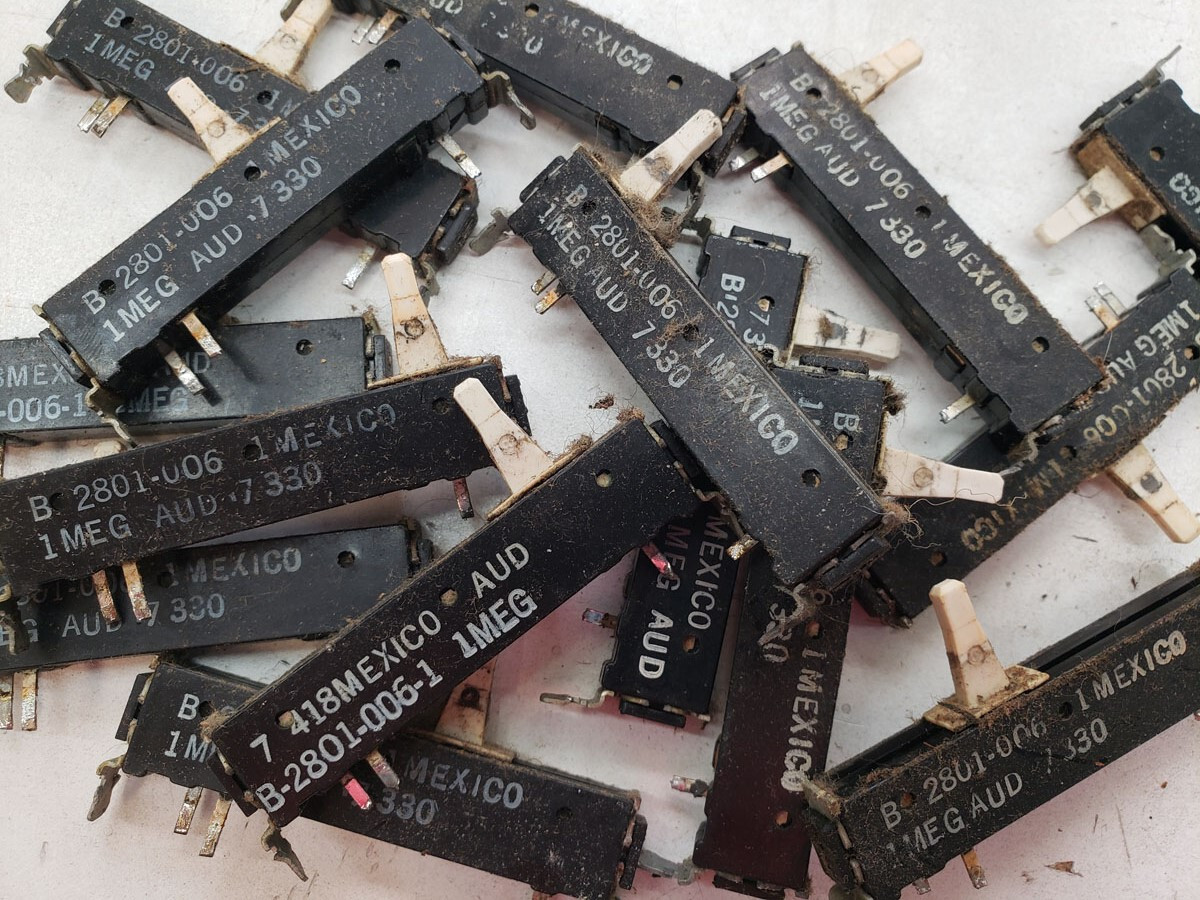
But buying an Explorer is not for the faint of heart. These are 50-year-old electronics, and the ticking time bombs are well documented. Tantalum capacitors—especially in the power supply and control circuits—are notorious for failing, sometimes catastrophically. Service technicians observe that units untouched since the 1970s often need a full recap, including the power supply and audio path. The original sliders are another weak point: they wear out, crack, or develop scratchy pots. Some restorers replace them with modern precision sliders, which improve feel and reliability but alter the original aesthetic. The hardboard bottom panel is also prone to warping or damage, and the gold silkscreen labeling on the front panel frequently fades or rubs off, making control identification a challenge without reference photos.
Before buying, insist on a demo video that shows all sliders in motion, not just a power-on test. Check for consistent keyboard response—some keys may stick or fail to trigger due to worn contacts. Verify that the filter sweeps smoothly and that the LFO modulates pitch and cutoff as expected. If the unit hasn’t been serviced, budget at least $300–$500 for a professional recap and calibration. And remember: there’s no external input or MIDI, so this isn’t a synth you’ll integrate into a modern setup without additional gear. It’s a standalone voice, best appreciated on its own terms.
eBay Listings

As an eBay Partner, we earn from qualifying purchases. This helps support our independent vintage technology research.
Service Manuals & Schematics
- Service Manual — archive.org