ARP 4075 (1975–1981)
The filter that defined ARP’s final era—bright, brash, and quietly flawed, hiding behind a legendary name.
Overview
Plug in an ARP Odyssey MkIII or Omni 2, twist the filter cutoff wide open, and that sudden rush of high-end fizz isn’t quite what you’d expect from a 24dB/octave analog ladder—there’s a ceiling, a soft glass lid capping the top end around 12kHz, even when the knob screams “OPEN.” That’s the ARP 4075 in its original form: a workhorse filter module that powered some of ARP’s most beloved late-’70s synths, yet carried a design flaw so persistent it became part of its lore. It wasn’t broken, not exactly—just hobbled, like a racehorse with a slightly off gait. And yet, when you crank up the resonance, that signature ARP snarl roars to life: aggressive, mid-forward, with a bite that cuts through any mix like a switchblade. This isn’t the smooth, syrupy Moog-style warmth—it’s sharper, more confrontational, the sound of a synth company fighting to stay relevant in a market turning digital.
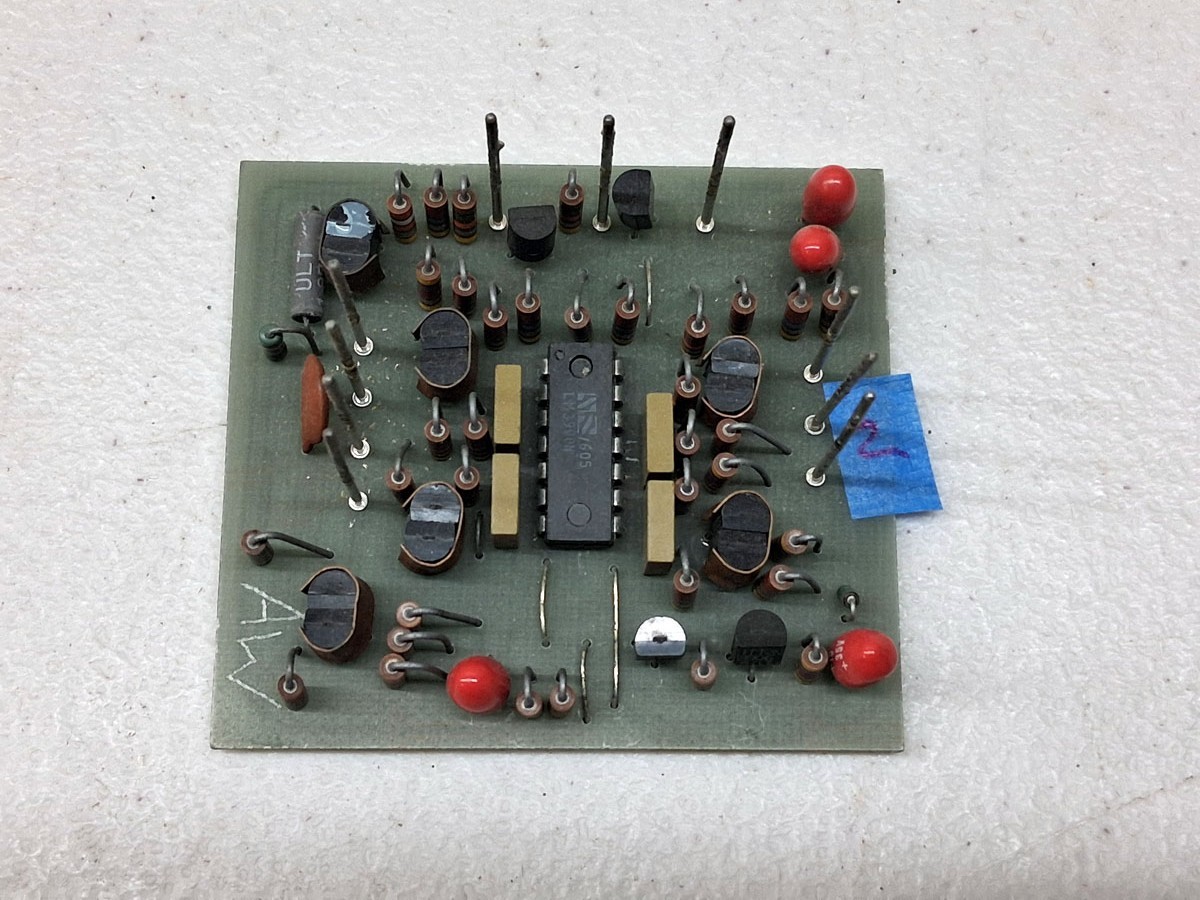
The 4075 wasn’t a standalone instrument but a voltage-controlled filter (VCF) module used across ARP’s keyboard line from roughly 1975 onward. It replaced earlier designs like the 4012 (the “white face” Odyssey filter) and the 4023, eventually becoming the standard in the Odyssey MkII and MkIII, Axxe, Omni, Quadra, Avatar, and Pro/DGX MkII. It’s a 24dB/octave cascaded Norton op-amp design—four poles of filtering stacked in series—giving it that steep roll-off ARP was known for. But unlike the earlier 4012, which stretched cleanly into the upper harmonics, the 4075’s top end was unintentionally choked. Service notes and mods from the era confirm it: due to incorrect resistor values in the circuit, the filter’s cutoff frequency maxed out around 12–14kHz instead of the intended 16kHz. That missing top air isn’t always obvious—until you A/B it with a properly modded unit and suddenly hear how much sparkle was missing.
And yet, people love it. Not despite the flaw, but sometimes because of it. That slightly rolled-off high end gives the 4075 a darker, more contained character compared to the airy brilliance of the white-face Odyssey. It’s a filter that doesn’t beg for attention—it demands it, with a growl that’s more bark than shimmer. In the Omni, it helped create those lush, detuned string machine textures with a gritty underbelly. In the Axxe, it gave a lean, punchy edge to basslines that could rattle a car trunk. It’s not as harmonically rich as a Moog ladder, nor as glassy as a Roland 303-style filter, but it has its own attitude: brash, slightly nasal, with a resonance that doesn’t just whine—it bites.
Specifications
| Manufacturer | ARP Instruments, Inc. |
| Production Years | 1975–1981 |
| Module Type | Voltage-Controlled Low-Pass Filter (VCF) |
| Filter Slope | 24dB/octave (4-pole) |
| Filter Topology | Cascaded Norton Operational Amplifier |
| Frequency Response (Original) | Approx. 20Hz–12kHz (limited by design flaw) |
| Frequency Response (Corrected) | 20Hz–16kHz |
| Resonance (Q) | Voltage-controlled, self-oscillating |
| Filter Inputs | Audio In, Control Voltage In, Keyboard Tracking |
| Control Voltage Response | Exponential (1V/octave) |
| Power Requirements | ±15V DC (standard ARP modular bus) |
| Physical Dimensions | Approx. 4.5" x 2.25" (standard ARP submodule size) |
| Weight | Approx. 8 oz (with PCB and connectors) |
| Used In Models | ARP Odyssey MkII/MkIII, Axxe, Omni, Omni 2, Quadra, Avatar, Pro/DGX MkII |
| Successor | None (end of ARP’s analog filter lineage) |
| Notable Replacement | Synthchaser 4075 Rebuild & Enhancement Kit |
Key Features
The Norton Op-Amp Filter Design
The 4075’s core is its use of cascaded Norton operational amplifiers—a departure from the discrete transistor ladder designs seen in Moogs or the CA3046-based filters in later ARPs. Norton amps respond to current rather than voltage, which changes how the filter behaves dynamically. They’re less linear, more prone to distortion, and interact differently with input levels. This gives the 4075 a slightly gritty, nonlinear character—especially when driven hard. It’s not a “clean” filter; it’s one that adds its own flavor, compressing and saturating in subtle ways that make basslines feel thicker and leads more aggressive. It’s also why the resonance has that distinctive “thumpy” quality—less sine-wave pure, more square-wave bark. This design choice made the filter easier to manufacture and integrate into ARP’s cost-reduced synths, but it came at the expense of high-frequency clarity.
The 12kHz Ceiling and the Mod That Fixed It
The most talked-about aspect of the 4075 isn’t what it does right—it’s what it got wrong. A design error in the original circuit limited the maximum cutoff frequency to around 12–14kHz, even with all components functioning perfectly. This wasn’t a failure of aging capacitors or drifted resistors—it was baked into the design. The fix? Replace four 4.7kΩ resistors on the filter board with 2.2kΩ ones. It’s a five-minute mod for anyone with a soldering iron, and it opens up the top end dramatically. Suddenly, cymbals sound crisper, leads cut with more presence, and the filter sweep feels more complete. The mod is so common now that many surviving 4075-equipped synths have already been corrected, often without the owner even knowing. Some purists argue the darker original character is part of the “authentic” late-ARP sound, but most engineers and players agree: once you’ve heard it modded, going back feels like listening through a blanket.
Drop-In Compatibility and Service Life
One of the 4075’s strengths was its role as a standardized module across ARP’s lineup. Unlike earlier filters that varied between models, the 4075 was designed to be a universal replacement—plug an Odyssey MkIII filter into an Axxe, and it should work. This made servicing easier for technicians and allowed for field upgrades. Service notes from ARP confirm that many MkI and MkII Odysseys were retrofitted with 4075 modules during repairs. However, this interchangeability had limits: the 4075 is not pin-compatible with the earlier 4012 (white face) or the 4023 (2-pole), so swapping them requires rewiring. Later, third-party companies like Synthchaser and CAE Sound offered drop-in replacements and upgrades, including versions that emulate the 4035 ladder filter for players wanting a Moog-like alternative.
Historical Context
The 4075 emerged during ARP’s most turbulent years. By 1975, the company was under financial pressure, competing against cheaper Japanese synths from Roland, Korg, and Yamaha. The original Odyssey and 2600 were engineering marvels but expensive to build. The Axxe, Omni, and later Odyssey revisions were cost-cutting exercises—streamlining production without completely sacrificing sound quality. The 4075 filter was part of that strategy: a standardized, easily manufactured module that could be used across multiple instruments. It wasn’t a leap forward in sonic design—it was a pragmatic solution to a manufacturing problem.
At the same time, the synth world was shifting. Polyphony was becoming expected, and digital control was on the horizon. ARP responded with the Quadra and Pro/DGX—hybrid synths with multiple engines and preset memory—but they still relied on analog filters for their core sound. The 4075 was the last widely used analog filter ARP ever designed. When the company folded in 1981, it marked the end of an era. Unlike Moog or Roland, ARP never developed a successor to this design. The 4075 became a dead end—a final statement in a language that was already being forgotten.
Collectibility & Value
The ARP 4075 itself isn’t a collectible in the way a complete synth is—it’s a circuit board, not a finished product. But its presence (or absence) affects the value and desirability of the instruments it lives in. An unmodified 4075 in an Odyssey MkIII or Axxe isn’t a dealbreaker, but it’s a red flag for serious players. Most technicians now consider the 12kHz mod standard practice, and many vintage synths have already been upgraded. A synth advertised as “original” with a 4075 should prompt a follow-up question: has it been modded?
Common failures include dried-out electrolytic capacitors, which can cause instability, noise, or complete filter dropout. The Norton op-amps themselves are robust, but surrounding components—especially the polarized caps—tend to degrade after 40+ years. A full recap of the filter board is recommended for any unit that hasn’t been serviced recently. Replacement parts are available from specialists like Synthchaser, who offer rebuild kits that include both the cap replacements and the 12kHz fix.
On the market, the 4075’s value is tied entirely to the synth it’s in. An Axxe with a working, modded 4075 might sell for $1,800–$2,500 depending on condition. An Odyssey MkIII in excellent shape with a corrected filter can fetch $3,000–$4,000. The filter itself, if pulled and sold separately, might go for $150–$250 to a restorer or DIYer—but only if it’s in good condition. Boards with cracked traces or corroded connectors are nearly worthless unless they’re being used for parts.
Buying advice: always ask if the filter has been modded. If not, budget for the repair. Also check for noise, crackling, or uneven response across the keyboard—signs of failing components. And be wary of “mint” synths that haven’t been played in decades; capacitors don’t age well in storage. A 4075 that hasn’t been powered in 20 years will likely need a full recap before it sounds right.
eBay Listings

As an eBay Partner, we earn from qualifying purchases. This helps support our independent vintage technology research.