ARP 3604 (c.1972–1980)
The keyboard that turned a modular powerhouse into a stage-ready beast—49 keys of vintage ARP attitude, wired to command the 2600 like a conductor with a grudge.
Overview
It doesn’t make a sound on its own, but plug in the ARP 3604, and suddenly the 2600 stops being a lab experiment and starts feeling like an instrument. This isn’t some afterthought MIDI controller slapped together in a rush—this is a purpose-built, heavy-duty analog command station, designed to give players real-time control over one of the most volatile, expressive synthesizers ever made. The moment you drop your hands on its slightly springy, medium-weight keys, you’re not just playing notes—you’re launching a campaign. The 3604 doesn’t coddle; it demands. Its build is industrial, almost military-grade, with a chassis that laughs at road cases and a keybed that’s seen more control rooms than cocktail lounges. And while it only speaks monophonically—no chords here—it doesn’t need to. This keyboard was built for leads that slice, basslines that crawl, and sequences so tight they feel like they’re breathing on their own.
Originally sold as an optional companion to the ARP 2600, the 3604 wasn’t the only keyboard in the family—there was the smaller 3601 and the later 3620—but it quickly became the preferred choice for players who wanted reach without compromise. Forty-nine keys gave enough range to handle both low-end growl and high-frequency shriek, and the integration with the 2600’s patch bay meant you could route gate, trigger, and CV signals with surgical precision. It wasn’t just about playing the synth; it was about wiring into it. The 3604 didn’t pretend to be a standalone instrument. It knew its role: to be the hand on the throttle, the bridge between human impulse and analog chaos.
And let’s be clear—this isn’t a “musical” keyboard in the modern sense. There’s no velocity, no aftertouch, no expression wheels or assignable knobs. What it does have is a direct, unfiltered connection to the 2600’s soul. You get pitch bend (via a spring-loaded lever that feels like it was salvaged from a jet cockpit), a dedicated portamento switch, and a gate time knob that lets you stretch notes like taffy. That’s it. No frills. But in the hands of someone who knows how to patch, that minimalism becomes a superpower. You’re not fighting a menu system or a digital layer—you’re in direct contact with the circuitry. It’s like driving a car with no power steering: exhausting at first, then deeply satisfying once you learn how to work with its resistance.
Specifications
| Manufacturer | ARP Instruments, Inc. |
| Production Years | c.1972–1980 |
| Original Price | $595 (approx. $4,300 today) |
| Keyboard Type | Monophonic analog remote keyboard |
| Keys | 49 (F to F) |
| Key Action | Spring-return, mechanical linkage |
| Pitch Bend | Spring-loaded lever (up/down) |
| Portamento | On/Off switch with variable glide time knob |
| Gate Time Control | Adjustable gate duration knob |
| CV Output | 1V/octave |
| Gate Output | Positive trigger |
| Trigger Output | Positive pulse |
| Connectivity | 18-pin cable to ARP 2600 (proprietary) |
| Power | Powered via 2600 (no internal power supply) |
| Weight | 22 lbs (10 kg) |
| Dimensions | 35.5" x 11.5" x 4.5" (90 x 29 x 11.5 cm) |
| Compatibility | ARP 2600, ARP 2600P, ARP 2600C |
| Finish | Black tolex with brushed aluminum faceplate, Tonus or G-clef logo (varies by era) |
Key Features
Designed as a System, Not an Accessory
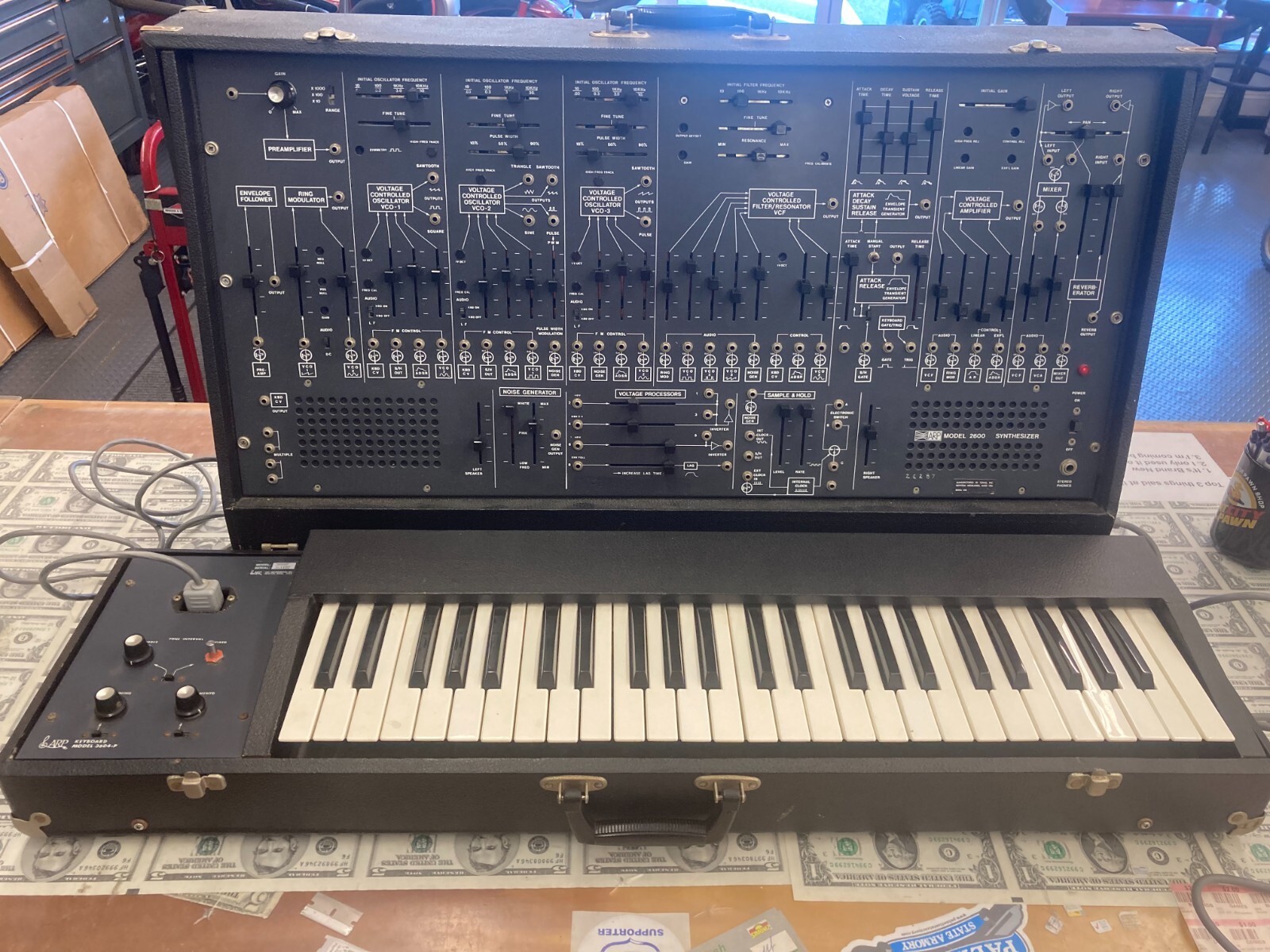
The 3604 wasn’t tacked on—it was engineered as a core part of the 2600 experience. While other manufacturers treated remote keyboards as optional extras, ARP designed the 3604 to feel like a natural extension of the synth itself. The 18-pin cable isn’t just a data link; it’s a lifeline, carrying CV, gate, trigger, and power in one thick, coiled tether that practically hums with intent. The keyboard’s layout mirrors the 2600’s no-nonsense philosophy: controls are placed within thumb’s reach, with the portamento knob and gate time adjustment right next to the pitch lever. There’s no menu diving, no hidden functions—everything you need is right there, labeled in crisp, utilitarian type. It’s the kind of interface that rewards muscle memory, not guesswork.
Pitch Lever with Purpose
Forget the flimsy pitch wheels of later synths—the 3604 uses a stiff, spring-loaded lever mounted on the left side of the keybed. It’s not subtle. It fights back. But that resistance is part of the charm: it forces intentionality. You don’t accidentally bend a note; you commit to it. The lever moves in a short arc, delivering precise control over pitch modulation, and returns to center with a satisfying snap. It’s not as smooth as a modern ribbon or wheel, but it’s more expressive in its own way—each nudge feels deliberate, almost mechanical, like you’re adjusting a dial on a radar array. Players who’ve used it on stage report that it holds up under aggressive playing, though the spring can weaken over decades of use if not maintained.
Gate Time Knob: The Secret Weapon
Most vintage keyboards give you a fixed gate time or nothing at all. The 3604 goes further with a dedicated knob that lets you adjust how long the gate signal stays open after you release a key. This isn’t just about sustaining notes—it’s about shaping articulation. Turn it up, and you can create legato lines that blur between pitches. Dial it back, and you get staccato precision, perfect for tight sequencing or percussive effects. When patched into the 2600’s envelope generators, this control becomes a performance tool, letting you shift from punchy attacks to slow swells on the fly. It’s a small detail, but one that reveals how deeply ARP thought about real-world playing dynamics.
Historical Context
The early 1970s were a battlefield of analog ideologies. Moog had the market cornered on modular systems, but they were expensive, fragile, and notoriously difficult to tour with. ARP entered the fray not by copying—they did something smarter. They rethought the workflow. The 2600 was designed as a self-contained, semi-modular synth that didn’t require a PhD to operate, and the 3604 was its mobile command unit. Released around 1972, the same time as the 2600P revision, the 3604 answered a real need: musicians wanted to play these machines, not just patch them. Studios were adopting synthesizers for pop and jazz, and artists like Herbie Hancock, Stevie Wonder, and Edgar Winter were pushing them into live settings. The 3604 gave them a way to do it without sacrificing control.
It wasn’t the first remote keyboard, but it was one of the first designed specifically for a semi-modular synth with performance in mind. Competitors like Oberheim and EMS offered their own solutions, but they were often clunky or limited. The 3604 stood out for its integration, durability, and sheer presence. It looked like it belonged on a stage, not just in a lab. And while ARP never marketed it as a standalone product (it was always sold alongside or as an add-on to the 2600), collectors now treat it as a crucial piece of the ecosystem. Losing the original 3604 can drop a 2600’s value by thousands—proof that this “accessory” is anything but.
Collectibility & Value
Today, the ARP 3604 isn’t just collectible—it’s essential. A complete 2600 system without its original keyboard feels incomplete, like a car without a steering wheel. On the used market, standalone 3604 units rarely appear, and when they do, they command serious prices: $1,800–$2,800 depending on condition, provenance, and whether it still has the original cable. Units with the rare “Tonus” logo (used from 1972–1974) are especially sought after, often fetching premiums over the later “G-clef” versions. Cosmetically, these keyboards age like vintage amplifiers—scuffed tolex, oxidized trim, and yellowed labels are all part of the charm, but major damage to the keybed or chassis can be a dealbreaker.
Functionally, the 3604 is robust, but not immortal. The biggest failure points are the pitch lever mechanism, which can wear out or lose spring tension, and the internal wiring, which may degrade over 50 years of coiled-and-uncoiled abuse. The 18-pin connector is proprietary and no longer manufactured, so broken cables are a real headache—though some techs now fabricate replacements. The keyboard itself has no active electronics; it’s purely mechanical and passive, which means it doesn’t “go bad” like a synth voice board. But that also means repairs are about precision mechanics, not circuit tracing. A full refurb—cleaning the key bushings, lubricating the linkage, replacing worn springs—can run $400–$600, but it’s worth it for a unit that plays smoothly.
When buying, test every key for consistent triggering and check that the portamento and gate time knobs respond evenly. Make sure the pitch lever returns to center without sticking, and verify that the 18-pin cable isn’t frayed or cracked. If the keyboard is being sold separately from a 2600, ask for proof it’s been tested with a compatible synth—some units sit in storage for decades and develop oxidation on the contacts. And if you’re pairing it with a 2600, confirm the model: early 2600s (pre-1976) use the same 4012 filter and 4027 oscillators as the best-sounding 3604-equipped systems, and collectors care about that synergy.
eBay Listings

As an eBay Partner, we earn from qualifying purchases. This helps support our independent vintage technology research.