ARP 2601 (1975–1980)
The last word in ARP’s semi-modular legacy—a synth that sounds like a storm in a bottle, if the bottle were painted black and orange and had sliders that crackle when you touch them.
Overview
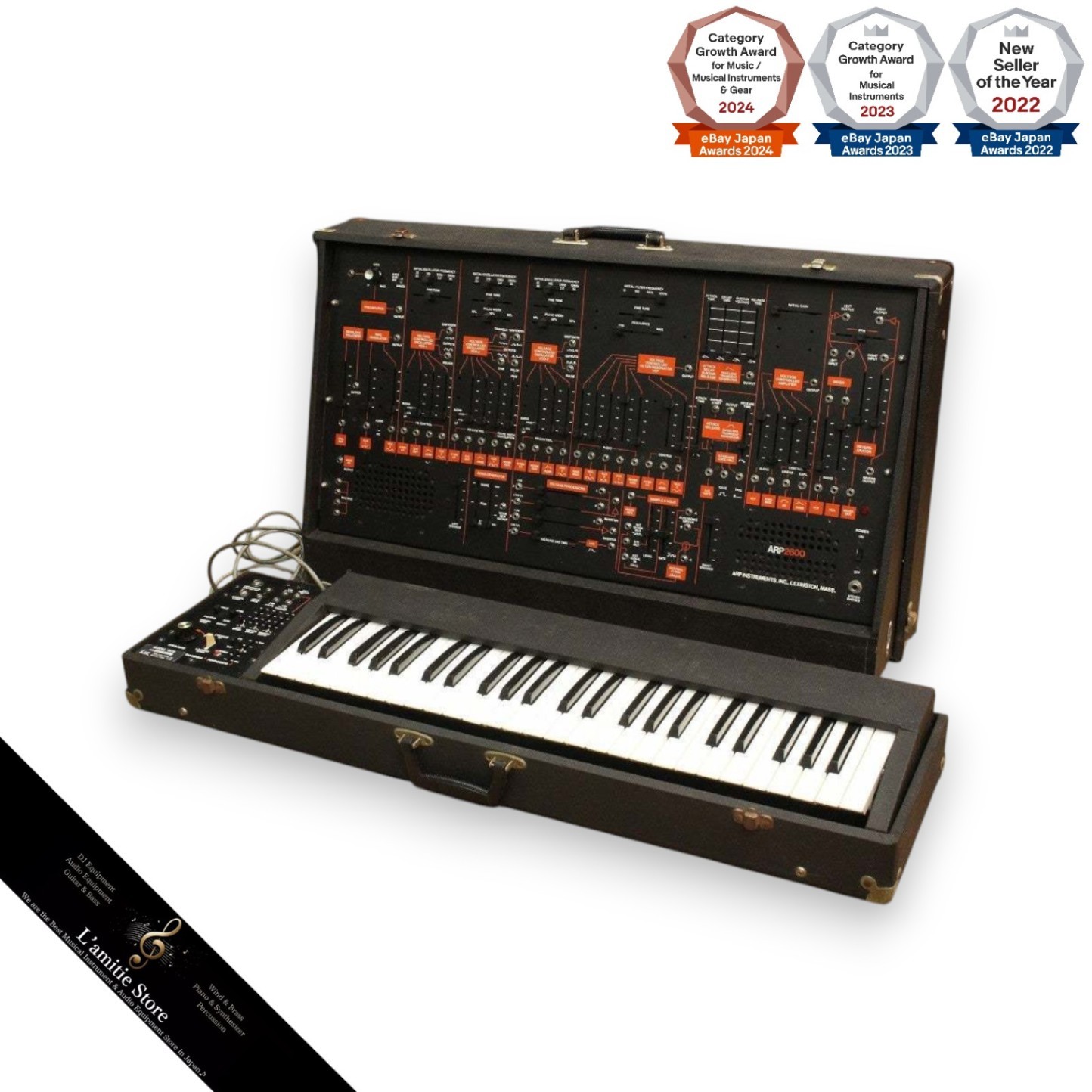
Plug in the ARP 2601 and you’re not just turning on a synth—you’re waking up a legend that spent decades in basements, studios, and university classrooms, slowly gathering dust but never losing its bite. This isn’t the flashy frontman of the ARP lineup; that was the Odyssey. The 2601 is the quiet genius in the back, the one who shows up with a suitcase full of patch cables and walks out having rewritten the soundtrack. It’s the final evolution of the 2600 series, a semi-modular beast designed to be both self-contained and endlessly reconfigurable, a teaching tool that somehow became a studio staple. You can fire it up with no patching and get a fat, snarling bass tone in seconds, or you can spend three hours wiring feedback loops through the ring mod and envelope follower just to see what happens when the spring reverb starts oscillating. And yes, it will oscillate—this thing lives on the edge of chaos.
The 2601 didn’t arrive with fanfare. It was ARP’s quiet pivot after the legal dust-up with Moog over the 4012 filter, a component so sonically revered it’s now spoken of in hushed tones. By the time the 2601 rolled out in 1975, ARP was already navigating financial headwinds, and the changes weren’t all graceful. The early 2601 v1.0 units still carried the disputed 4012 filter—the same Moog-derived design that gave the original 2600s their thunderous low end and singing resonance—but that wouldn’t last. By 1977, with v2.0, the 4072 filter was in place, a four-pole low-pass circuit that many owners describe as “duller,” “less musical,” or, in one particularly blunt technician’s notes, “like trying to scream through a pillow.” That shift alone splits the collector base in two: those who chase the pre-1977 sound, and those who accept the later model’s reliability in exchange for a slightly muted character.
But let’s not pretend the 2601 lives or dies by its filter. This synth is a full ecosystem. Three analog oscillators—each capable of sine, triangle, sawtooth, and square waves—feed into a mixer that can blend external audio, noise, and ring-modulated sources before they even hit the filter. The envelope section is dual: one ADSR for the classic contour, one AR for sharper attacks, and both can be inverted or repurposed via the envelope follower, which turns any incoming sound—your voice, a drum hit, a passing ambulance—into a modulation source. That feature alone made the 2601 a favorite for sound designers; it’s no accident that R2-D2’s voice was famously shaped on a 2600. Add a built-in spring reverb tank, stereo preamp with actual speakers, and a ring modulator that can turn a flute into a robot choir, and you’ve got a machine that doesn’t just make sounds—it interrogates them.
The keyboard, when bundled, is usually the 3620—a 49-key duophonic controller with its own LFO, portamento, and tuning controls. It’s not velocity-sensitive, and the action is stiff, but it’s built like a lab instrument, not a stage toy. And the 2601 itself? It’s housed in a road case-style enclosure, the kind that says “I belong in a university basement or a professional studio, not a club.” The v3.0 revision in 1980 finally ditched the potted modules—those black epoxy-coated circuit boards that made repairs a nightmare—and replaced them with open, serviceable submodules. That change came too late to save ARP, which folded in 1981, but it’s a godsend for restorers today. If you find a v3.0, you’re holding one of the most maintainable 2600-series synths ever made—assuming, of course, that it hasn’t been chewed up by time.
Specifications
| Manufacturer | ARP Instruments, Inc. |
| Production Years | 1975–1980 |
| Original Price | $2,495 (with 3620 keyboard) |
| Polyphony | Monophonic |
| Oscillators | 3 VCOs (audio/LFO switchable) |
| Waveforms | Sine, triangle, sawtooth, square |
| Filter Type | 4-pole 24 dB/oct low-pass (Model 4072 in v2.0+; Model 4012 in v1.0) |
| Filter Modulation | Cutoff, resonance, keyboard tracking |
| Envelopes | ADSR + AR (selectable linear/exponential) |
| LFO | 1 (on 3620 keyboard), triangle, square, sample & hold |
| Modulation Matrix | Ring modulator, envelope follower, voltage processor, inverter |
| Noise Generator | White, pink, low frequency |
| Outputs | Stereo VCA, headphone, spring reverb send/return |
| Inputs | External audio, microphone preamp, CV/Gate in |
| Effects | Built-in spring reverb with dedicated preamp |
| Keyboard | Optional 49-key duophonic (Model 3620) |
| MIDI | No |
| Weight | 45 lbs (synth unit) |
| Dimensions | 22.5" x 17.5" x 8" |
| Power | 115V AC, 60 Hz (transformer-based power supply) |
Key Features
The Semi-Modular Brain
What sets the 2601 apart isn’t just its components—it’s the way they’re wired. Unlike a fully modular system, where you start from nothing, the 2601 comes pre-patched in a classic subtractive signal path: oscillators → mixer → filter → VCA, with envelopes shaping both filter and amplitude. But every stage has patch points, and the front panel is laid out like a flowchart of synthesis itself. Want to modulate the filter with noise? Patch it. Want to use the envelope follower to control pitch? Go ahead. Want to route the VCA output back into the input and create self-oscillation in the preamp? That’s discouraged, but it’s possible. The design invites experimentation without requiring a PhD in electronics. That balance—accessibility and depth—was revolutionary in the 1970s and still feels rare today. Modern clones often simplify the routing or add MIDI, but they lose the tactile immediacy of the 2601’s layout, where every slider has a label, every jack has a purpose, and the spring reverb tank sits exposed like a beating heart.
Spring Reverb & Built-In Speakers
Few synths from this era came with their own speakers, and even fewer included a spring reverb tank wired directly into the signal path. The 2601 does both, and it changes everything. You don’t need an amp to hear what you’re doing—just flip the power switch and the room fills with whatever monstrous sound you’ve just created. The reverb isn’t subtle; it’s splashy, metallic, and prone to feedback if you’re not careful, but that’s the point. It’s an effect that wants to be abused, perfect for dub, industrial, or anything that needs a sense of space without sounding polished. The speakers themselves are modest—two 4-inch drivers with a basic preamp—but they’re enough to monitor your patches without headphones. In a teaching environment, that was a game-changer; students could hear the effect of a filter sweep or LFO modulation in real time, without fumbling with external gear.
Envelope Follower & External Processing
The envelope follower is the 2601’s secret weapon. Feed it a voice, a drum loop, or even a record player’s output, and it converts the amplitude of that signal into a control voltage. That CV can then modulate pitch, filter cutoff, or even the LFO rate. It’s how you make a synth “react” to live performance, and it’s why the 2601 became a favorite for experimental composers and film sound designers. The preamp section includes both mic and line inputs, so you can process external sources through the synth’s filter and modulation system. Run a guitar through the ring mod and envelope follower, and you’ve got a tone generator that responds to your picking dynamics. It’s not a modern multi-effects unit, but it’s more expressive than most vintage gear dared to be.
Historical Context
The 2601 emerged at a crossroads. ARP had spent the early 1970s battling Moog for dominance in the professional synth market, positioning the 2600 as a more stable, user-friendly alternative to modular systems. But by 1975, the landscape was shifting. Musicians wanted portability, stage reliability, and polyphony—none of which the 2601 offered. The Minimoog had already captured the solo synth market, and the Prophet-5, introduced in 1978, brought programmability and polyphony to the masses. The 2601, by contrast, was a specialist’s tool: complex, monophonic, and expensive. Its primary audience wasn’t touring keyboardists but universities, film studios, and dedicated electronic musicians who valued flexibility over convenience.
The legal pressure from Moog over the 4012 filter forced ARP to redesign the 2601’s core tone-shaping circuit, resulting in the 4072 filter. While technically ARP’s own design, it lacked the warmth and resonance of its predecessor, a compromise that still divides collectors. Later revisions improved serviceability—especially the v3.0’s unpotted modules—but they arrived as ARP was collapsing financially. The company ceased operations in 1981, making the 2601 one of the last true ARP synths ever built. It never achieved the commercial success of the Odyssey or the Minimoog, but its influence was outsized. Artists like Herbie Hancock, Stevie Wonder, and Pete Townshend used earlier 2600 models extensively, and the 2601 inherited that legacy, even if it didn’t expand it.
Collectibility & Value
The ARP 2601 trades in two currencies: condition and filter type. Units with the original 4012 filter (v1.0, 1975–1976) are the holy grail, often commanding $12,000–$18,000 in working order, especially if paired with a 3620 keyboard. These are rare—only a few hundred were made before the filter swap—and they’re coveted for their richer, more aggressive sound. After 1977, the 4072 filter became standard, and prices drop accordingly: $7,000–$10,000 for a clean, restored v2.0 or v3.0. The v3.0 models, with their serviceable unpotted modules, are increasingly sought after by restorers, even if the sound is less revered.
Common failure points are well-documented. The original power supplies often fail due to aging capacitors, and the tantalum caps in the signal path are notorious for shorting out. Sliders and jacks degrade over time, especially on units that were heavily patched; many restored models have replaced sliders and jack nuts. The spring reverb tank is fragile—drops can misalign the springs—and the rubber grommets that isolate it from the chassis often disintegrate, causing microphonics. Owners report that the 3620 keyboard’s bushings and bus bars wear out, leading to sticky keys or dead notes, so a full rebuild is often necessary on vintage units.
Buying advice? Never purchase untested. These synths are 45+ years old, and even “working” units can have latent issues. Look for service records, preferably from a specialist like CMS or Tone Tweakers. A full recap, slider cleaning, and calibration should be assumed, adding $1,500–$2,500 to the effective cost. If you’re after the 4012 filter sound, verify the serial number and module labels—some later units were retrofitted. And if you’re buying a v3.0, confirm the modules are truly unpotted; some early v3.0s still had potted boards.
For all its flaws, the 2601 remains a top-tier vintage synth—not because it’s easy to use, but because it rewards obsession. It’s the kind of instrument you buy not to play songs, but to disappear into for weeks at a time, patching, recalibrating, and chasing the perfect scream.
eBay Listings

As an eBay Partner, we earn from qualifying purchases. This helps support our independent vintage technology research.
Service Manuals & Schematics
- Service Manual — archive.org