ARP 2600 (1971–1981)
A blue flash in a red Chevy van—that’s how the ARP 2600 first tore into the world, not on a stage, but on a sales pitch to skeptical hi-fi stores.
Overview
There’s a photo from 1971: a synth in electric blue, glowing like a prop from a forgotten sci-fi film, sitting on a table while a crowd of Italian music journalists lean in, half-disbelieving. That synth—the first run of the ARP 2600, now called the “Blue Marvin”—wasn’t just a machine. It was a manifesto. Alan R. Pearlman didn’t build it for the elite studios or the modular obsessives. He built it for the classroom, for the curious, for the guy who’d never touched a patch cable but could play a keyboard. And yet, it ended up in the hands of Weather Report, Depeche Mode, and the man who gave R2-D2 his voice. The genius of the 2600 was its duality: pre-wired so you could power it on and play a sound immediately, but covered in 1/8" jacks so you could dismantle that signal path with a single cable. It wasn’t just a synth—it was a teacher, a lab, a performance instrument, and a sound design weapon, all in one road-worn case.
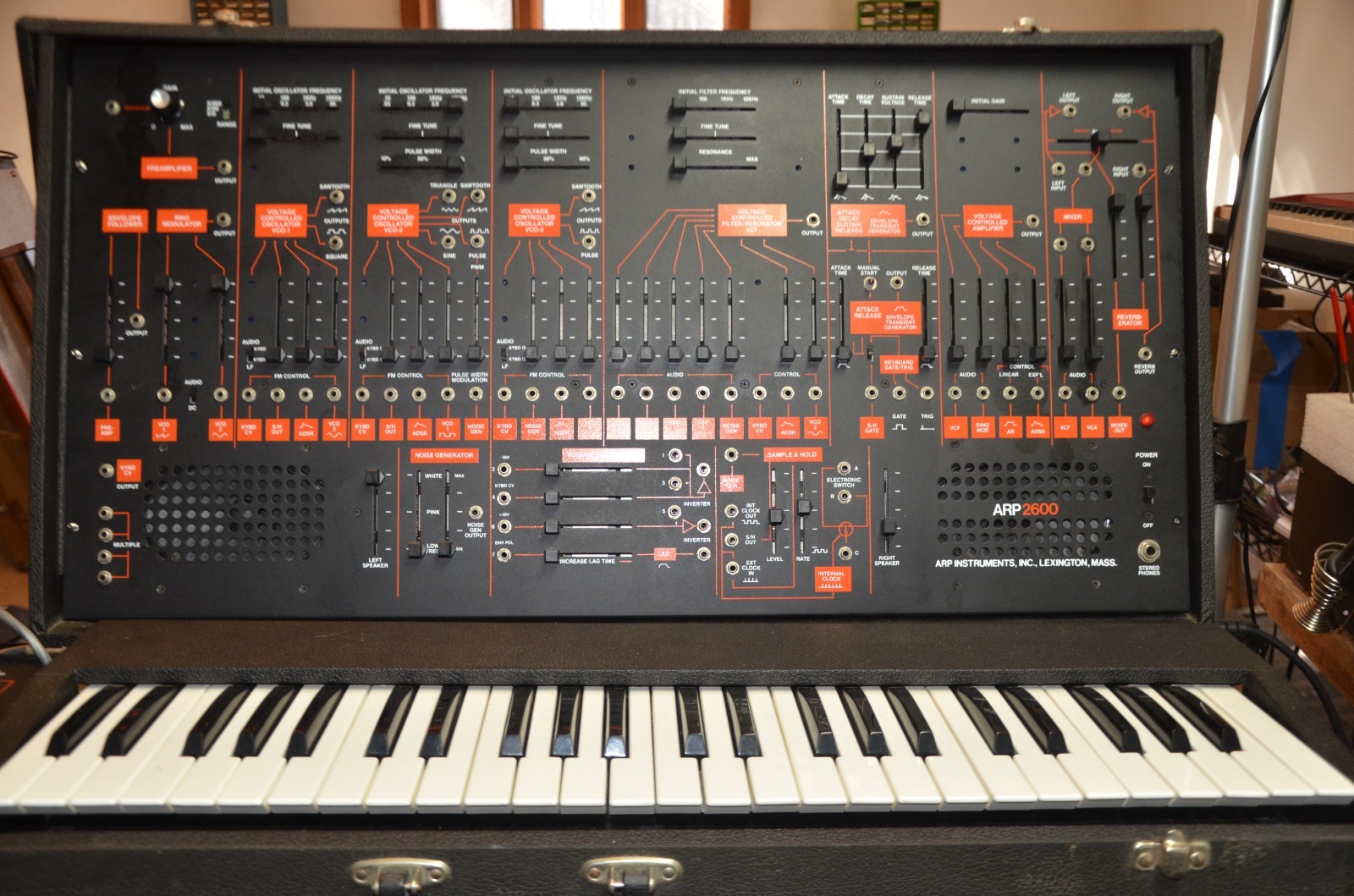
The 2600’s layout is a masterclass in clarity. Signal flows left to right: oscillators, mixer, filter, amplifier, envelope generators—each section labeled in bold, with sliders instead of knobs so you could see your patch at a glance. It came with its own speakers and a spring reverb tank, making it one of the first truly self-contained analog synths. You didn’t need a mixer, a reverb unit, or even external monitors. Plug in a keyboard, hit a key, and the room filled with that warm, snarling ARP tone. But the real magic started when you grabbed a cable and rerouted the envelope to modulate pitch, or fed noise into the filter for a burst of windstorm texture, or used the ring modulator to turn a simple melody into something alien. It was this balance—immediate usability and deep flexibility—that made it a hit with educators and professionals alike. Schools bought them by the dozen, but so did Stevie Wonder and Herbie Hancock.
And then there’s the sound. It’s not just “big” or “warm”—it’s articulate. The oscillators are stable, thanks to ARP’s IC-based design, a direct shot across Moog’s bow at a time when tuning drift was considered normal. The filter, especially the early 4012 model, has a musicality that borders on orchestral—smooth when subtle, screaming with authority when pushed. Later models swapped in the 4072 filter, which is cleaner, less aggressive, and to some ears, less characterful. The built-in spring reverb isn’t an afterthought; it’s integral. That splashy, metallic decay on a plucked envelope, or the way it smears a sawtooth sweep into something cinematic—it’s part of the 2600’s DNA. Joe Zawinul didn’t just use it for effects; he used it as a compositional tool, layering reverb-drenched textures that sounded like wind through bamboo or distant choirs. This wasn’t just synthesis. It was storytelling.
Specifications
| Manufacturer | ARP Instruments, Inc. |
| Production Years | 1971–1981 |
| Original Price | $2,600 (1971) |
| Synthesis Type | Analog subtractive, semi-modular |
| Keyboard | 37-note monophonic or duophonic (model-dependent) |
| Keyboard Range | 4 octaves |
| Oscillators | 3 VCOs (audio/LFO switchable) |
| Waveforms | Sawtooth, square, triangle, pulse (VCO 1 only) |
| Noise Source | White, pink, low frequency |
| Filter | 1 VCF (24dB/oct low-pass, 4012 or 4072 model) |
| Filter Modulation | Keyboard tracking, envelope, LFO |
| Envelopes | 1 ADSR, 1 AR |
| LFO | 1 internal, plus optional keyboard-mounted LFO (3620 model) |
| VCAs | 2 (including pan control for stereo output) |
| Modulation | Ring modulator, sample & hold, envelope follower |
| Inputs | External audio, microphone preamp, CV, gate |
| Outputs | Stereo with internal speakers, headphone, reverb send/return |
| Effects | Spring reverb (Q115 tank) |
| Power | Internal power supply, 120V AC |
| Weight | 35 lbs (15.9 kg) |
| Dimensions | 25.5" x 16.5" x 6.5" (64.8 x 41.9 x 16.5 cm) |
Key Features
The Semi-Modular Revolution
The 2600 didn’t invent modular synthesis, but it reinvented it for the real world. Before the 2600, modular systems were sprawling, cable-choked beasts that required a PhD in signal flow just to make a beep. The 2600’s internal “default” patch meant you could open the case, plug in the keyboard, and play. No patching required. But the moment you wanted more—more movement, more chaos, more control—you could override any connection with a 1/8" patch cable. This wasn’t just convenient; it was pedagogical. The front panel’s silk-screened block diagram taught synthesis as clearly as any textbook. Musicians learned by doing: rerouting an envelope to modulate filter cutoff, patching noise into the VCO for FM-like effects, using the sample & hold with a random source to create unpredictable sequences. It turned sound design into a tactile, immediate process. And because everything was normalized, you could always unplug and return to a working patch—no fear of getting lost in a cable jungle.
Self-Contained Sound Lab
Most synths of the era expected you to bring your own effects, speakers, and mixing. The 2600 brought its own. The built-in Q115 spring reverb tank wasn’t just a gimmick—it was a core part of the sonic character. That metallic, slightly unpredictable reverb colored everything from basslines to sound effects, giving the 2600 a spatial depth most monosynths lacked. And those two small speakers in the lower corners? They weren’t high fidelity, but they were loud enough to fill a room, a classroom, or a backstage area. Combined with the microphone preamp and envelope follower, the 2600 could process external audio—voice, guitar, anything—turning it into something unrecognizable. Ben Burtt didn’t just use it to generate tones for R2-D2; he fed his own voice into it, modulated it with filters and LFOs, and created a language. That level of integration was unheard of in 1971. This wasn’t a synth that needed a studio. It was the studio.
Evolution of the Filter
If you care about the sound of the 2600, you care about the filter. Early models, particularly the Blue Marvin and Gray Meanie, used the 4012 filter—a design heavily inspired by Moog’s transistor ladder. It’s thick, harmonically rich, and when resonance is cranked, it howls with a controlled aggression that cuts through any mix. This is the filter that defined the 2600’s early voice. But in 1977, ARP replaced it with the 4072 filter, a more stable, integrated-circuit design that matched the orange-and-black aesthetic of the Odyssey and other late-era ARPs. The 4072 is cleaner, brighter, and less prone to temperature drift, but it lacks the low-end heft and character of the 4012. Collectors and players are split: some swear by the 4012’s musicality, others prefer the 4072’s reliability. The truth is, they’re different instruments sonically. If you’re buying a 2600, the filter version isn’t just a spec—it’s a sonic decision.
Historical Context
The ARP 2600 arrived in 1971 at a moment of transition. Synthesizers were no longer just academic curiosities—they were appearing on pop records, film scores, and rock stages. But they were still intimidating. Moog’s systems were powerful but temperamental; Buchla’s were avant-garde and expensive. ARP saw an opening: build a synth that was reliable, portable, and educational. The 2600 was the answer. It was introduced at the same NAMM show as the Minimoog, but where the Minimoog was a performance instrument, the 2600 was a laboratory. Pearlman’s background in aerospace engineering showed in the build quality and stability—ARP oscillators didn’t drift like Moogs. But convincing retailers was another matter. David Friend and Roger Powell spent months driving a red Chevy van across the U.S., demoing the 2600 in hi-fi stores and music shops. Most turned them away. The breakthrough came when Sam Ash in New York agreed to stock it. From there, it spread—not through ads, but through word of mouth from players like Edgar Winter, whose “Frankenstein” made the 2600 a rock star.
Over its decade-long run, the 2600 evolved. The early Blue Marvin gave way to the Gray Meanie, then the white-lettered 2600P, and finally the orange-and-black late models. The keyboard changed too: the 3604 was monophonic, but the 3620 added duophony by letting oscillators track separate notes—a hack that felt clever but limited. ARP never made it polyphonic, but it didn’t need to. The 2600’s strength was in its depth, not its note count. It appeared on records by Zawinul, Wonder, Hancock, and Townshend, and in films like Close Encounters of the Third Kind and Star Wars. By the time ARP folded in 1981, the 2600 had become a legend—not because it was the most advanced, but because it was the most useful. It taught a generation how synthesis worked, and in doing so, changed what music could sound like.
Collectibility & Value
Today, a working ARP 2600 isn’t just rare—it’s a commitment. Prices vary wildly by model, condition, and provenance. A Blue Marvin in good condition can fetch $15,000–$20,000, while later orange-panel models might go for $8,000–$12,000. But those numbers assume the synth is fully functional, recapped, and calibrated. Many aren’t. The 2600’s power supply is a known failure point—electrolytic capacitors dry out, regulators fail, and the internal wiring can become brittle. The 1/8" jacks, while durable, can develop crackles or shorts, especially if the synth was heavily patched. The spring reverb tank is robust, but if it’s been moved without securing the springs, it can develop a rattle or lose tension. And the sliders, while iconic, wear out over time; replacing them with modern equivalents can alter the feel and response.
Buying a 2600 isn’t like buying a Minimoog. You’re not just purchasing a synth—you’re adopting a project. Service technicians observe that most units need at least a recap and calibration, which can run $500–$1,000. Finding a tech familiar with ARP’s discrete circuitry is crucial; modern synth techs used to Roland or Korg IC-based designs might miss subtle issues. And documentation matters: original manuals, brochures, and patch books add value and are essential for learning the system. If you’re not prepared to invest time and money, consider the Korg reissue or a software emulation. But if you want the real thing—the weight, the smell of old electronics, the way the sliders click into place—there’s no substitute. Just know what you’re getting into: this is a museum piece that still wants to make noise.
eBay Listings


As an eBay Partner, we earn from qualifying purchases. This helps support our independent vintage technology research.
Service Manuals & Schematics
- Owner's Manual (1971) — archive.org
- Service Manual — archive.org
- Owner's Manual — archive.org
- Service Manual — archive.org
- Service Manual — archive.org