ARP String Ensemble (1974–1981)
That slow, shimmering swell at the start of “Video Killed the Radio Star”? That’s the sound of a thousand church basements, disco ballrooms, and prog-rock odysseys wrapped in one analog chassis.
Overview
It doesn’t hit you right away. At first, it’s just a soft wash—like fog rolling over a string section warming up. Then the chorus kicks in, that triple-layered BBD modulation doing its slow, hypnotic wobble, and suddenly you’re not in a studio anymore. You’re in 1977, standing behind a curtain as the strings rise beneath a synth solo that’s about to change everything. The ARP String Ensemble doesn’t just make sound; it creates atmosphere. It’s the sonic equivalent of a slow zoom on a film camera—inevitable, lush, and just a little melancholy.
Born from a Dutch organ company called Eminent and rebadged for the American market by ARP, the String Ensemble was never meant to be a synthesizer in the traditional sense. It wasn’t competing with the Minimoog or the Prophet-5. Instead, it filled a niche: affordable, portable orchestral backing for keyboardists who couldn’t afford a Mellotron or a unionized string section. And it did so with a brilliance that still stuns today. The core of its magic lies in its architecture—twelve discrete oscillators feeding a divide-down polyphonic system, meaning every key has its own dedicated tone generator before being split into octaves. This isn’t the thin, reedy sound of cheaper string machines; this is rich, full-bodied analog texture, with a harmonic complexity that feels almost alive.
It offers four polyphonic voices—violin, viola, trumpet, and horn—plus two monophonic bass voices: cello and contrabass. The trumpet and horn aren’t literal recreations, of course; they’re more like tonal approximations, shaped by filters and envelope responses to evoke the character of brass without the bite. Layer them with the strings, and you’ve got a pseudo-orchestra at your fingertips. The crescendo control is where the drama lives: hold a chord, dial it up, and the volume swells in a way that mimics human breath, giving even static pads a sense of motion. The sustain button keeps the sound decaying slowly after release, perfect for ambient beds or ghostly echoes.
But the real star is the chorus—what ARP called the “Ensemble” effect. It runs the signal through three bucket-brigade devices, each modulated by slightly different LFO rates, creating a thick, phase-shifted smear that makes a single note sound like an entire section. It’s not just vibrato; it’s a living, breathing modulation that gives the machine its signature “wobble.” No digital plugin has truly replicated it, and even modern analog reissues struggle to match the subtle inconsistencies of aging BBD chips. This is why, decades later, producers still hunt for original units: because the flaws are part of the charm.
Specifications
| Manufacturer | ARP (rebranded Eminent Solina) |
| Production Years | 1974–1981 |
| Original Price | $995 (1974) |
| Keyboard | 49 keys, full-size, non-weighted |
| Polyphony | 49-note polyphonic (divide-down architecture) |
| Oscillators | 12 discrete tone generators with octave divide-down |
| Voices | 4 polyphonic (violin, viola, trumpet, horn); 2 monophonic bass (cello, contrabass) |
| Filter | Fixed, non-adjustable |
| Envelope | Crescendo (attack/sustain-like), Sustain (decay control) |
| Modulation | Triple BBD chorus (Ensemble effect), LFO-controlled |
| Effects | Integrated Ensemble chorus, no reverb |
| Outputs | 1x 1/4" mono output |
| Inputs | None (no external audio processing) |
| MIDI | No MIDI (pre-MIDI era) |
| Power | Internal power supply, 120V AC |
| Weight | 42 lbs (19 kg) |
| Dimensions | 37.5" W × 14" D × 6" H (95 × 35.5 × 15 cm) |
| Case Material | Particle board with woodgrain vinyl, end cheeks often warped over time |
| Revision Variants | SE-I to SE-IV; later models include "Mod Defeat" button |
Key Features
The Divide-Down Engine: Polyphony Without Compromise
Long before digital sampling, polyphonic synths had to cheat. The ARP String Ensemble didn’t. While most organs and string machines used a single oscillator per octave and divided it down, the String Ensemble started with twelve discrete oscillators—one for each chromatic note in the octave. This meant no phase cancellation, no tuning drift between notes, and a harmonic richness that cheaper divide-down systems couldn’t touch. Each key press triggers a pure, stable tone that’s then split across octaves, preserving clarity even in dense chords. It’s why the sound remains so full and present, even when layered with other instruments. This architecture was borrowed from Eminent’s organ designs, but ARP’s implementation gave it a smoother, more refined character than its church-organ cousins.
The Ensemble Effect: Analog Chorus as Alchemy
If the oscillators provide the body, the chorus provides the soul. The Ensemble effect isn’t just a chorus—it’s a triple-modulated phasing system using bucket-brigade devices, each with its own LFO running at slightly different rates. The result is a constantly shifting, three-dimensional swirl that mimics the natural pitch variations of a live string section. It’s not a clean modulation; it’s slightly uneven, with a warm, organic instability that modern digital delays can’t quite capture. The effect is so integral to the sound that disabling it (via the “Mod Defeat” button on later revisions) reveals a stark, almost clinical tone—proof that the chorus isn’t an add-on, but part of the instrument’s DNA. Service technicians observe that original BBD chips, particularly the Panasonic MN3004 and MN3007, are prone to noise and dropout as they age, and replacing them with modern equivalents often sacrifices some of that vintage character.
Voicing and Layering: The Illusion of an Orchestra
The String Ensemble doesn’t let you tweak filters or envelopes, but it doesn’t need to. Its strength lies in its presets and how they interact. The violin and viola are bright and present, ideal for melodic lines or rhythmic stabs. The trumpet and horn are softer, more nasal—closer to a muted brass section than a fanfare. The cello and contrabass, while monophonic, add a deep, resonant foundation when played with the left hand. The volume knob for the bass section allows blending, so you can subtly reinforce the low end without overpowering the strings. Players quickly learn that the most powerful sounds come from layering multiple voices: violin and horn for a richer top end, or viola and cello for a darker, more cinematic texture. It’s not a flexible synth, but within its narrow lane, it’s incredibly expressive.
Historical Context
The mid-1970s were a golden age for keyboard innovation, but also a time of sharp division between the elite and the accessible. If you were in Yes or Emerson, Lake & Palmer, you could afford a Mellotron. For everyone else, the ARP String Ensemble was the next best thing. Introduced in 1974 at $995—roughly $5,800 today—it was expensive for a preset machine, but a fraction of the cost of a tape-based Mellotron. It arrived just as disco, funk, and progressive rock were embracing lush, layered textures, and it fit perfectly into that world. George Harrison used it on “You” in 1975, the Bee Gees on “Nights on Broadway,” and Elton John on “Someone Saved My Life Tonight.” The Buggles’ “Video Killed the Radio Star” immortalized it in pop history, its opening swell becoming a cultural signifier of analog nostalgia.
It wasn’t alone. Competitors like the Freeman String Symphonizer and the Roland RS-202 offered similar sounds, but the ARP had the advantage of ARP’s name and distribution in the US market. It also benefited from its build quality—despite the flimsy particle board case, the electronics were robust and reliable for the era. Unlike the Mellotron, it didn’t require tape maintenance or tuning every five minutes. It was a plug-and-play orchestra, and that simplicity made it a studio staple. By the time polyphonic synths like the Prophet-5 arrived in 1978, the String Ensemble had already carved its niche. It wasn’t replaced so much as overshadowed—superseded by more flexible instruments, but never truly duplicated.
Collectibility & Value
Today, the ARP String Ensemble trades between $1,800 and $3,500, depending on condition, revision, and whether it’s been serviced. Units labeled SE-IV with the “Mod Defeat” button—allowing players to bypass the chorus—are more desirable, especially for studio use where clean tone might be needed. Fully functional examples with working crescendo and sustain controls command premiums, while units with failing BBD chips or cracked keybeds can drop below $1,500, even if they’re otherwise complete.
The biggest enemy of longevity is the power supply. Original units used electrolytic capacitors that degrade over time, often leading to hum, noise, or complete failure. Owners report that a full recap (capacitor replacement) is almost mandatory for any unit that hasn’t been maintained in the last 15 years. The BBD chips themselves are another weak point—noisy, crackling, or completely dead chorus sections are common, and replacing them with modern equivalents can alter the sound. Some purists insist on NOS (new old stock) MN3004 chips, but they’re scarce and expensive.
The case is another liability. Made of particle board with vinyl wrap, it’s prone to warping, chipping, and delamination, especially at the end cheeks. Finding a unit with an intact case is rare, and restoration can cost hundreds. Road cases exist, but they often suffer from rusted latches and musty interiors.
For buyers, the checklist is simple: power it on and listen for hum or distortion, test every key across all voices, check that the crescendo and sustain work smoothly, and verify that the chorus has depth and movement—not just a flat wobble. MIDI retrofits are available but not original; purists avoid them. If the unit has been modified—especially if the trumpet preset has been replaced with a “Mod Defeat” button, as seen in some factory-early models—document it carefully, as it affects value.
Despite its quirks, demand remains strong. Film composers, synthwave producers, and vintage pop revivalists all seek its sound, and no software or modern hardware has fully captured its character. Even Behringer’s 2025 Eurorack module, while impressive, lacks the weight and interaction of the original. The ARP String Ensemble isn’t just a relic—it’s a living part of the sonic vocabulary of the 20th century.
eBay Listings
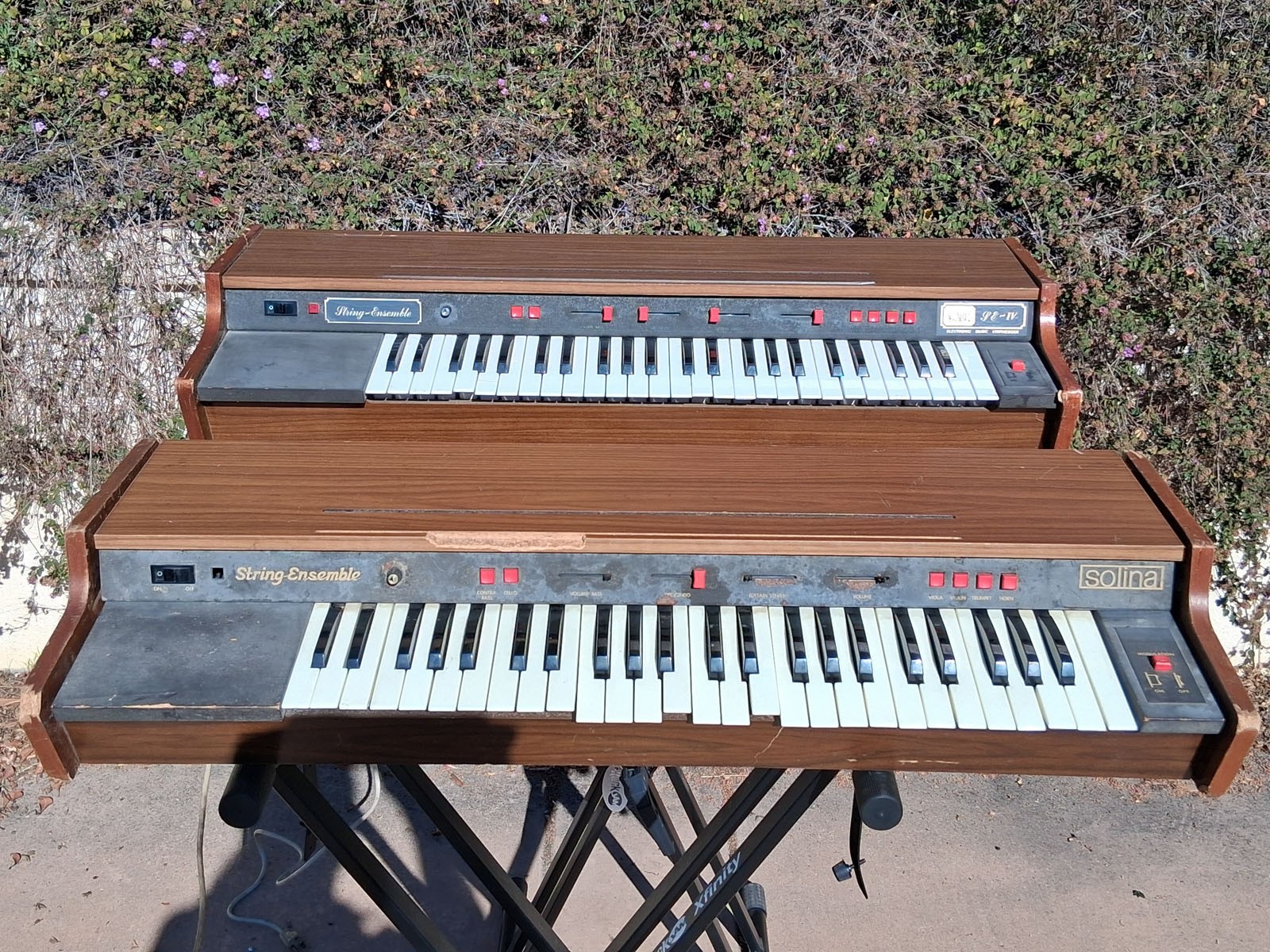
As an eBay Partner, we earn from qualifying purchases. This helps support our independent vintage technology research.