ARP Odyssey MkII (1975–1978)
That growl when you crank the filter into self-oscillation? That’s the sound of a synth that refused to play nice.
Overview
Turn on an ARP Odyssey MkII and you’re not just powering up a synth—you’re waking up a beast with a grudge. It doesn’t purr like a Minimoog; it snarls, bites, and sometimes threatens to short out if you look at it wrong. But that’s the point. The MkII, produced from 1975 to 1978, was ARP’s answer to their own early missteps and Moog’s dominance—a no-compromise, performance-ready analog machine that packed the guts of a 2600 into a road-tough case. It’s the synth that powered Gary Numan’s icy leads, Herbie Hancock’s funk futurism, and the dystopian textures of Ultravox, and it did it all with a filter that still sparks legal conspiracy theories.
The MkII wasn’t a clean-sheet redesign. It evolved from the MkI, but where the early white-faced Odysseys had a 2-pole filter that some found too polite, the MkII went full warhead. Most units came with a 4-pole low-pass filter, but here’s where things get juicy: the first MkIIs used the Model 4035 filter, a near carbon-copy of Moog’s legendary ladder design. Rumor has it ARP paid a quiet licensing fee after Bob Moog raised an eyebrow, but no lawsuit ever surfaced. Still, the “lawsuit filter” tag stuck, and so did the sound—thick, snarling, and capable of oscillating into a sine wave so pure it could tune a piano. Later MkIIs swapped in ARP’s own 4075 filter, which was stable but slightly less harmonically rich, especially at high resonance. If you’re hunting for that mythical “Moog-like” ARP tone, you want a MkII with the 4035. They’re rare, they’re temperamental, and they’re worth every penny.
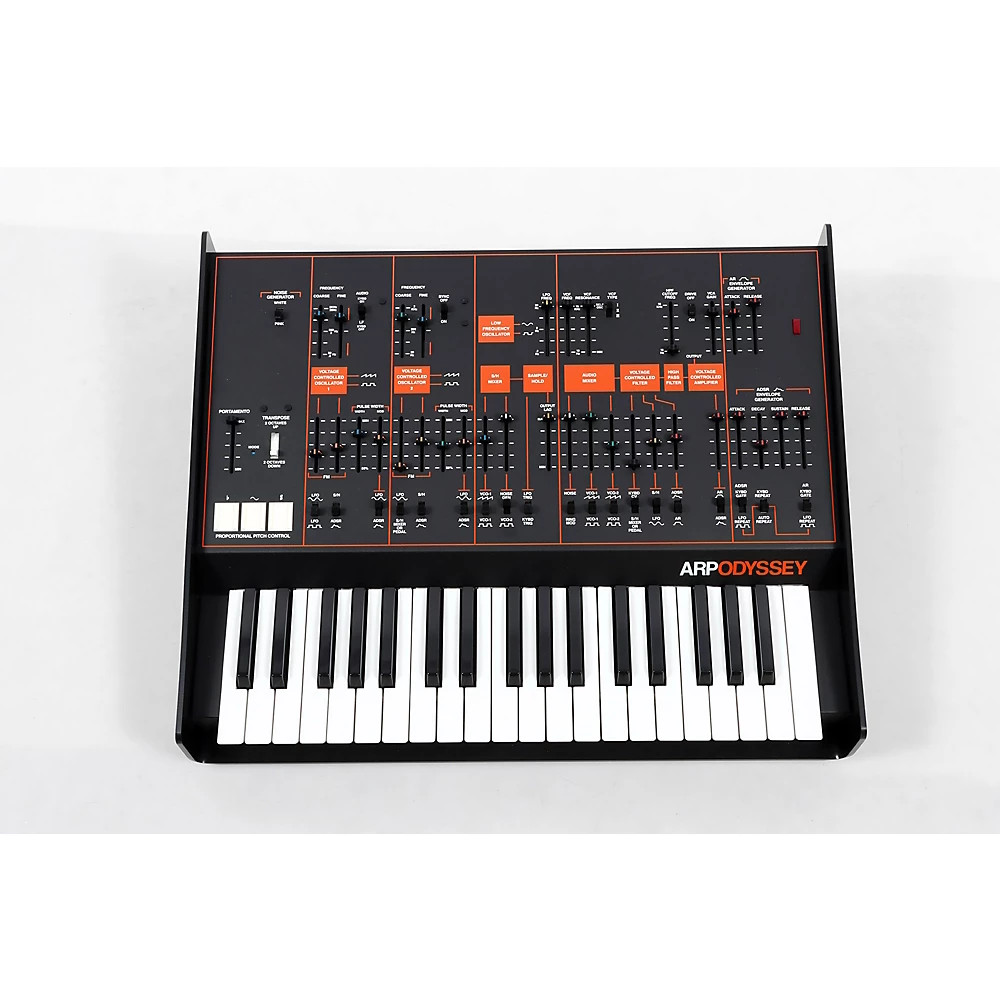
Cosmetically, the MkII is all business: black panel, gold lettering, sliders that feel like they were milled from tank armor. It kept the MkI’s 37-note keyboard with aftertouch (a rarity for the time), but added CV/gate jacks across the board—no more factory mods needed. The pitch bend system is a point of confusion: some MkIIs still have the rotary knob from the MkI, while later ones feature the Proportional Pitch Controller (PPC), three pressure-sensitive buttons for bend up, bend down, and vibrato. The PPC was ARP’s answer to expressive control, and while it looks like a relic from a 1970s sci-fi prop room, it actually works—once you get used to not smashing your fingers into the panel.
What makes the MkII special isn’t just its parts list—it’s the way it behaves. This is a synth that doesn’t stay in tune, not really. It drifts, warms up, breathes. Its oscillators wobble in the first 10 minutes, then settle into a slightly unstable harmony that somehow makes basslines feel alive. The ring modulator doesn’t just clang—it tears holes in the frequency spectrum. The sample-and-hold doesn’t just stutter—it feels like the synth is making decisions on its own. It’s not a tool for pristine replication. It’s a collaborator with attitude.
Specifications
| Manufacturer | ARP Instruments, Inc. |
| Production Years | 1975–1978 |
| Original Price | $1,595 (1975) |
| Polyphony | Monophonic / Duophonic |
| Oscillators | 2 VCOs: sawtooth, square, pulse, PWM, noise (pink/white) |
| Filter Type | 4-pole resonant low-pass (Model 4035 or 4075), static high-pass |
| LFO | Sine, square, sample-and-hold |
| Envelopes | ADSR, AR |
| Keyboard | 37 keys with aftertouch (Proportional Pressure) |
| Pitch Control | Rotary knob or Proportional Pitch Controller (PPC) |
| Modulation | Oscillator sync, ring mod, FM, PWM via LFO or ADSR |
| Inputs/Outputs | 1/4" audio output, external audio input, CV/Gate/Trigger in/out |
| Power | Internal power supply (115V or 230V) |
| Weight | 22 lbs (10 kg) |
| Dimensions | 35.5" x 13.25" x 4.75" (90 x 33.7 x 12 cm) |
| MIDI | No (original model) |
| Effects | None (analog only) |
| Memory | None (all parameters manual) |
Key Features
The Filter Wars: 4035 vs. 4075
The heart of the MkII’s identity crisis is its filter. Early units with the 4035 filter are sonic doppelgängers of the Minimoog—warm, punchy, and capable of that throaty roar when resonance hits critical mass. This is the “Moog ladder” clone, and while ARP eventually phased it out for the in-house 4075, many players consider the 4035 the peak of the Odyssey’s tonal evolution. The 4075, while stable and less prone to high-frequency roll-off, has a slightly narrower bandwidth and can sound a bit “tighter” at extreme settings. It’s not worse—just different. But in the collector world, “4035” on the spec sheet can mean a $500–$1,000 premium. If you’re buying, open the case. The filter board will tell you which one you’ve got.
Proportional Pitch Controller: Ahead of Its Time, Clumsy in Practice
Replacing the MkI’s simple pitch wheel, the PPC was ARP’s bid for expressive control. Three rubber buttons—up, down, vibrato—respond to finger pressure, letting you bend pitch smoothly or add subtle wobble. In theory, it’s brilliant. In practice, it takes muscle memory to avoid overbending. Some players yank it out and install a modern pitch stick; others swear by its precision once mastered. The MkII straddles a transition: some have the knob, some have PPC, and a few rare units even have both. If you’re performing live, know which version you’re dealing with—there’s no muscle memory transfer between knob and buttons.
Analog Grit as a Feature, Not a Bug
The MkII doesn’t just allow modulation—it encourages chaos. The ring modulator isn’t a clean XOR; it’s a clangorous mess when you feed it square waves. The sample-and-hold doesn’t just randomize pitch—it can glitch the entire signal path if you patch it wrong. The external audio input lets you process drum machines or vocals through that legendary filter, and the lack of MIDI means you’re hands-on with every slider. This isn’t a synth for preset recall. It’s for patching, tweaking, and riding the edge of instability. When it’s working, it’s transcendent. When it’s not, it’s a $2,000 paperweight with a hiss.
Historical Context
The MkII arrived in 1975, right when the synth market was shifting from modular behemoths to portable performance instruments. Moog had the Minimoog, Oberheim the SEM, and ARP needed a contender that was both roadworthy and sonically distinct. The Odyssey was that machine—but the MkI’s 2-pole filter was seen by some as underpowered. The MkII fixed that with the 4-pole upgrade, aligning it more closely with the Minimoog’s authority in the low end. It also standardized CV/gate, making it a natural fit for the emerging ecosystem of sequencers and drum machines.
ARP wasn’t just chasing Moog—they were building a philosophy. Where Moog favored stability and musicality, ARP embraced aggression and experimentation. The Odyssey’s duophonic capability (two-note chords via keyboard scanning) was rare for the time. Its modulation matrix was deep without being overwhelming. And its build, while not indestructible, was clearly designed for stage use. By 1978, it would be succeeded by the MkIII, with an orange-on-black faceplate and a sturdier chassis, but the MkII remains the sweet spot for many: the last of the gold-on-black era, the first to standardize CV/gate, and the only one to straddle the 4035/4075 filter divide.
Collectibility & Value
Today, a working MkII will set you back $2,200 to $3,800, depending on filter type, condition, and whether it’s been serviced. Units with the 4035 filter command top dollar—$3,500 and up if fully restored. Those with the 4075 are more common and typically sell for $2,200–$3,000. Cosmetic condition matters less than function; scratches on the panel are expected, but cracked sliders or sticky keys are red flags.
The biggest threat to longevity? Capacitors. The MkII’s power supply uses aging tantalum caps that can fail spectacularly—sometimes with smoke. A full recap runs $300–$500, but it’s non-negotiable for long-term ownership. The sliders themselves are another pain point: original Alps units wear out, and replacements are expensive. Some techs install modern Alps clones, but purists insist on NOS (new old stock) for authenticity.
Before buying, check for:
- Oscillator stability (do they drift more than 20 cents after 15 minutes?)
- Keybed function (all notes should trigger, no dead spots)
- Filter sweep (should go from full rumble to icy whistle without dropouts)
- PPC or pitch knob response (should be smooth, not jumpy)
- Noise floor (some hiss is normal; constant hum suggests grounding issues)
Serviced units with documented repairs are worth the premium. Avoid anything described as “needs love” unless you’ve got a tech on speed dial.
eBay Listings


As an eBay Partner, we earn from qualifying purchases. This helps support our independent vintage technology research.