ALM TAZM-O (2023–)
It hums to life with a triangle wave so smooth it feels like warm oil, then morphs into a sawtooth that bites clean through a mix—this is analog oscillation with surgical precision and vintage soul.
Overview
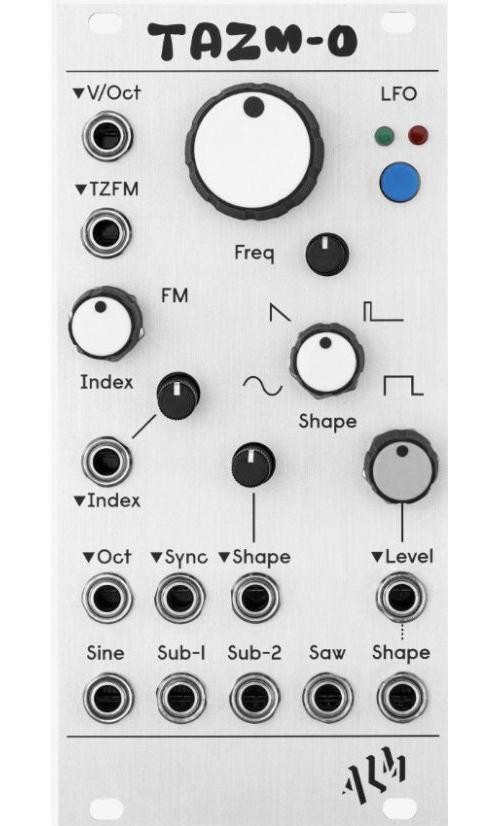
You don’t just hear the TAZM-O—you feel it tuning up, like a violinist drawing a bow across a string in a darkened room. ALM Busy Circuits didn’t just build their first analog oscillator to fill a gap in their lineup; they built it to *argue* with the rest of the modular world. In an era where digital oscillators can mimic anything and warp time, the TAZM-O stakes its claim in the analog soil with through-zero FM, a triangle core that tracks like a dream, and a waveform morphing system so fluid it makes most other VCOs feel like they’re shifting gears with a rusty lever. It’s compact—just 12HP—but it doesn’t play small. This is a primary oscillator with the confidence of a flagship, borrowing design cues from Serge’s NTO and the Roland SH-101, then stitching them together with ALM’s own digital-savvy logic.
What makes the TAZM-O stand out isn’t just that it does through-zero FM (TZFM), but how it *hands* you control over it. Most TZFM oscillators give you the input and hope you’ve got a stable modulator. The TAZM-O adds a voltage-controlled FM index, meaning you can modulate the depth of the FM itself—automate it, sequence it, or ride it like a filter envelope. That’s a feature usually reserved for complex oscillators twice its size. Pair that with the built-in output VCA, and suddenly you’re not just generating a waveform—you’re sculpting dynamic, evolving tones without needing to patch in a single extra module. It’s thoughtful engineering, not just feature stacking.
And then there’s the sound. It’s not “warm” in the hazy, nostalgic way some analog gear gets described. It’s *clear*. The triangle wave is silky, the sawtooth is rich without being harsh, and the pulse wave—shaped continuously from narrow to square—has that satisfying snap that makes basslines pop. The dual sub-octave outputs, inspired by the SH-101, are a godsend for thick, punchy low end, and they’re not just square waves—you can switch the -2 octave output between narrow and wide pulse via a rear toggle, giving you instant access to different flavors of sub-bass texture. It’s these little decisions, the ones that anticipate what you’ll actually *do* with the module, that make the TAZM-O feel lived-in from day one.
Specifications
| Manufacturer | ALM Busy Circuits |
| Production Years | 2023–present |
| Original Price | $379 USD / £315 GBP |
| Module Type | Analog Thru-Zero Oscillator |
| HP Size | 12HP |
| Depth | 38mm |
| Power Consumption +12V | 70mA |
| Power Consumption -12V | 60mA |
| 5V Draw | Not specified |
| Waveforms | Sine (or triangle), sawtooth, pulse, square, morphable wave shape |
| Waveform Morphing | Continuous crossfading via knob and CV |
| FM Type | Through-zero FM with voltage-controlled index |
| Sub-Oscillator Outputs | Dual: -1 octave (square), -2 octave (switchable pulse width) |
| Outputs | Primary (morphed wave, VCA-processed), sine/triangle, sawtooth, square, sub-1, sub-2 |
| Inputs | V/Oct, FM (through-zero), hard sync, wave shape CV, FM index CV, octave transpose CV |
| Octave Range | Approximately 8 octaves via V/Oct |
| Octave Transpose CV | 0, +1, +2 octaves via CV |
| LFO Mode | Yes, with bipolar LED indication |
| Hard Sync | Yes |
| Reverse Power Polarity Protection | Yes |
| Manufacturing Origin | England |
Key Features
Waveform Morphing Inspired by the Serge NTO
The TAZM-O’s most hypnotic feature is its continuously variable waveform output. Turn the shape knob, and the oscillator doesn’t just switch between waveforms—it glides from triangle to sine, then into sawtooth, and finally into pulse width modulation, all in one smooth arc. This isn’t a digital interpolation trick; it’s analog crossfading, executed with the elegance of the Serge NTO, one of the most revered oscillators in modular history. But ALM doesn’t stop there. You can voltage-control this morphing, meaning you can sequence the evolution of a sound over time, or modulate it with an envelope to create timbral swells that feel organic and unpredictable. It’s not just a tone knob—it’s a performance control.
Voltage-Controlled FM Index and Through-Zero Modulation
Through-zero FM is a niche but powerful tool, allowing for symmetrical frequency modulation that produces the bell-like, harmonic-rich tones beloved in West Coast synthesis. But most TZFM oscillators leave you to manage the modulation depth manually. The TAZM-O hands you a dedicated CV input for FM index, letting you dynamically control how deep the modulation goes. Want a clean sine tone that suddenly explodes into metallic inharmonicity? Patch an envelope into the FM index, and you’ve got it. This turns FM from a static effect into a dynamic performance parameter, and it’s a feature usually found on much larger, more expensive oscillators like the Rossum Evolution or the WMD Chordz.
Integrated Output VCA and Octave Transposition
Most oscillators expect you to patch their output into a VCA for amplitude control. The TAZM-O has one built right in, fed by the primary morphed waveform. That means you can control the level of your main tone without eating up another module slot. It’s a small convenience that adds up in a crowded system. Even more unusual is the voltage-controlled octave transposition input, which lets you shift the oscillator up by 0, +1, or +2 octaves via CV. It’s a nod to ALM’s own Akemie’s Castle, their digital FM oscillator, and it opens up quick harmonic layering or octave jumps without retuning or complex sequencing. It’s not a full pitch CV, but it’s fast, musical, and perfect for live shifts.
Historical Context
The TAZM-O arrived in 2023, a time when the Eurorack market was saturated with digital oscillators, complex wavetable engines, and FM beasts powered by microprocessors. Analog oscillators were still popular, but many were either minimalist designs or clones of classics. ALM, known for their digital-heavy modules like the Squid and the Hermod, surprised the community by launching their first analog oscillator—and not just any oscillator, but one that embraced the West Coast tradition of through-zero FM while integrating modern conveniences like CV-controllable parameters. It was a statement: analog isn’t just about nostalgia, it’s about precision, flexibility, and integration.
At the same time, competitors like Noise Engineering, Joranalogue, and 4ms were pushing the boundaries of analog oscillation with features like wavefolding, harmonic generation, and complex modulation routing. The TAZM-O didn’t try to out-feature them all. Instead, it focused on doing a few things exceptionally well—TZFM, waveform morphing, and sub-octave generation—while staying compact and skiff-friendly. It wasn’t trying to be the center of attention; it was trying to be the reliable, versatile workhorse that you build a system around. In that sense, it’s less a reaction to the market than a refinement of it—a distillation of what a modern analog oscillator should be.
Collectibility & Value
The TAZM-O is too new to be considered “vintage” in the traditional sense, but it’s already carved out a place as a modern classic among ALM users and West Coast synthesis enthusiasts. New units sell for around $379–$420, depending on the retailer, and used prices hover in the $350–$400 range, indicating strong demand and low turnover. It’s not a “flip-it-for-profit” module, but it’s also not the kind of thing people sell off lightly. Its build quality is excellent—hand-assembled in England, with reverse power protection and a sturdy panel—so failure rates are low. That said, as with any analog oscillator, temperature stability and tracking accuracy can vary slightly between units, especially at the extremes of the 8-octave range. Most owners report excellent tracking, but it’s worth checking if you’re buying used.
There are no known fatal flaws or common failure points. The rear-mounted switches for selecting the -2 octave pulse width and sine/triangle wave are sturdy, and the module draws modest current, making it safe for smaller power supplies. The only real “risk” is that it might be too subtle for some. If you’re looking for aggressive wavefolding, built-in effects, or digital chaos, the TAZM-O won’t deliver. But if you want a pristine, flexible analog oscillator that does TZFM right, it’s hard to beat. For collectors, it’s a significant piece—not because it’s rare, but because it represents ALM’s first full commitment to analog oscillation, a milestone in their design evolution.
eBay Listings



As an eBay Partner, we earn from qualifying purchases. This helps support our independent vintage technology research.