ALM Busy Circuits Squid Salmple (2020–)
A sampler that works like rewinding a mixtape with your fingertips. It eats CV, spits out glitched kicks, and turns field recordings into synth lines.
Overview
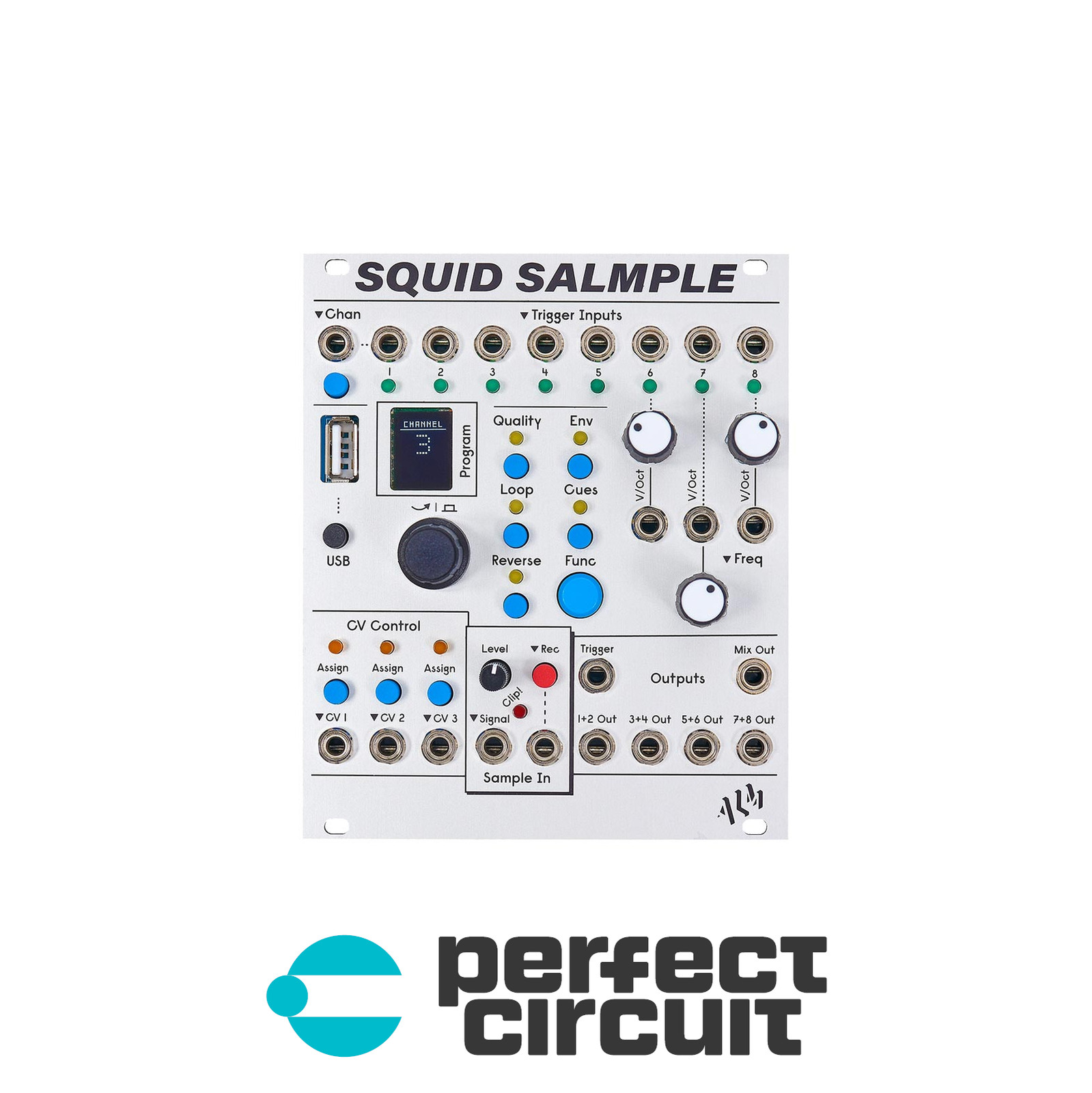
You press record, twist a knob, and the audio runs through a 4-bit low-pass filter like a Game Boy having a seizure. That is the Squid Salmple. It's a 21HP Eurorack module that turns any incoming audio or control voltage into something you can carve, crush, and re-sequence in real time. It has the immediacy of a vintage Akai and the control of a modern DSP unit. There are no menus or file browsers. You grab a parameter, tweak it live, and hear the change snap into place. Bit depth runs from pristine 16-bit down to crunchy 1-bit, sample rate from CD clarity to dial-up modem warble, all per channel, all CV-controllable.
Eight channels give you room for drum kits, melodic sequences, or layers of CV modulation. Each has up to 11 seconds of RAM-based sample time at 44.1kHz/16-bit resolution. That's not endless, but it's plenty for chopping transients or looping micro-fragments for granular textures. The interface is inspired by ALM's own Pamela's Workout. It's tactile, screen-light, and built for performance. You twist knobs, hit buttons, and watch LEDs pulse as samples stutter, reverse, and pitch-shift under voltage control. It ships with nearly 100 royalty-free sample banks on a USB stick. You get drum machines from the x0x lineage, obscure synths like the Roland R70 and Casio RZ1, field recordings, and pre-sampled CV curves from artists like Mumdance and Russell Haswell.
The Squid Salmple also eats CV. You can record control voltages directly into its channels, then play them back as mod sources. Capture an LFO sweep, mangle its resolution, and use it to modulate a filter across three other modules. Or record a random voltage sequence, loop it with crossfades, and use it as a generative melody. The mono input handles both audio and CV at modular levels, so you can patch internal signals in and reprocess them on the fly. With eight dedicated trigger inputs, you can fire each channel independently, which suits rhythmic sequencing or polyphonic stutters.
It isn't all nostalgia. The Squid Salmple saves and loads over USB in standard WAV format, manages samples through the free Squid Bank Maker software, and takes firmware updates from a USB stick. It skips the over-complication: no touchscreen, no Wi-Fi, no cloud syncing. You plug in a USB drive, load a bank, and go. It's built around low-latency RAM, not SD cards or hard drives, so trigger-to-sound latency is around 1-2ms.
Specifications
| Manufacturer | ALM Busy Circuits |
| Production Years | 2020– |
| Original Price | $499 USD |
| Format | Eurorack |
| Width | 21 HP |
| Depth | 38 mm |
| Power | +12V 300mA Max / -12V 35mA |
| +5V | 0mA |
| Sample Resolution | 16-bit |
| Sample Rate | 44.1 kHz |
| Channels | 8 independent |
| Sample Time per Channel | Approx. 11 seconds (mono) |
| Record Input | 1 mono, DC-coupled, handles audio and CV |
| Outputs | 4 DC-coupled (2 channels per output), 1 AC-coupled mix output |
| Trigger Inputs | 8 (one per channel) |
| CV Inputs | 3 assignable, expandable via Axon-1 or Axon-2 |
| Pitch Control | 1V/oct on channels 6, 7, 8 |
| Filter Type | Digital multimode per channel (low, high, band, notch) with resonance |
| USB | USB 2.0 for sample saving/loading, firmware updates |
| Included Accessories | USB stick with ~90 sample banks |
Key Features
Real-Time Sample Mutilation, No Menu Diving
Every major parameter on the Squid Salmple is a knob or button away. Twist the bit depth knob while a kick is playing and it turns lo-fi. Adjust the playback rate to slow down a vocal snippet without dropping pitch, and the waveform crawls across the display. Each channel lets you set bit depth (16 to 1 bit), sample rate (44.1kHz down to 4kHz), playback speed, amplitude (with a simple envelope), loop points with crossfade, direction (forward, reverse, ping-pong), and start/end cues. All of it works in real time, without stopping playback. The interface is dense but logical, with dedicated buttons for cue editing, looping, and channel selection.
CV Sampling and Playback—Yes, Really
Most samplers ignore CV as a signal to record. The Squid Salmple treats it like first-class data. Patch in an LFO, random voltage, or sequencer output, hit record, and you have a reusable modulation waveform stored in a channel. Play it back at half speed, reverse it, loop a fragment, and send it out through the DC-coupled outputs to modulate filters, oscillators, or other samplers. That makes the Salmple a CV looper, a generative sequencer, or a voltage morphing tool. It pairs well with modules like Pamela's New Workout or a complex envelope generator: record the output, tweak its resolution, and use it as a new modulation source.
Expandable CV Control and Axon Integration
Three front-panel CV inputs let you assign modulation to almost any parameter, including pitch, bit depth, loop position, and filter cutoff. The Axon-1 and Axon-2 expanders add up to four additional CV inputs, bringing the total to seven. The Axon integration needs no extra configuration. Just plug in and patch. Channels 6, 7, and 8 offer 1V/oct pitch control, so you can play melodic samples chromatically, albeit with some aliasing at extreme pitches. It's not a ROMpler, but it'll handle basslines, leads, or staccato hits.
Historical Context
The Squid Salmple landed in 2020, when Eurorack was hitting a sweet spot between experimental sound design and performance-ready instruments. Modules were getting smarter, but many samplers still felt either too simple or too computer-like. ALM Busy Circuits was known for retro-futuristic takes on classic gear, like the MUM M8 filter, inspired by the E-mu SP-1200. They saw a gap for a sampler that felt like the hardware units of the '80s and '90s but lived fully in the modular world. No floppy drives, no SCSI headaches, no boot times, but the same hands-on immediacy. The result channels the spirit of the Akai S950 or Ensoniq EPS, stripped down to its most playable elements and rebuilt for patching. It arrived alongside performance-oriented samplers like the Elektron Digitakt and Critter & Guitari's EYESY. Unlike those, the Salmple doesn't try to be a standalone groovebox. It's meant to be twisted, modulated, and abused by the rest of your system.
It also reflects a broader trend in Eurorack: "intelligent" modules that do more than generate or process signals. The Salmple sits alongside units like the Make Noise Morphagene or the Endorphin.es Furaciler as a hybrid - part sampler, part effects processor, part sequencer. Where others lean into granular or spectral processing, the Salmple keeps it visceral. It's about crunch, punch, and immediacy. The included library, from LinnDrum kits to obscure Japanese synths, lowers the entry barrier for players who don't want to spend hours importing files.
Collectibility & Value
The Squid Salmple launched at $499 and has held steady, with used units typically trading between $400 and $475 depending on condition. It's not a "grail" module, but it's respected, and increasingly hard to find new, as ALM's production runs are limited. Check the USB port for damage (it's surface-mounted and can be knocked loose), verify the display is responsive, and test all eight trigger inputs. The module is solidly built, with reverse power protection and a metal faceplate. The USB stick sits flush on the front panel, though, so repeated insertions can wear the slot. Some users report certain USB drives not mounting. ALM recommends small, high-quality sticks (like SanDisk Ultra) formatted as FAT32.
Firmware updates are easy: drop a .bin file on the stick and reboot. The module has seen consistent improvements since launch, including better USB compatibility, Axon-2 support, and new features like "Step T" for round-robin triggering. Failures are rare, but when they happen it's usually the display or USB port, both repairable by experienced techs. Because it's RAM-based, not flash-based, samples vanish when power is off, so save to USB before repatching. The included sample library is a major value add. For live players, the lack of battery backup isn't a dealbreaker since you're loading banks anyway, but you can't rely on it to retain state between sets.
If you're buying, look for units that come with the original USB stick and documentation. Missing banks mean you'll need to download them from squidbanks.com or use the Squid Bank Maker to rebuild your own. Stick to official firmware releases, because unofficial builds can brick the unit.
eBay Listings
As an eBay Partner, we earn from qualifying purchases. This helps support our independent vintage technology research.