ALM Squid Salmple (ALM-022) (2019)
You plug in, hit record, twist a knob, and suddenly your modular’s spitting out crunchy 1-bit snares like it’s 1993 all over again.
Overview
The ALM Squid Salmple (ALM-022) isn’t just another sampler in a Eurorack world full of them — it’s a hands-on, no-menu-dive, immediate lo-fi playground that feels more like a drum machine you built than a module you patched. Built by ALM Busy Circuits, this 21hp beast packs eight independent channels of real-time sampling, mangling, and playback, all wrapped in a workflow that prioritizes speed and tactile control. At $499 when it launched around 2019, it wasn’t cheap, but it wasn’t trying to be an entry-level toy either. It’s for the modular head who wants to sample a noise burst, drop the bit depth to 2, stretch the playback, and send it out with a gritty, aliased edge that feels ripped from an old Akai S950 — which, incidentally, is exactly the vibe it’s going for.
It’s designed to live in the thick of a live modular setup, where you’re sampling, re-sampling, and warping sounds on the fly. The interface is physical: buttons, knobs, a screen (though some wish it were bigger), and a front-panel USB slot so you can yank out your stick and swap banks like a DJ flipping cartridges. You can record both audio and CV, mangle each channel independently with bit reduction and sample rate shifting, assign cue zones, and even let one channel borrow another’s sample for layered processing — a trick that’s deceptively powerful when building kits. And yes, it’s got that Elektron Digitakt DNA in its DACs, but owners report the output is cleaner, less colored, and more transparent than its standalone cousin.
But let’s be real: this thing has quirks. It doesn’t crossfade or zero-cross when setting loops, which means you’ll hear clicks and pops if you’re not careful — one user called it a “significant design flaw.” The clip indicator? Apparently useless — it doesn’t light until after clipping happens, and the level meter reads hot at just 10% deflection. And while the immediacy is addictive, there’s a learning curve, especially when it comes to saving settings. Some users report inconsistent saves for things like channel level and quantize, which can be maddening mid-session. Still, the consensus is clear: once you’re in, you’re in. It’s fast, fun, and full of that instant “vibe” that makes rave and jungle material snap to life.
Specifications
| Manufacturer | ALM Busy Circuits |
| Module width | 21hp |
| Depth | 38mm |
| Supply | +12V 300mA Max / -12v 35mA |
| Maximum sample duration | 11 seconds |
| Max sample time per channel | 11 seconds |
| Number of banks | up to 99 banks per USB storage device |
| Channels per bank | 8 |
| Cue zones per channel | up to 32 |
| Audio outputs | 4 DC coupled outputs (2 channels per out) and a mix output (ac coupled) |
| Audio output routing | Channels 1/2 on output 1, 3/4 on output 2, 5/6 on output 3, 7/8 on output 4 |
| Supported sample file format | 44.1kHz / 16 bit mono WAV |
| Recording quality | 16 bit 44.1khz mono |
| Supplied samples | 85 banks of samples |
| Number of channels | 8 independent channels |
| Trigger response time | 1-2ms |
| Record input | 1 mono record input handling both CV and audio input signal from line to modular level |
| Audio output configuration | Mono |
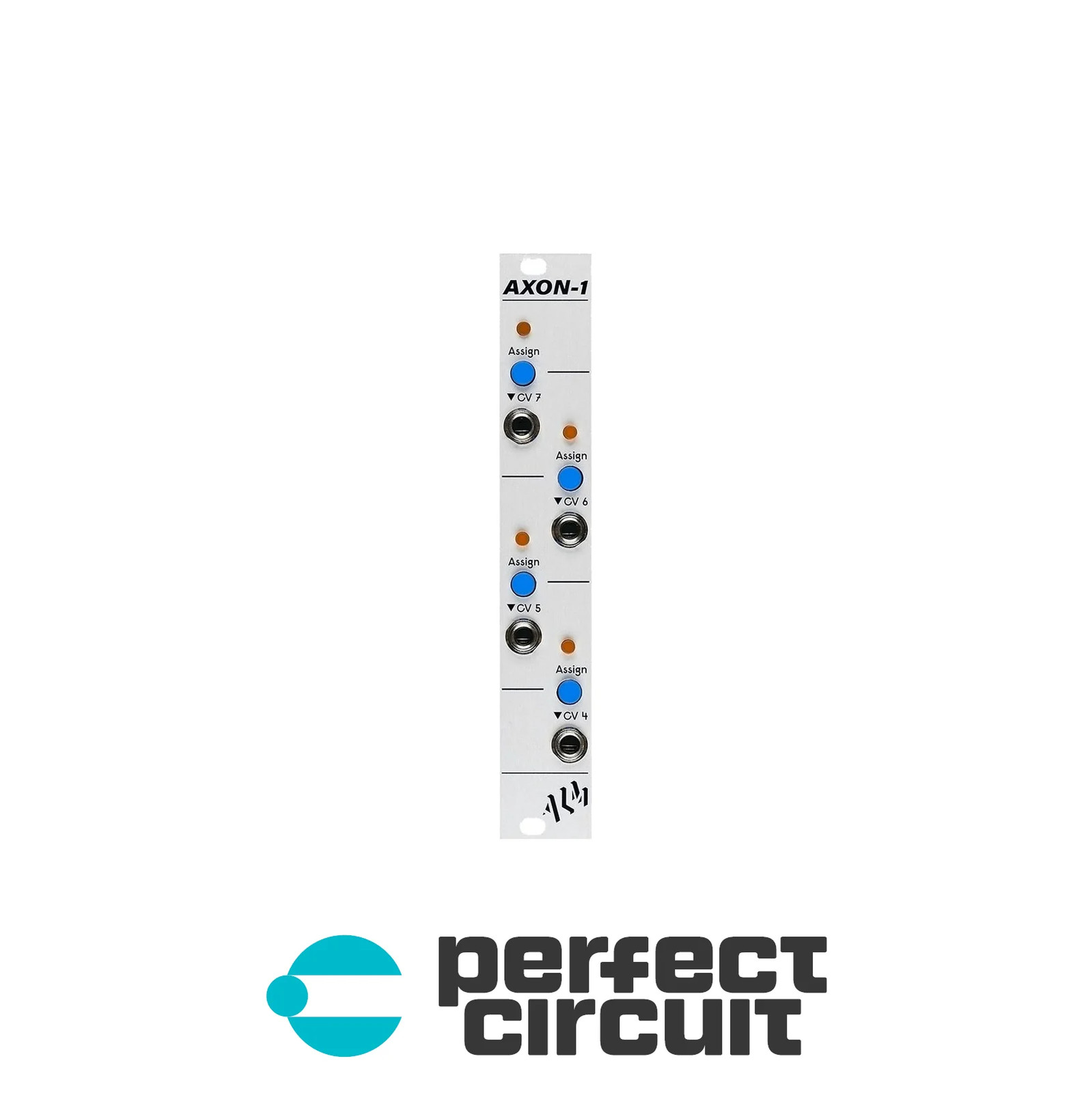
| Expandability | Can be paired with an AXON-2 expander |
| Bit depth per channel adjustable from 16 bits to 1 | Sample rate per channel adjustable from 44khz to 4 |
Key Features
Real-Time Sampling & Mangling
The Squid Salmple thrives on immediacy. You hit record on the fly, sample a modular source — a snare, a drone, a burst of noise — and play it back instantly. After sampling, one reviewer said they couldn’t differentiate between the original and the sample in a blind test, which speaks volumes about its fidelity when clean. But the magic kicks in when you start mangling: each channel lets you adjust bit depth (down to 1-bit), sample rate (as low as 4kHz), playback speed/pitch, amplitude with a simple envelope, loop points, direction, and cue positions. You can even set up to 32 cue zones per channel, making it a powerhouse for slicing and dicing rhythmic material. And because most parameters are CV-able, you can automate or modulate the grit in real time.
USB Workflow & Sample Management
Samples are saved as standard 44.1kHz/16-bit mono WAV files to a USB flash drive slotted right on the front panel — no computer needed during performance. But here’s the catch: the WAV files contain Squid-specific metadata, including panel settings, cue points, and loop markers. That means if you overwrite a bank, you’re overwriting the original sample and all its settings. Some users have reported cue points disappearing when using non-OEM USB sticks, though the PNY 64GB Elite-X Fit USB 3.1 is confirmed to work reliably. For desktop editing, there’s a free open-source tool called SquidManager that lets you drag and drop samples, concatenate them, and add cue markers before loading them onto the stick.
Reference Channel & Expandability
One of the smarter workflow touches is the “reference channel” feature — it lets one channel use the audio from another, so you can have the same sample playing across multiple channels with different bit depth, pitch, or envelope settings. It’s perfect for building kits where a single kick gets three variations without eating extra memory. And if you need more hands-on control, the Squid pairs with the AXON-2 expander, which gives you dedicated knobs for each channel. Though some users report lag when assigning too many parameters (three or more per knob), the combo turns the Squid into something closer to a standalone groovebox.
CV & Trigger Integration
Despite lacking MIDI, the Squid is deeply integrated into the modular world. It has a +5V trigger output, a mono record input that handles both audio and CV, and the ability to record and play back CV — not quite a Dnipro Krait, but still a useful trick for capturing LFO sequences or envelope shapes. Channels 6, 7, and 8 even have V/Oct pitch inputs, so you can play melodic content chromatically. The trigger response is lightning-fast at 1–2ms, so timing stays tight. But one user reported a sync issue where the CV output drifted from the input trigger, which could be a firmware or hardware quirk worth watching for.
Historical Context
The ALM Squid Salmple emerged around 2019, slotting into a Eurorack scene already rich with samplers but hungry for something immediate and tactile. It was positioned as a homage to 12-bit samplers like the Akai S950, but with modern expandability and modular integration. At the time, it was compared to units like the BitBox Micro, Assimil8or, 4ms samplers, Squarp Rample, and Sample Drum — all of which lean into lo-fi or modular-centric workflows. Unlike some of its peers, the Squid avoided deep menu diving in favor of physical control, a design choice that won it fans who wanted to play, not program. As of May 2025, ALM has confirmed that a “Squid II / Pro” is not on the horizon, which has eased fears of obsolescence among buyers.
Collectibility & Value
As of August 2022, the Squid Salmple was out of stock due to an unavailable IC, and ALM suggested that the only way to get one was through their “Coupe” bundle or the secondhand market. That scarcity, combined with its cult following, has kept demand steady. But buying used comes with caveats. Common issues include power-on failures — some units require multiple power cycles to boot, and a few have reportedly stopped powering on entirely. Quality control has also been spotty: users have reported screens installed backwards, ribbon cables misrouted from the factory, and sticky or unresponsive buttons. One fix for a reluctant channel button involved rotating the plastic actuator 180 degrees — a workaround that sometimes fails over time. ALM has offered repair services for faulty units, but shipping a module overseas isn’t ideal. If you’re hunting, check for consistent bank recall (some report loading bank 72 on startup regardless of save state) and test all buttons and outputs. The original $499 price tag now feels like a bargain given the feature set — if you can find one that powers on reliably.
eBay Listings


As an eBay Partner, we earn from qualifying purchases. This helps support our independent vintage technology research.