ALM PE-1 (2010s)
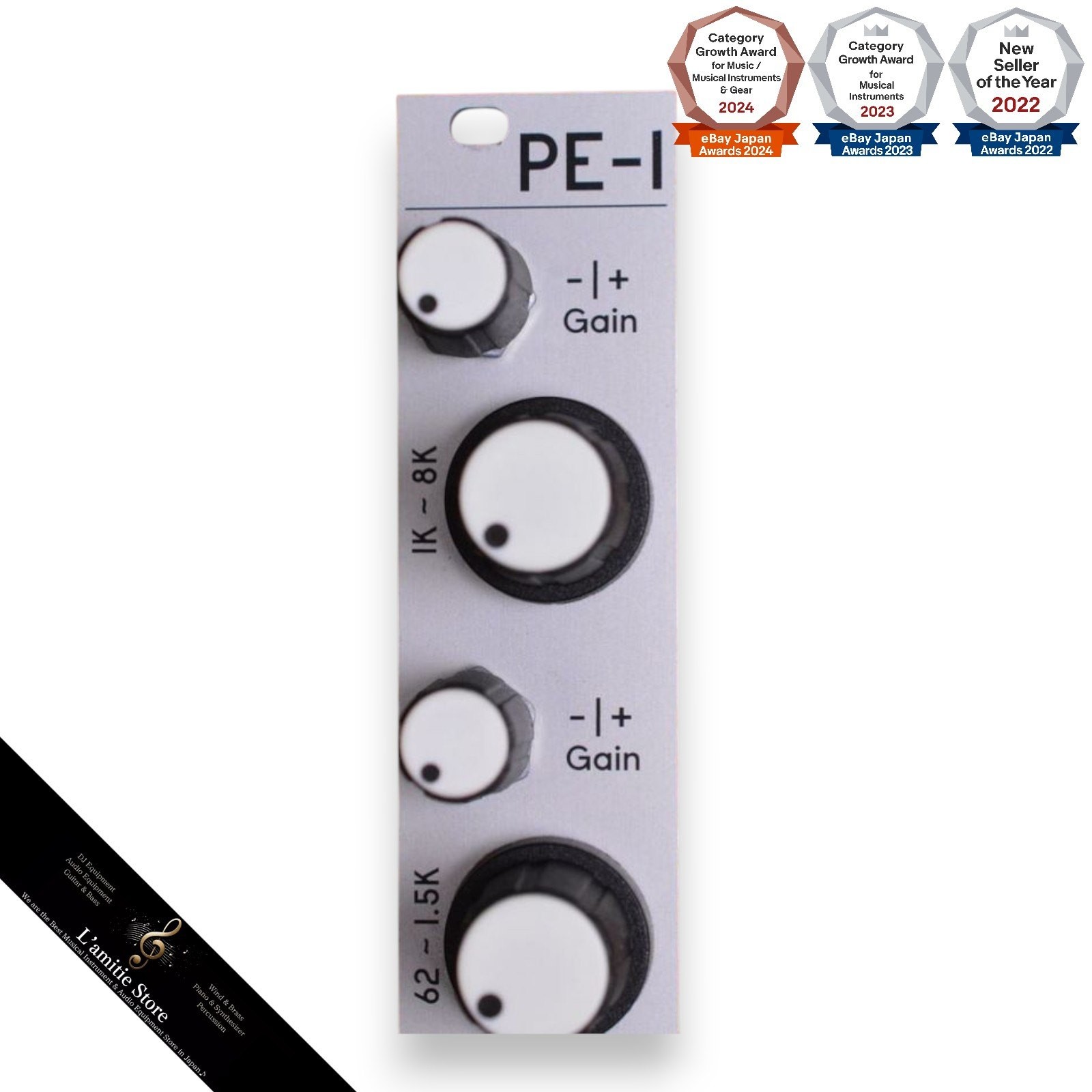
A tiny 5HP EQ with the guts of a 1980s home studio console — and just as much attitude.
Overview
Plug in a digital oscillator, turn up the high-frequency band with a sharp Q, and give it a +10dB boost — suddenly your sterile sine wave sounds like it’s being broadcast through a blown tweeter in a damp basement. That’s the PE-1 talking. It doesn’t just shape tone; it injects character, grit, and a faint echo of cassette hiss and transistor distortion that feels less like equalization and more like time travel. This isn’t a surgical EQ. It’s a tone vandal with a soldering iron, built to make modular systems feel less pristine and more human. At just 5HP wide, it’s skiff-friendly and unassuming, but don’t let the size fool you — the PE-1 punches like a unit twice its width, especially when pushed into self-oscillation or used to tweak feedback loops until they start growling.
Born from ALM Busy Circuits’ obsession with resurrecting the quirks of analog gear, the PE-1 draws its DNA from the EQ sections of early Tascam Portastudios — those four-track cassette beasts that birthed a thousand bedroom demos. Those mixers weren’t known for neutrality; they were colored, limited, and full of compromises. The PE-1 doesn’t apologize for that. Instead, it weaponizes it. With two fully parametric bands, each offering ±12dB of cut or boost, it gives precise control over frequency, gain, and bandwidth (Q), but the circuit’s inherent nonlinearity means that even subtle boosts add a kind of harmonic thickness that’s hard to describe but instantly recognizable. It’s not modeled or emulated — it’s built the same way, with discrete components and audio transformers that saturate gently when driven, giving it a warmth that digital EQs can’t replicate.
Despite its roots in vintage hardware, the PE-1 is very much a product of the modern Eurorack era. It arrived when modular synthesis was shifting from purely experimental sound design toward more structured composition and live performance. Musicians needed tools to balance and shape their mixes without leaving the rack — but they didn’t want sterile transparency. The PE-1 filled that gap perfectly: compact, affordable, and sonically distinctive. It’s not a full mixer, but with two AC-coupled inputs (one with attenuation), it can blend two signals before EQ’ing them, making it ideal for grouping drums, processing parallel effects, or acting as a final tone shaper on a master bus. And because it’s designed and built in the UK with reverse polarity protection, it’s as reliable as it is musical — a rare combo in a format where a single misplugged cable can fry a module.
Specifications
| Manufacturer | ALM Busy Circuits |
| Production Years | 2010s |
| Model Number | ALM016 |
| Format | Eurorack |
| Width | 5 HP |
| Depth | 32 mm (including power header) |
| Power Supply | ±12V |
| Current Draw | +12V: 10 mA, -12V: 10 mA |
| Function | Dual Band Parametric EQ with Mixing Capabilities |
| Frequency Bands | 2 fully parametric (selectable upper and lower frequency bands) |
| Gain Range | ±12 dB per band |
| Inputs | 2 AC-coupled audio inputs |
| Input Control | One input with attenuation control |
| Output | 1 audio output |
| Protection | Reverse polarity protection |
| Construction | Designed and made in the UK |
| Mounting | Skiff-friendly |
| Manual | Available as PDF from manufacturer |
Key Features
Parametric Control with Personality
Each of the two EQ bands on the PE-1 is fully parametric, meaning frequency, gain, and Q (bandwidth) are all adjustable. But unlike clinical digital EQs where Q remains consistent across frequencies, the PE-1’s Q behaves differently depending on where you set the frequency — a side effect of its analog design that ends up being a feature, not a flaw. At lower frequencies, the Q tends to widen, creating broad, musical sweeps that feel organic. At higher frequencies, it can get quite narrow, allowing for surgical presence boosts or harsh resonant cuts that border on filtering. The ±12dB range is modest compared to some modern EQs, but in practice, it’s more than enough — most users find that gains beyond +8dB start to saturate the output stage in a way that’s musically useful but not always clean. This isn’t a module for transparent correction; it’s for transformation.
Simple Mixing Meets Tone Shaping
The PE-1 isn’t labeled as a mixer, but it functions like a two-channel passive mixer with tone control. Both inputs are AC-coupled, preventing DC offset issues, and while only one has an attenuation knob, the other accepts full-level signals and blends them internally. This makes it ideal for combining two related sources — say, a kick and snare — before applying shared EQ. The attenuation control doubles as a balance knob, letting you fine-tune the blend before the signal hits the EQ stage. It’s not a substitute for a proper mixer, but in a compact system or skiff setup, it eliminates the need for an additional module. And because the EQ comes after the mix point, the entire summed signal gets the full character of the circuit — including its subtle saturation and harmonic enhancement.
Built for the Rack, Born from the Basement
The PE-1’s 32mm depth and 5HP width make it one of the most space-efficient parametric EQs in Eurorack. It’s designed to fit into tight systems without sacrificing functionality — a rare balance in a format where utility modules often demand disproportionate space. The PCB is cleanly laid out, with through-hole components that are easy to service, and the front panel uses durable silkscreening with clear, functional labeling. Reverse polarity protection means it won’t die the first time someone plugs in a cable backward — a small but critical detail that reflects ALM’s reputation for reliability. It’s also one of the few Eurorack modules that proudly declares “Designed and Made in the UK,” a point of pride given the prevalence of overseas manufacturing in the industry.
Historical Context
The PE-1 emerged during a pivotal moment in modular synthesis — the early 2010s, when Eurorack was transitioning from niche curiosity to mainstream adoption. As more musicians began building systems for live performance and studio use, they needed tools to manage tonal balance without resorting to external mixers or DAWs. Most available EQ modules at the time were either too broad (like shelving filters) or too clinical (digital models). The PE-1 offered a third path: an analog EQ with musical character, inspired not by high-end studio consoles, but by the humble Portastudios that democratized home recording in the 1980s. These machines — like the Tascam 424 and Fostex X-15 — had EQs that were crude by professional standards but beloved for their ability to add presence and edge to thin cassette recordings. ALM didn’t just replicate the topology; they embraced the limitations, using similar discrete transistor stages and transformer-coupled outputs to recreate that gritty, slightly unpredictable behavior. In doing so, they tapped into a nostalgia not for perfection, but for imperfection — for the sound of music made on gear that fought back a little.
At the time, few manufacturers were focusing on utility modules with sonic character. Most EQs in modular were afterthoughts — functional but dull. The PE-1 changed that perception, proving that even a simple tone control could be a sound design tool. It arrived alongside other ALM classics like the SQ-1 and MUM M8, reinforcing the brand’s identity as builders of no-nonsense, sonically distinctive modules that prioritized musicality over flash. It also reflected a broader shift in the modular community toward embracing coloration rather than avoiding it. Where early adopters sought pristine, digital-like clarity, a new wave of users began chasing saturation, distortion, and circuit-level quirks. The PE-1 wasn’t just responding to that trend — it helped define it.
Collectibility & Value
The PE-1 has never been rare — it’s been in continuous production since its release, with no limited editions or major revisions. That consistency keeps prices stable, but it also means condition and provenance matter less than with vintage gear. New units typically sell for around $115 USD or £90 GBP, with used examples fetching 60–80% of that depending on seller location and market demand. Because it’s a modern module with robust construction, most used units are fully functional, though buyers should still check for bent jacks or damaged power connectors, especially if the module has been frequently moved between cases.
Failures are uncommon, but not unheard of. The most frequent issue reported by service technicians is capacitor degradation in older units, particularly in the AC coupling stage, which can lead to low-end roll-off or DC offset at the output. This is easily remedied with a recapping, a job that costs $30–$50 at most modular repair shops. The reverse polarity protection has saved countless modules from destruction, but it won’t protect against sustained overvoltage — so users should still double-check their power supplies. The knobs and pots are standard Alps-style components, widely available and simple to replace if they develop crackle or dropouts.
For collectors, the PE-1 isn’t a trophy piece — it’s a workhorse. Its value lies in utility, not scarcity. That said, early production runs with the original UK-made PCBs are slightly preferred by purists, though no measurable sonic difference has been documented. The silver front panel version is more common than black, but both are functionally identical. If you’re building a compact or travel-friendly system, two PE-1s paired with a Ghost Prophecy or similar mixer can form the core of a master buss chain with serious tonal authority. For those reasons, it’s often found in performing musicians’ racks rather than display cases — which is exactly where it belongs.
eBay Listings


As an eBay Partner, we earn from qualifying purchases. This helps support our independent vintage technology research.