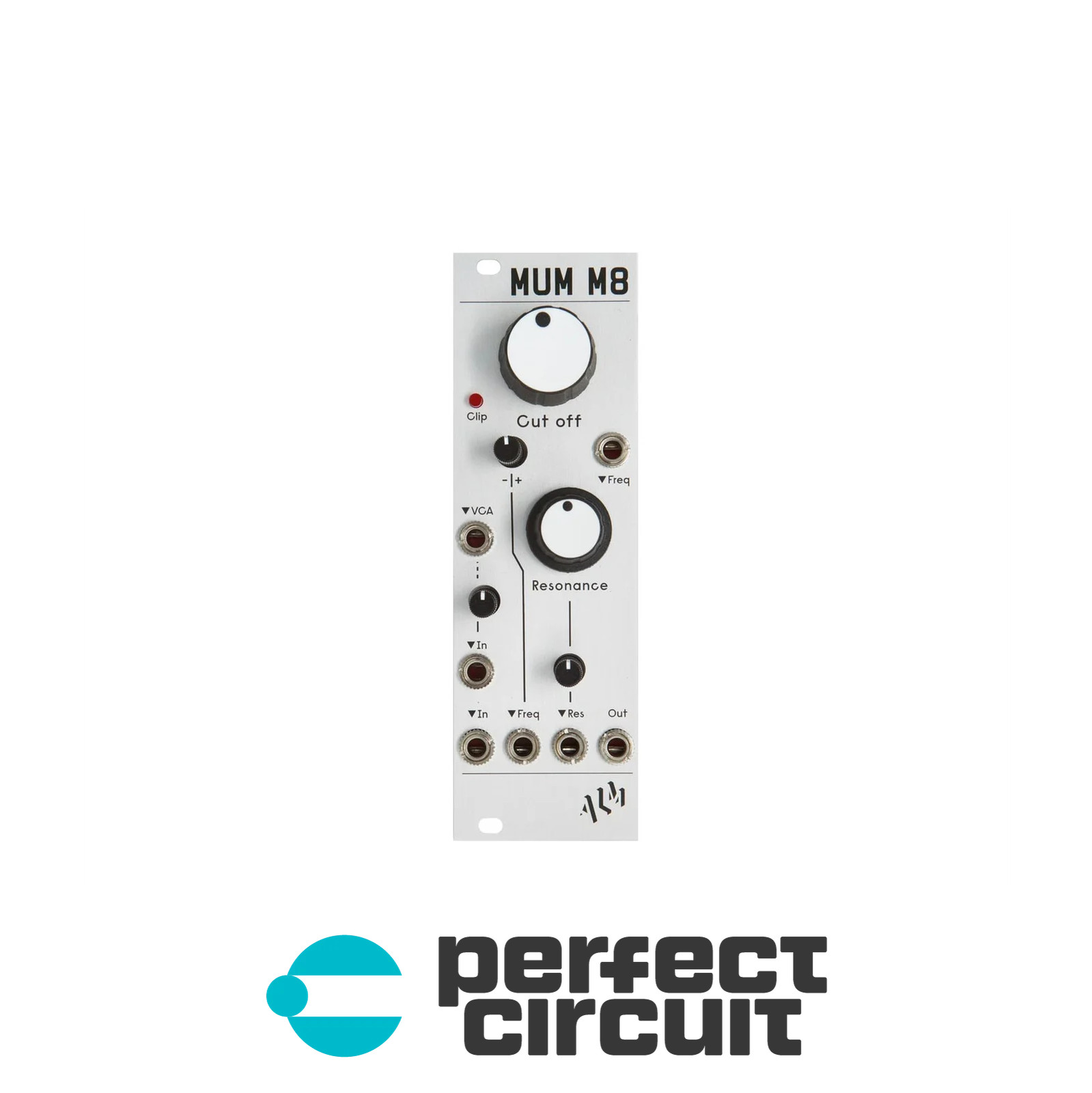
ALM Busy Circuits MUM M8 (2017–)
A filter modeled on the Akai S950 sound that defined early jungle.
Overview
Take a classic Akai S950, run a snare loop through it with just a little resonance, and you get a dark, smooth, sucking tone. That tone defined early jungle, hardcore, and the UK's rave underground. The ALM Busy Circuits MUM M8 is built from the same core. This 8hp Eurorack module brings back the S950's 6th-order Butterworth switched-capacitor filter, then adds modern control: voltage-controlled cutoff, resonance with self-oscillation, clipped saturation, and a dedicated VCA.
The filter's sound is easy to pick out. The low-pass sweep is silky and almost liquid, like a vacuum drawing air out of a room. Crank the resonance and it snarls, self-oscillating into acidic squeals and gritty overtones that sound more like a 303 pushed into the red than a vintage sampler. That is intentional. The design came out of conversations with Jack Adams, better known as Mumdance, a producer deeply embedded in early jungle. His input shaped the module's aggression, and its ability to go from smooth to savage with one twist of a knob. It is not a polite filter for ambient pads. It is built to mangle drum loops, warp field recordings, and add raw, nostalgic energy to a patch.
The MUM M8 is digital underneath, since a high-speed clock runs the switched-capacitor design, but it responds like an analog filter. The cutoff glides smoothly, with one caveat: the minimum frequency is relatively high, to keep clock bleed out of the audio path. That is a design trade-off from the original S950, and ALM kept it. They also added rear-mounted trimmers to adjust the minimum cutoff, so you can fine-tune the low-end reach. For the full 12-bit Akai grit, note that the MUM M8 delivers the filter tone but not the S950's bit-crushed coloration. Pairing it with a bit crusher or running degraded samples into it gets you damn close.
Specifications
| Manufacturer | ALM Busy Circuits |
| Model | MUM M8 |
| Production Years | 2017– |
| Format | Eurorack |
| Width | 8HP |
| Depth | 32mm |
| Power Supply | ±12V |
| +12V Current Draw | 40mA |
| -12V Current Draw | 40mA |
| Filter Type | 6th-order Butterworth switched-capacitor low-pass |
| Resonance | Voltage-controlled, self-oscillating |
| Audio Inputs | Dual: one with VCA and level control |
| Cutoff CV Inputs | Dual, with attenuversion |
| Resonance CV Input | Single, with attenuation |
| Onboard VCA | Yes, with clipping saturation |
| Self-Oscillation | Yes |
| Reverse Polarity Protection | Yes |
| Manufacturing Origin | United Kingdom |
Key Features
A Filter with a Memory
The switched-capacitor architecture is technically hybrid, but the response curve is smooth like an analog one, especially when sweeping complex, harmonically rich sources like drum loops or granular textures. Resonant ladder filters growl and state-variable designs morph. The MUM M8 glides. It is a "tone-sucking" filter in the best sense: close the cutoff and it doesn't just remove highs, it pulls them in like a vacuum, leaving a warm, rounded thump. That behavior is what made the S950 a secret weapon in early jungle production, where producers needed to carve space in dense, fast-paced mixes without losing punch. The MUM M8 adds voltage control, so you can modulate the cutoff with envelopes, LFOs, or sequencers.
Clipped Saturation and the Onboard VCA
One of the most practical upgrades over the original S950 filter is a dedicated VCA with clipping. The second audio input feeds this VCA, which can be driven hard to add grit and harmonic distortion before the signal hits the filter. This isn't subtle tape warmth. It is aggressive, digital-style clipping that pushes sounds into overdrive, which suits kicks that need to punch through or snares that need to crack. The clipping interacts with the filter's resonance, and with both cranked you get a feedback-like intensity. It's a small addition, but it turns a passive filter into a sound design tool that can both sculpt and generate character.
Voltage Control and Attenuversion
Modulation is where the MUM M8 does well in a modular context. It has dual CV inputs for cutoff, each with attenuversion (attenuation and polarity inversion), so you can blend multiple sources, say an envelope and an LFO, without external mixers or offset utilities. Patch both, set the attenuversion knobs, and the filter can open on a trigger but close slightly with each step of a sequence. The resonance CV input is simpler, with standard attenuation, but it covers everything from subtle warble to full-on squelch. Self-oscillation is stable and tracks well across a range, so it can serve as a sine-like oscillator when needed. Its real strength is how it interacts with incoming audio, creating ringing peaks and harmonic reinforcement that can turn a simple noise burst into a laser blast.
Historical Context
The Akai S950, released in 1988, was never the most famous sampler. The Fairlight and the SP-1200 overshadowed it. But in the UK underground it became a cornerstone of early jungle and hardcore. Its 12-bit resolution gave samples a gritty, lo-fi edge, and its filter, often overlooked, was smooth and almost viscous, cutting through dense, fast mixes without muddying them. Producers like Goldie, Shut Up and Dance, and later Mumdance reached for that sound. ALM's decision to rebuild the filter answered a specific gap in the Eurorack ecosystem. Plenty of modules emulate analog synth filters, but few capture the digital-era sampler sound.
The MUM M8 arrived in 2017, when modular synthesis was expanding beyond traditional analog designs. Modules were starting to explore digital signal paths, hybrid designs, and niche sonic artifacts. The MUM M8 stood out for being focused. It did one thing. Its release was met with immediate interest from producers working in electronic, experimental, and beat-driven music. Unlike limited-run ALM modules like the FIZZLE GUTS, the MUM M8 wasn't marketed as rare, but its initial run was small, leading to quick sellouts and a steady presence on the used market. It also signaled ALM's interest in bridging vintage digital gear with modern modular, seen again in modules like Akemie's Castle, which uses actual Yamaha FM chips.
Collectibility & Value
The MUM M8 has settled into a stable spot in the Eurorack market. It is not a hyped grail, but a respected workhorse with a devoted following. New units typically sell for around £190 GBP (approximately $240 USD), though European retailers may list them closer to €229 due to VAT. On the used market, prices range from $180 to $250 depending on condition and location, with faster shipping or bundled deals sometimes pushing values higher. It doesn't inflate rapidly, and it rarely dips below $160.
Condition is generally not a major concern, as the MUM M8 has no known widespread failure points. The switched-capacitor core is solid-state, and the module includes reverse polarity protection, reducing the risk of damage from incorrect power. The rear trimmers for minimum cutoff are the only user-serviceable parts that might need adjusting, and they are stable and not prone to drifting. Buyers should still check that the resonance self-oscillates cleanly and that the VCA doesn't crackle when driven hard. Those are signs of a failing op-amp or dirty pot, though such issues are rare. The module is designed and made in the UK, so supply chain delays can occasionally affect availability, but ALM has maintained consistent production since launch.
For the full S950 experience, the MUM M8 is only half the story. To replicate the Akai's sound, pair it with a 12-bit ADC/DAC module or run degraded, bit-crushed samples into it. Some users have even patched it after a Doepfer A-189-1 or similar bit crusher to simulate the S950's entire signal chain. As a standalone filter, the MUM M8 holds its own.
eBay Listings
As an eBay Partner, we earn from qualifying purchases. This helps support our independent vintage technology research.