ALM MFD (2018–Present)
A silent workhorse in a sea of flashing lights—this unassuming Eurorack crossfader slips between tracks like a velvet curtain parting at just the right moment.
Overview
You don’t buy the ALM MFD for sonic fireworks or menu-diving modulation. You buy it because, at 4HP, it solves a problem most modular rigs don’t even know they have: how to switch or blend audio sources without clicks, pops, or that awkward gap when you’re live and the crowd is listening. It’s the module you install and then forget—until you need it, and suddenly it’s the most important thing on your rack. Designed by ALM Busy Circuits, a UK-based boutique known for clean, utilitarian designs with a slight digital edge, the MFD (Multi-Function Device, though it’s anything but generic) is a stereo voltage-controlled crossfader and dual VCA rolled into one. It’s not flashy, but in a system built for performance, its reliability and smoothness are quietly revolutionary.
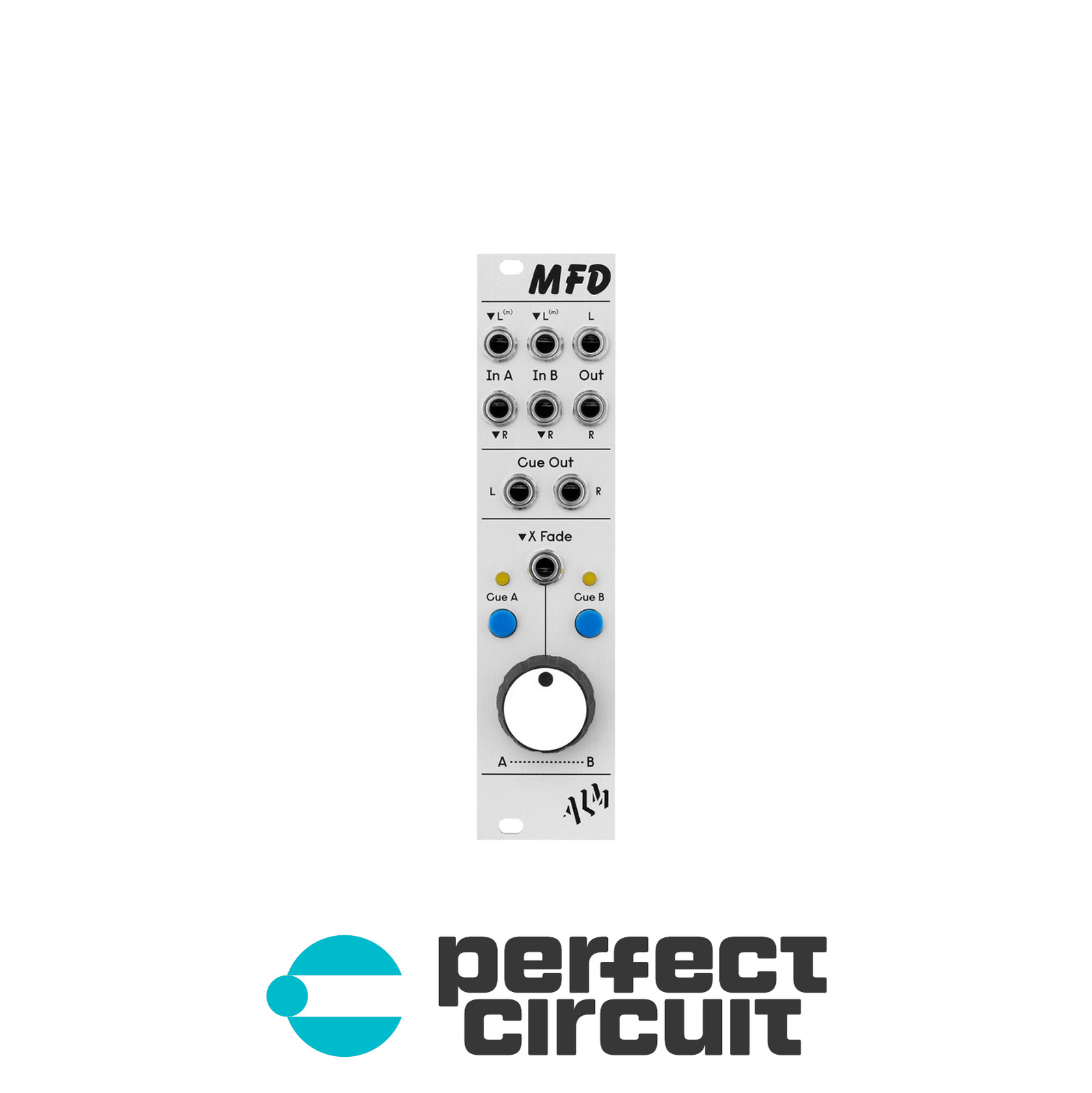
The MFD shines brightest when used for live sets—DJ-style transitions between sequenced patterns, switching between different drum processors, or fading in a drone patch without jarring the listener. It accepts two stereo (or mono) inputs and blends them into a single stereo output, either via front-panel knobs or CV control. The crossfade curve is carefully weighted to feel natural, avoiding the abruptness that plagues cheaper VCAs. And unlike many VCAs that drift or crackle with age, the MFD’s design prioritizes low noise and minimal crossbleed, so you’re not hearing one track leak into another when it should be silent. That might sound like table stakes, but in Eurorack, where ground loops and impedance mismatches are common, it’s a rare consistency.
What sets it apart isn’t just what it does, but how it refuses to get in the way. No menus, no shift functions, no OLED screen to debug. Just two faders, a cue switch, and a handful of jacks. It doesn’t try to be a mixer, a processor, or an effect—it’s a tool, built like a stagehand: invisible until the moment it’s needed, then flawless. And because it’s DC-coupled, it can handle CV signals too, letting you crossfade modulation sources or blend LFOs, which opens up some clever patching tricks for morphing between modulation shapes or automating filter sweeps.
Still, it’s not for everyone. If you’re building a compact rack and need every module to multitask like a circus acrobat, the MFD might feel too single-minded. It doesn’t add color, distortion, or character—it’s transparent by design. And while that’s a strength in a live context, it won’t satisfy those who crave the grit and saturation that some analog VCAs impart. But that’s missing the point. The MFD isn’t about flavor. It’s about function. It’s the seatbelt in your synth rig—unnoticed until the moment it saves your performance.
Specifications
| Manufacturer | ALM Busy Circuits |
| Production Years | 2018–Present |
| Module Type | Eurorack Crossfader / Dual VCA |
| HP | 4 |
| Depth (mm) | 35 |
| Current Draw +12V | 60 mA |
| Current Draw -12V | 30 mA |
| Inputs | 2x Stereo (4x Mono) Audio/CV Inputs |
| Outputs | 1x Stereo Mix Output, 1x Stereo Cue Output |
| CV Inputs | 2x CV for Fader A, 2x CV for Fader B |
| Control | 2x Manual Faders, Cue Switch |
| Crossfade Type | Voltage-Controlled, DC-Coupled |
| Fader Curve | Equal Power (Smooth Transition) |
| Signal Path | Discrete VCA Design |
| Noise Performance | Low Noise, Low Crossbleed |
| Mounting | Standard Eurorack 3U |
| Manual | Available via ALM Busy Circuits Website |
| Original Price | $237 USD (approx.) |
Key Features
Silent, Smooth Transitions
The heart of the MFD is its crossfader design, engineered for performance. Unlike basic VCAs that can click or pop when modulated quickly, the MFD uses an equal-power crossfade curve that maintains perceived volume across the blend. This means fading from a pounding bass sequence to a delicate pad feels seamless—no sudden dips or swells in level. The faders themselves are high-quality linear potentiometers with smooth action and no notchiness, making manual transitions feel intuitive. And because the signal path is discrete and carefully shielded, crossbleed between channels is minimal, so when one input is faded out, it’s truly out. That’s critical in live sets where timing and clarity matter.
Cue Function for Live Monitoring
One of the MFD’s most underrated features is its cue system. A dedicated cue switch lets you monitor the second input (Input B) through headphones or a separate output while the main mix continues playing Input A. This is pure gold for live performance—think of it as a built-in DJ mixer feature. You can prep your next sequence, check levels, or adjust effects before bringing it into the main mix. The cue output is normalled, so if you’re not using it, nothing changes. But when you need it, it’s there, eliminating the need for external monitoring solutions or awkward patching mid-set.
DC-Coupled for CV Flexibility
While primarily designed for audio, the MFD’s DC-coupled inputs and outputs open up creative uses beyond simple mixing. You can crossfade between two LFOs, blend envelope shapes, or even use it as a voltage-controlled morphing tool for filter cutoff or resonance. This kind of utility is rare in such a compact module. Most VCAs in this size are AC-coupled, limiting them to audio signals only. The MFD’s flexibility means it can sit in a utility row just as comfortably as in a performance stack. Patch it between two sequencers and use CV to automate which one is “active,” or blend modulation sources to create evolving textures. It’s not advertised as a modulation matrix, but in practice, it can play that role with elegance.
Historical Context
The MFD arrived in 2018, a time when Eurorack was shifting from experimental hobbyist setups to serious performance instruments. Artists were taking modular synths on tour, and the limitations of patch-based systems—like the inability to switch sounds cleanly—became glaring. Most solutions were kludgy: using multiple VCAs, external mixers, or relying on digital sequencers to mute tracks. ALM saw the gap and filled it with surgical precision. While other manufacturers were chasing digital effects, complex sequencers, or analog oddities, ALM delivered a module that solved a real-world problem with minimalism and reliability.
It wasn’t the first crossfader in Eurorack—Intellijel’s Quad VCA had some crossover functionality, and Make Noise offered blend utilities—but the MFD was the first dedicated, stereo, voltage-controlled crossfader in such a compact form. It arrived alongside a wave of performance-oriented modules like the Qu-Bit Performer and ALM’s own AXON-2, signaling a shift toward live playability. Competitors like Mutable Instruments were focusing on algorithmic complexity, while ALM leaned into practicality. The MFD didn’t wow at trade shows, but it earned quiet respect in the field—especially among modular DJs and live patchers who needed smooth, reliable transitions without adding a mixer the size of a toaster.
Collectibility & Value
The ALM MFD isn’t a “grail” module, nor is it likely to appreciate in value. It’s a utilitarian piece, and that’s reflected in its pricing. New units sell for around $237 USD, and used ones typically go for $180–$210 depending on condition. Because it has no moving digital components or fragile displays, it’s one of the more reliable modules in a rack. Failures are rare, but when they occur, they’re usually related to the fader pots—either wear from heavy use or contamination from dust. Cleaning with contact cleaner often resolves minor scratchiness, but full pot replacement is a straightforward repair for experienced technicians.
What to check when buying used: test both faders for smoothness and noise, verify that the cue function works correctly, and ensure there’s no crossbleed when one channel is fully faded out. Also, confirm the module powers up without drawing excessive current—while not common, a faulty power rail can damage the discrete VCA circuitry. Since the MFD is still in production, there’s little incentive to hunt down early units or “vintage” versions. It’s not a module that evolves; it’s a tool that just works. That consistency is part of its appeal.
For collectors, the MFD is more about utility than rarity. It’s the kind of module you buy once and keep forever. It doesn’t need firmware updates, won’t become obsolete, and integrates seamlessly into any system. If you’re building a performance-oriented rack, it’s not a luxury—it’s a necessity. And if you’re restoring a modular setup from the late 2010s, the MFD is a common sight, often paired with ALM’s BX series preamps or used alongside TipTop Audio’s CV mixers.
eBay Listings
As an eBay Partner, we earn from qualifying purchases. This helps support our independent vintage technology research.