ALM FMco (2025)
A tiny 8HP Eurorack module that packs the punch of a 1980s FM powerhouse—if Yamaha had built one with modern DSP and a sense of humor.
Overview
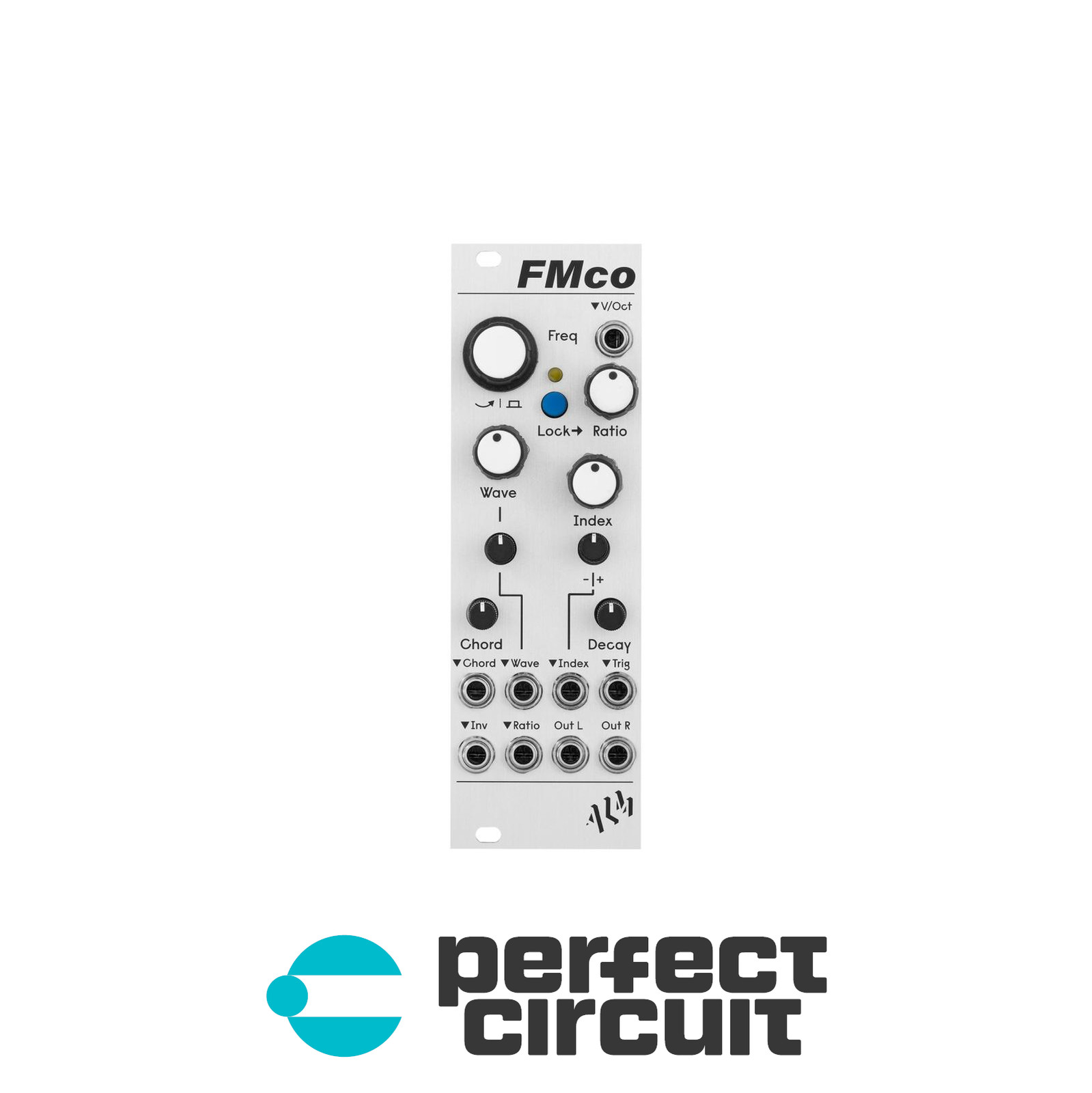
You’re elbow-deep in a skiff, wires snaking like ivy, and you need a voice that cuts through the mix without stealing real estate—this is where the ALM FMco winks at you from the shadows. It doesn’t look like much: a clean, unassuming panel of white knobs and crisp labeling, the kind of module that could blend into a wall of oscillators if it weren’t for the quiet menace in its stereo output. Fire it up, twist the ratio knob just past 3.0, crank the FM index with one hand while feeding it a trigger, and suddenly there’s a bell tone so glassy and precise it feels like it could etch silicon. That’s the FMco doing what it does best—delivering the crystalline, harmonically rich timbres of classic FM synthesis, but without the brittle sterility that sometimes plagued its ancestors.
What makes the FMco special isn’t just that it fits in 8HP, but that it refuses to compromise. It’s not a simplified FM toy or a CV-controlled approximation—it’s a full 2-operator FM voice with a dedicated DSP core, derived from ALM’s experimental Akemie series but reined in for immediacy. The sound engine is digital, yes, but it’s voiced with an analog sensibility: the decay envelope isn’t just tacked on, it’s woven into the architecture, routing dynamically to both FM depth and output level so that every note has shape, punch, and release. Hit the trigger input and the FMco behaves like a standalone voice—no external envelope needed. That’s rare in a module this size, and rarer still when it sounds this good.
It’s also remarkably playable. The encoder-based tuning system eliminates the drift and guesswork that haunt analog VCOs, giving you rock-solid pitch accuracy with just a few twists. Need to dial in a perfect fifth or a minor third? The ratio lock switch snaps you to integer values or lets you float freely into microtonal seas. And when you want more than a single note, the chord mode steps up—CV-controllable, with inversion and up to four voices, it turns the FMco into a shimmering pad generator or a staccato rhythm machine depending on how you patch it. The stereo output isn’t just a gimmick, either; the widening effect adds spatial depth that makes the FMco feel larger than its chassis, like a tiny speaker projecting into a cathedral.
But let’s be honest: this isn’t a warm, buttery analog oscillator. If you’re chasing Moog-style roundness or the soft drift of a Roland SH series, look elsewhere. The FMco lives in the upper registers, in the realm of electric pianos, metallic plucks, and laser-etched leads. It excels at sounds that need to cut through a dense mix—perfect for percussion, arps, and high-frequency textures. And while it’s deeply programmable via CV, it doesn’t come with presets or a screen, so you’ll live in the patch bay if you want dynamic movement. This is hands-on synthesis, not recallable performance.
Specifications
| Manufacturer | ALM Busy Circuits |
| Production Years | 2025 |
| Original Price | $299 USD |
| Format | Eurorack |
| Width | 8HP |
| Max Depth | 32mm |
| Power | 65mA @ +12V, 25mA @ -12V, 0mA @ +5V |
| Oscillator Type | Digital 2-operator FM synthesis |
| Waveforms | 8 operator wave shapes (sine, saw, square, triangle, and variants) |
| FM Index Control | Manual and CV with attenuverter |
| Ratio Control | Manual with lock switch for integer/microtonal selection |
| Envelope | Internal decay envelope routed to FM depth and output level |
| Trigger Input | Yes, for envelope activation |
| Chord Mode | CV-controllable, up to 4 voices with inversion |
| Tuning System | Encoder-based for precise pitch control |
| Outputs | Stereo Left and Right with widening effect |
| CV Inputs | FM Index, Ratio, Chord, Trigger |
| Firmware Update | USB-C, drag-and-drop |
| Reverse Power Protection | Yes |
| Country of Origin | England |
Key Features
DSP-Powered FM with Analog Workflow
The FMco runs on a custom DSP implementation that ALM developed in-house, inspired by their Akemie line but stripped of unnecessary complexity. Unlike some FM modules that simulate FM through analog circuits or oversimplified algorithms, the FMco uses true digital computation to generate its core waveforms and modulation paths. This means the math behind the harmonics is accurate, predictable, and capable of the sharp, evolving timbres FM is known for. Yet the interface feels analog—knobs for every major parameter, CV inputs with attenuverters, and immediate feedback. There’s no menu diving, no screen to squint at. You turn a knob, you hear the change. It’s FM synthesis made tactile.
Built-In Envelope as Performance Catalyst
Most FM oscillators in Eurorack are just that—oscillators. You need an external envelope to shape the FM index or amplitude. The FMco flips that script. Its internal decay envelope activates on trigger and simultaneously modulates FM depth and output level, giving every note a natural attack and release. This isn’t just convenient; it’s expressive. You can patch a sequencer directly into the trigger input and have a fully shaped voice without a single additional module. The decay time is fixed, but that’s part of the charm—it forces you to work within a defined envelope shape, encouraging rhythmic, percussive use. It’s like having a self-contained FM drum voice or a plucky electric piano in a sliver of space.
Chord Mode in 8HP? Yes, Really.
Few modules this size dare to offer polyphony, let alone chord generation. The FMco not only includes a chord mode but makes it CV-controllable, with selectable inversions and up to four voices. Patch a voltage into the chord input and you can sweep through triads, sevenths, or clusters in real time. It’s not full polyphony—each chord plays as a single triggered event—but in a modular context, that’s often enough. Layer it with reverb or delay, and the FMco becomes a miniature pad machine, capable of lush, evolving textures that belie its footprint. The stereo output enhances this further, spreading the voices across the soundstage for a wider, more immersive image.
Historical Context
The FMco arrives at a moment when Eurorack users are hungry for compact, self-contained voices that don’t sacrifice sonic character. The 2020s saw a boom in skiff-friendly designs, but many sacrificed features or playability to save space. ALM, known for their no-nonsense, engineer-driven approach, responded with the FMco: a module that answers the question, “What if you could have a DX7 voice in a format smaller than a credit card?” It draws lineage from Yamaha’s FM revolution of the 1980s, but updates it for a world where CV control, stereo imaging, and immediate playability matter more than banks of presets. Competitors like Noise Engineering’s Loquelic Iteritas or XAOC’s Belgrad offer complex digital synthesis, but they’re larger, more expensive, and often steeper to learn. The FMco splits the difference—accessible but deep, compact but complete.
It also reflects a broader shift in modular synthesis: the acceptance of digital sound generation as equal to analog, not just a compromise. Where early digital modules were often seen as cold or clinical, the FMco embraces its digital nature while giving it warmth through design choices—like the stereo widening, the envelope integration, and the carefully selected waveforms. It’s not trying to be analog. It’s trying to be better at being digital.
Collectibility & Value
As of 2026, the FMco is too new to be considered “vintage” in the traditional sense, but it’s already gaining cult status among modular enthusiasts who value compact, high-performance voices. With an original price of $299, it sits in the mid-tier for digital oscillators, but its feature set justifies the cost. Used units are beginning to appear on the secondary market, trading between $250 and $320 depending on condition and demand. Because it’s a recent release, most units are in excellent working order, and there are no widespread reports of hardware failures.
That said, buyers should be cautious of firmware issues. The module relies on USB-C for updates, and while the drag-and-drop system is simple, a corrupted firmware file could render the module inoperable until reflashed. Always verify that the seller includes the original firmware or can confirm the module is up to date. The lack of user presets means there’s no sound library to lose, but a bricked DSP would still be a headache. Otherwise, the FMco is solidly built—reverse power protection, robust jacks, and a metal faceplate mean it can handle life in a touring skiff.
For collectors, the FMco’s value lies in its efficiency. In a format where every HP counts, a module that delivers FM synthesis, chord generation, stereo output, and an internal envelope in 8HP is a rare find. It’s not likely to become a “grail” module like a vintage PPG or a rare Serge, but it may age into a modern classic—the kind of module that becomes a staple in compact systems. If ALM discontinues it, prices could climb, especially as demand for skiff-friendly digital voices grows.
eBay Listings
As an eBay Partner, we earn from qualifying purchases. This helps support our independent vintage technology research.