ALM CIZZLE (2024)
That brittle, fizzy, neon-drenched CZ magic—now with voltage-controlled chaos and a side of stereo swirl.
Overview
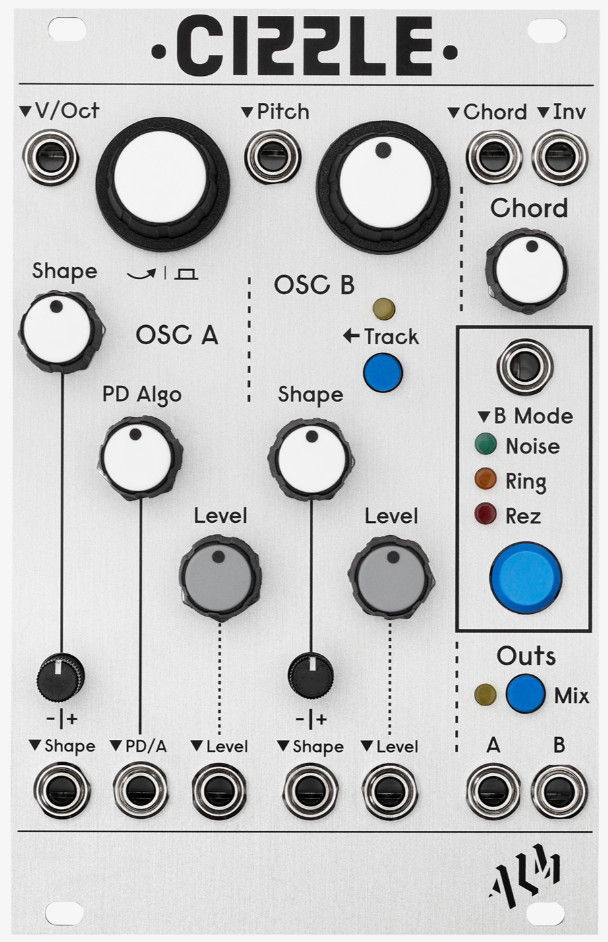
You remember that sound—crisp, digital, almost too clean until you twist one knob and it rips open with a synthetic snarl that feels like it was coded in a Tokyo lab at 3 a.m. in 1985. The ALM CIZZLE doesn’t just nod to the Casio CZ series; it reverse-engineers its DNA and splices in Eurorack-grade flexibility. This isn’t nostalgia with training wheels. It’s a full rebuild: two phase distortion oscillators in 16HP, each capable of generating the entire CZ palette—from glassy bell tones to Reese basses that chew through mix buses—and then some. What made the CZs cult favorites despite their plastic keyboards and cryptic interfaces was their unique synthesis method: phase distortion, where one sine wave bends the timing of another to create complex, evolving waveforms. The CIZZLE doesn’t simulate that—it *is* that, digitally implemented with surgical precision, then supercharged with CV control over nearly every parameter that mattered.
And it’s not just Osc A doing the heavy lifting. Osc B isn’t a simple sub or noise source—it’s a full CZ-style secondary oscillator with its own resonance waveform (that fake filter squelch everyone loved), ring modulation, and noise modes, all switchable via trigger or manually. That means you can layer a detuned PD wave with a squelchy Rez tone, then slap on noise bursts for percussive attack—all within one module. The chord mode, capable of up to 8 voices with inversion, brings back that cheesy-but-addictive CZ-3000 polyphony, now voltage-controlled so you can morph from major triads to diminished clusters in real time. It’s the kind of feature that makes you forget you’re in a modular system—until you patch in an LFO to modulate the PD shape and realize you’ve just made a living, breathing synth voice that evolves for minutes without repeating.
But here’s what you won’t find in the spec sheet: the way it sits in a mix. Unlike analog VCOs that smear into each other, or wavetable oscillators that can feel clinical, the CIZZLE cuts with a kind of digital clarity that’s neither warm nor cold—it’s *present*. It doesn’t blend; it announces. That makes it perfect for leads, yes, but also for rhythmic textures and pads that need to shimmer without dissolving. And because both oscillators have dedicated VCAs, you can fade them in and out independently, creating pseudo-ADSR contours even before you hit a filter. The mixed output even applies a subtle stereo widening effect, which feels like a small luxury—until you’re panning it across a mix and realize how much space it suddenly occupies.
Specifications
| Manufacturer | ALM Busy Circuits |
| Production Years | 2024–present |
| Original Price | £290 GBP |
| Module Type | Dual Digital Phase Distortion VCO |
| HP | 16 |
| Depth | 32mm |
| Power Consumption +12V | 65mA |
| Power Consumption -12V | 25mA |
| Oscillator Count | 2 (A and B) |
| Phase Distortion Algorithms | 9 morphable (Osc A) |
| Oscillator B Modes | Resonance (Rez), Ring Modulation, Noise |
| Chord Mode | Voltage-controlled, up to 8 voices with inversion |
| Outputs | Osc A, Osc B, Mixed (stereo widened) |
| VCAs | Dedicated level VCAs per oscillator |
| Frequency Tracking | Osc B can track Osc A with offset |
| Mode Switching | Manual or trigger-controlled for Osc B |
| Calibration | Internal calibration with firmware updates |
| Firmware Version | v103 (as of release) |
| Reverse Power Protection | Yes |
| Warranty | 2 years |
| Country of Origin | England |
Key Features
Dual Oscillators with Specialized Roles
The CIZZLE doesn’t treat both oscillators as equals—and that’s its strength. Osc A is the workhorse: it runs the 9 morphable phase distortion algorithms, each a digital reinterpretation of the CZ’s core waveforms, from pulse-width-like shapes to FM-adjacent metallic zaps. These aren’t static waveforms; they morph in real time with CV control over the “PD Offset Shape,” letting you sweep from sine-like purity to jagged, harmonically rich distortion. Osc B, meanwhile, is the character engine. It doesn’t generate standard PD waves. Instead, it offers three distinct modes pulled straight from the CZ playbook: Resonance (a simulated filter sweep without an actual filter), Ring Mod (for clangorous, bell-like tones), and Noise (perfect for snare hits or wind-like textures). You can switch between them manually or via trigger, making it easy to add rhythmic noise bursts or sudden timbral shifts mid-phrase. And because Osc B can track Osc A with an offset, you can create beating effects or detuned layers that stay musically locked.
Voltage-Controlled Chord Engine
The chord mode is where the CIZZLE stops being a VCO and starts feeling like a complete voice generator. With up to 8 voices, it goes beyond the original CZs’ 4- or 6-note limits, and the fact that chord type and inversion are voltage-controllable means you’re not stuck with static harmonies. Want to sweep from a major 7th to a diminished 9th while modulating the detune? Patch in a sequencer or random source and go. Firmware updates have expanded the chord library to include Minor 9 and Major 9, while removing the less-used Major 4—small touches that show ALM is listening to users. The chords aren’t just stacked voices; they’re detuned and layered with subtle timing offsets that mimic the slight imperfections of vintage poly synths, giving them a humanized feel despite their digital origin.
Integrated VCAs and Output Flexibility
Most dual oscillators in Eurorack expect you to route each output to a separate VCA. The CIZZLE builds them in, with dedicated level controls and CV inputs for each oscillator. That means you can fade Osc A in while Osc B pulses rhythmically—all without patching a single extra module. The mixed output isn’t just a sum; it applies a stereo widening effect that spreads the phase differences between the two oscillators across the stereo field. It’s subtle, but in a full mix, it creates a sense of space that makes the CIZZLE feel larger than its 16HP footprint. You can also use the individual outputs for more precise routing—say, sending Osc A to a filter and Osc B to a delay—giving you maximum flexibility whether you want a unified voice or two independent sources.
Historical Context
The Casio CZ series—models like the CZ-101, CZ-1000, and CZ-3000—landed in the mid-1980s as a budget-friendly alternative to Yamaha’s FM synths. They offered complex, digital sounds at a fraction of the cost, but their interface was notoriously opaque, and their plastic build didn’t inspire confidence. Yet, over time, a cult following emerged. Producers in Detroit techno, early UK rave, and ambient scenes discovered that the CZ’s phase distortion synthesis could create sounds FM couldn’t—smoother pads, snappier basses, and that distinctive “squelch” that felt like a filter without the analog drift. Fast forward to 2024, and while the original CZs are now vintage curiosities, their sonic DNA has been resurrected not in software alone, but in Eurorack hardware. The CIZZLE arrives at a moment when modular users are hungry for digital textures that don’t sound like granular mush or sterile wavetables. It’s not the first PD module—Pittsburgh Modular’s Lifeforms SV-404 came close—but it’s the first to fully commit to the CZ architecture, complete with chord modes and Rez waveforms. Competitors like Mutable Instruments’ Plaits offer PD among many other models, but the CIZZLE is singular in its focus: this is a CZ, reborn.
Collectibility & Value
As a 2024 release, the CIZZLE isn’t vintage yet—but it’s already collectible. At £290 new, it’s priced as a premium digital module, but owners report it pays for itself in versatility. Used units are already trading for £250–£280, depending on condition, with minimal depreciation—a sign of strong demand. The module is solidly built, with reverse power protection and a metal faceplate, but the main failure point is firmware-related: early versions had bugs with encoder double-clicks and Osc B CV wrapping, now fixed in v103. Anyone buying used should verify the firmware is up to date and perform a calibration check, especially if the chord mode sounds unstable. There are no known hardware failure modes beyond standard connector wear, and ALM’s 2-year warranty and UK-based support make repairs accessible. For those restoring a CZ synth or building a PD-heavy system, the CIZZLE is becoming essential—not as a replacement, but as an evolution. It’s the kind of module that, in ten years, will be considered a modern classic: not because it’s rare, but because it does one thing exceptionally well, and in a format that encourages exploration.
eBay Listings

As an eBay Partner, we earn from qualifying purchases. This helps support our independent vintage technology research.