ALM Stereo Sum (2023–)
A no-nonsense 4HP summing hub that quietly becomes the backbone of your stereo patching—until you realize you can’t live without it.
Overview
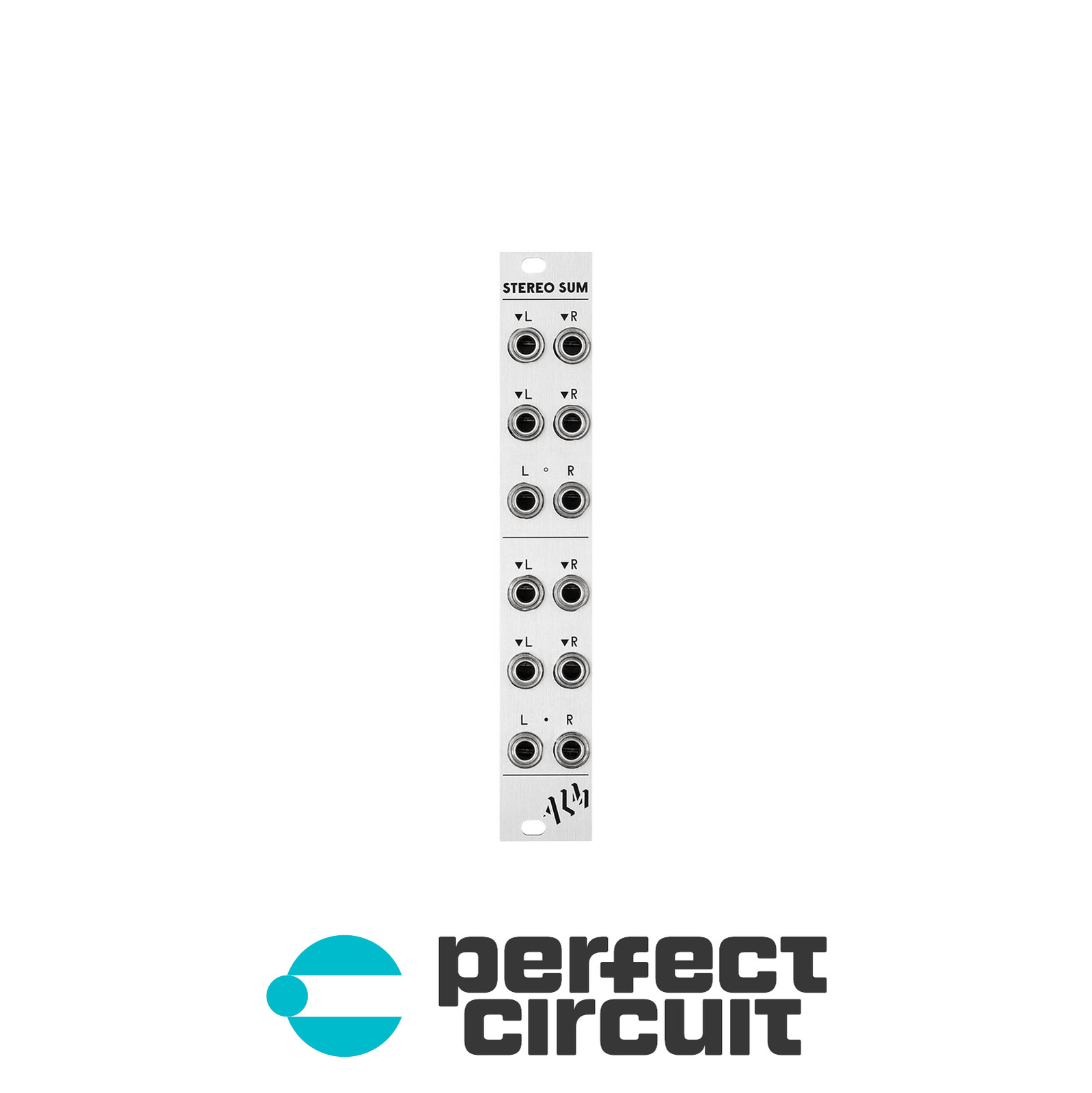
You don’t think twice about patching a stereo signal into two separate mixers—until you run out of space, and suddenly you’re juggling cables like a circus act. That’s where the ALM Stereo Sum slips in: unassuming, compact, and wired with a logic so clean it feels like cheating. It doesn’t boost, it doesn’t color—just sums. Four stereo input pairs, each pair summed independently to one of two stereo outputs, or all eight inputs funneled into a single master mix via normalization. It’s the kind of module that doesn’t announce itself until your patch starts breathing easier.
This isn’t a mixer with faders or pan controls. It’s a utility—like a junction box for stereo signals—but one with clever internal routing that rewards modular thinking. The top half’s outputs are normalized to the bottom half, so if you leave the top output unpatched, those two stereo inputs get folded into the lower mix. That means you can treat it as two independent 2-stereo-input mixers, or chain them into one big 4-pair combiner. And because it’s DC-coupled, it doesn’t care if you’re mixing audio or CV—LFOs, envelopes, modulation streams, whatever. It sums them all with the same indifferent precision.
Made in England and built to ALM’s usual skiff-friendly standards—32mm depth, reverse power protection, minimal current draw—it’s the kind of module that fits behind other gear or tucks into tight cases without complaint. It doesn’t scream for attention, but once you’ve used it to merge the returns from a pair of stereo effects, or combine multiple stereo VCO stacks, you’ll wonder how you ever patched without it.
Specifications
| Manufacturer | ALM Busy Circuits |
| Production Years | 2023– |
| Original Price | £75 GBP |
| Module Height | 3U |
| Width | 4HP |
| Depth | 32mm |
| Power Supply | +12V / -12V |
| Power Consumption | +12V 8mA / -12V 8mA |
| Input Type | Stereo (Dual Mono), Normalled |
| Number of Inputs | 4 Stereo Pairs (8 Total) |
| Output Type | Stereo (Dual Mono), Normalled |
| Number of Outputs | 2 Stereo Pairs (4 Total) |
| Gain | Unity (0dB) |
| Coupling | DC-Coupled (Audio and CV Compatible) |
| Normalization | Top Output → Bottom Input Section |
| Panel Color | Silver |
| Country of Origin | England |
| Model Number | ALM038 |
Key Features
Flexible Dual-Mixer Architecture
The Stereo Sum isn’t just a passive combiner—it’s a smartly normalized utility that lets you reconfigure its function on the fly. The top two stereo input pairs feed into their own mix output, and the bottom two do the same. But patch a cable into the top output and that path breaks free; leave it open, and those signals cascade down into the lower mix. This means you can use it as two isolated 2-input stereo mixers, or let it act as a single 4-pair summing hub. It’s the kind of design that feels obvious in hindsight—exactly what you need when merging stereo effects returns or layering multiple stereo VCO outputs without eating up valuable panel space.
DC-Coupled for Audio and CV Mixing
Most summing mixers assume you’re only dealing with audio, but the Stereo Sum doesn’t discriminate. Because it’s fully DC-coupled, it handles control voltages just as cleanly as audio signals. That opens up creative routing options: summing multiple LFOs for complex modulation, blending envelope generators, or combining sequenced CV streams before feeding them into a VCA or filter. Some users even repurpose it as a passive mult of sorts, exploiting the left-to-right normalization on inputs to duplicate a mono signal across both channels—though it’s not a true mult, so high-impedance sources should be approached with caution.
Skiff-Optimized and Power-Efficient
At just 4HP and 32mm deep, the Stereo Sum is built for tight systems. It draws a mere 8mA on both rails, making it one of the most power-efficient active mixers in the Eurorack world. There’s no front-panel clutter, no knobs, no switches—just clean, labeled jacks. The panel is silver anodized aluminum, consistent with ALM’s minimalist aesthetic, and the module includes reverse power protection, so a misrouted power cable won’t fry it. It’s not flashy, but it’s built to disappear into your case and work flawlessly for years.
Historical Context
The Stereo Sum arrived in 2023 as part of a quiet but significant wave of utility-focused modules from ALM Busy Circuits, a UK-based designer known for no-nonsense, function-first Eurorack gear. At a time when many manufacturers were chasing complex modulation or digital wizardry, ALM doubled down on the plumbing—modules that solve real patching problems without overengineering. The Stereo Sum fits that ethos perfectly: it doesn’t try to be a mixer, a processor, or a sound generator. It’s a summing junction, refined to its essence.
It slots into a lineage of compact mixers like the Intellijel Mixer 4, the Mutable Instruments Vectron Mix, and the Doepfer A-138p, but stands out by focusing exclusively on stereo pairs and clever normalization. Unlike those modules, it offers no level control—just clean, unity-gain summation. That makes it less of a performance tool and more of a behind-the-scenes workhorse, the kind of module you buy once and never remove. Its closest conceptual sibling might be the ALM MEGA-TANG, a VCA/mixer combo it’s often paired with, but the Stereo Sum fills a gap even that module doesn’t: combining stereo sources without CV control or coloration.
Collectibility & Value
As a recent release, the ALM Stereo Sum isn’t a vintage collectible—yet. But its build quality, efficient design, and integration into ALM’s ecosystem suggest it will remain a sought-after utility for years. New units sell for around £75 GBP (or ~$95 USD), with European retailers listing them for €88. There’s no secondary market premium; prices stay close to retail, and used units typically go for 20–30% less.
Failures are rare. There are no active components prone to drift, no pots to wear out, and no complex circuitry to debug. The most common issue reported is accidental overloading—patching hot signals into multiple inputs and clipping the output stage—but that’s user error, not a design flaw. Because it’s passive in function (unity gain), it doesn’t color or distort, so there’s no “mojo” to lose over time. Still, checking for cold solder joints or jack misalignment is wise when buying used, especially if the module shows signs of heavy use.
For buyers, the real value isn’t in resale—it’s in utility. If your system lacks a clean way to merge stereo effects, combine layered voices, or sum CV streams, the Stereo Sum pays for itself in patching clarity. It’s not a flashy centerpiece, but it’s the kind of module you’ll find yourself reaching for daily.
eBay Listings
As an eBay Partner, we earn from qualifying purchases. This helps support our independent vintage technology research.