ALM Busy Tyso Daiko (2021–)
A dual-voice digital drum module that doesn’t just mimic drums—it mutates them, mangles them, and makes them argue with each other.
Overview
Plug in the Tyso Daiko and you’re not just adding a drum module—you’re dropping a pair of digital gladiators into your rack, each armed with a wavetable sword and a grudge. It doesn’t politely sit in the background making hi-hats; it elbows its way to the front, growling through an analog EQ on one side and getting digitally folded into oblivion on the other. This isn’t a polite percussionist—it’s the guy who shows up to the jazz club with a circuit-bent toy drum and a theremin. And yet, somehow, it works. Brilliantly.
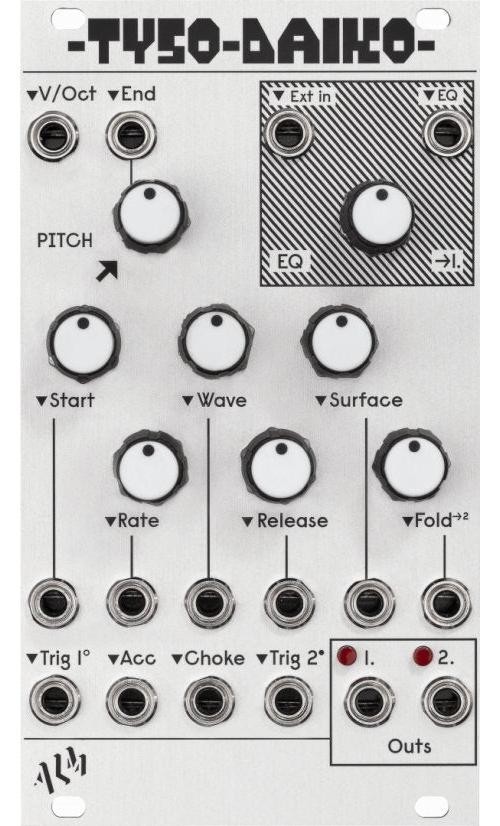
Born in 2021 as the spiritual successor to ALM/Busy Circuits’ earlier Dinky’s Taiko, the Tyso Daiko takes the same raw, digital drum philosophy and sharpens it with precision control, expanded wavetables, and a dual-voice architecture that feels more like a conversation than a rhythm machine. At its core is a 12-bit digital wavetable oscillator shared between two voices, each with independent trigger inputs and outputs. That shared oscillator means both voices start from the same sonic DNA, but from there, they diverge—one routed through a fully analog tilt EQ, the other through a digital wavefolder that can turn a sine wave into a snarling burst of harmonic chaos with a twist of a knob.
What sets the Tyso Daiko apart isn’t just its sound—it’s its attitude. It doesn’t care if you want a kick drum or a snare. It’ll give you those if you ask nicely, but it’s far more interested in becoming something else entirely: a glitchy bassline, a metallic resonance, a burst of FM-like aggression, or a rhythmic texture that sounds like a drum kit being slowly digested by a synth. The wave selector knob cycles through noise, sine, triangle, saw, pulse, and then dives into more complex digital textures—‘voice’, FM bells, cymbal, spectra, buzz—each one a doorway into a different sonic universe. And because every parameter is voltage-controllable, you’re not just selecting sounds—you’re morphing them in real time, sliding from a deep kick to a shimmering metallic ping with a simple CV sweep.
It’s not a module that rewards passive use. Patch it in with no modulation, and it can feel a bit clinical—like a drum machine with a stiff upper lip. But add a slow LFO to the wave selector, modulate the Rate knob that controls pitch slide, or run stepped voltages into the V/oct input, and suddenly it’s alive. It responds to chaos, to instability, to the kind of patches that make you wonder if your rack is about to catch fire. And that’s where it thrives: in the messy, unpredictable space between control and collapse.
Specifications
| Manufacturer | ALM/Busy Circuits |
| Production Years | 2021– |
| Original Price | £280 GBP / $349 USD |
| Format | Eurorack |
| HP | 14 |
| Depth | 32mm |
| Power | +12V 70mA, -12V 35mA |
| Polyphony | Dual voice (shared oscillator) |
| Oscillator Type | 12-bit digital wavetable |
| Waveforms | Noise, sine, triangle, saw, pulse, voice, FM bells (x2), cymbal, spectra, buzz (11 total) |
| Pitch Control | V/oct input, Rate knob (frequency slide) |
| Envelopes | Attack and Release (shared, CV controllable) |
| Outputs | Two independent audio outputs (Voice 1: analog EQ, Voice 2: digital wavefolder) |
| Inputs | Dual trigger, Accent (CV), Choke (Voice 1 only), Surface CV, External mix input (via EQ path) |
| CV Control | All parameters voltage controllable |
| EQ Type | Analog tilt EQ (Voice 1), emphasizes highs below 12 o’clock, lows above |
| Wavefolder | Digital wavefolder (Voice 2), adds harmonic complexity and noise |
| Surface Control | Adjusts attack transients—punch, click, or soft attack |
| External Input | Mix input through tilt EQ path |
| Reverse Power Protection | Yes |
Key Features
The Dual-Voice Illusion
The Tyso Daiko isn’t truly polyphonic in the traditional sense—both voices share the same oscillator core—but the way it splits the signal at the output stage creates a convincing illusion of independence. Voice 1 runs through an analog tilt EQ, letting you shape its tonal balance with broad, musical strokes: turn the knob left and it gets bright and snappy, right and it swells into subby warmth. Voice 2, meanwhile, gets fed into a digital wavefolder that doesn’t just distort—it restructures the waveform entirely, adding layers of harmonic grit that can range from subtle warmth to full-on digital disintegration. This isn’t just two outputs; it’s two personalities. You can set them to complement each other (kick and snare), oppose each other (tight click vs. smeared noise), or let them evolve independently via CV, creating rhythmic dialogues that feel almost conversational.
FM by Accident (or Design)
One of the Tyso Daiko’s most delightful quirks is its accidental FM synthesis capability. The Rate knob controls how quickly the oscillator slides from its starting frequency to its fundamental pitch. Set it slow, and you get that classic drum-machine pitch sweep. But if the Rate time is shorter than the envelope time, the pitch begins to cycle—first like a rhythmic delay, then, at audio rates, like full-on FM modulation. Patch a sequencer into the V/oct input and another into the Rate CV, and suddenly you’re generating complex, evolving timbres that sound nothing like a drum module. It’s not clean FM like a DX7, but a gritty, unstable cousin that thrives on imperfection. Some users report slight slew artifacts in the V/oct response—what might be a flaw in a melodic synth becomes a feature here, adding a lurching, humanized motion to sequences that would otherwise feel too perfect.
Choke, Accent, and the Art of Conflict
The Accent and Choke inputs aren’t just performance controls—they’re tools for drama. Accent, when triggered, shortens the release of Voice 1 and lengthens that of Voice 2, forcing them to take turns instead of playing over each other. It’s a simple trick, but it creates rhythmic tension, like one voice stepping aside so the other can shout. Choke applies only to Voice 1: when triggered, it cuts off the current sound immediately, waiting for the next trigger to restart. This lets you create tight, stuttering patterns or simulate the natural damping of acoustic drums. Patch a fast gate sequence into the Choke input, and Voice 1 starts to splutter and choke like a malfunctioning robot—perfect for industrial textures or chaotic breakdowns.
Historical Context
The Tyso Daiko didn’t emerge in a vacuum. It’s the heir to ALM/Busy Circuits’ long-running fascination with digital percussion in analog spaces. The original Dinky’s Taiko was a cult favorite—a compact, quirky drum voice that prioritized character over fidelity. The Tyso Daiko takes that spirit and scales it up: more control, more voices, more modulation, more chaos. It arrived in 2021, a time when Eurorack was saturated with drum modules, from sampled players to analog emulations. What made the Tyso Daiko stand out was its refusal to play nice. While others chased realism or vintage warmth, ALM leaned into the digital’s inherent weirdness, embracing glitches, instability, and unpredictability as features, not bugs.
Competitors like the Erica DR6 or the Squid Salmple offered more traditional drum-machine functionality, but the Tyso Daiko was never trying to be a Roland TR-808. It was closer in philosophy to Mutable Instruments’ Plaits (before its discontinuation) or the more experimental offerings from Joranalogue or Noise Engineering—modules that blurred the line between drum, oscillator, and effects processor. And unlike many digital modules of the era, it didn’t hide behind a menu system or MIDI complexity. Everything was right there on the panel, knob-per-function, patch-cable-ready. It was digital, but tactile. Complex, but immediate.
Collectibility & Value
The Tyso Daiko isn’t a vintage classic—yet. But it’s already developing the kind of cult following that suggests it might age well. New units sell for around $349 or £280, and used prices hover between $250 and $300 depending on condition and market availability. It’s not rare—ALM has maintained steady production—but it’s not common, either. You won’t find it gathering dust at every synth meet, but you will see it in the racks of modular artists who value character over convenience.
There are no known fatal flaws, but owners report a few quirks to watch for. The V/oct input can exhibit slight slew, meaning pitch changes aren’t always instantaneous. Some users initially see this as a bug, but many come to appreciate it as a source of rhythmic instability—like a slightly loose drum machine that never quite locks in. If you’re using it for precise melodic work, this might be an issue; for percussion and texture, it’s often a feature.
The module is built in England and feels solid, with a clean PCB and reliable jacks. Reverse power protection means you won’t fry it by accident, and the 32mm depth makes it skiff-friendly. The real maintenance cost isn’t in repairs—it’s in patch cables. This is a module that demands modulation. Leave it static, and it’s merely interesting. Patch it aggressively, and it becomes essential. When buying used, check that all knobs and jacks are tight, and verify that both outputs respond correctly to triggers. There are no user-serviceable parts inside—opening it voids any remaining warranty, and given its digital core, repairs are best left to specialists.
Is it a “must-have”? Not for everyone. If you want a straightforward drum machine, look elsewhere. But if you want a module that challenges your idea of what percussion can be, that rewards experimentation and embraces chaos, the Tyso Daiko isn’t just collectible—it’s addictive.
eBay Listings

As an eBay Partner, we earn from qualifying purchases. This helps support our independent vintage technology research.