ALM Busy Pamela's New Workout (2015–2021)
It doesn’t just keep time—it thinks in rhythm, breathes in sync, and turns a clock pulse into a living, modulating organism.
Overview
You patch in a clock, flip it on, and suddenly your whole system feels like it’s woken up—like the module didn’t just start counting beats, but started composing them. That’s Pamela’s New Workout. Not just a clock divider, not just a trigger generator—this is the brain stem of a modular rig, the quiet architect behind rhythms that feel human, off-kilter, and weirdly alive. It’s the kind of module that makes you step back mid-patch and mutter, “Wait, how is it doing that?” with a grin spreading across your face. The original Pamela’s Workout was already a cult legend when it dropped, but the New Workout didn’t just iterate—it evolved. It took the DNA of its predecessor and spliced in a nervous system, giving it modulation, waveforms, CV control, and a brain big enough to remember 200 different rhythmic personalities.
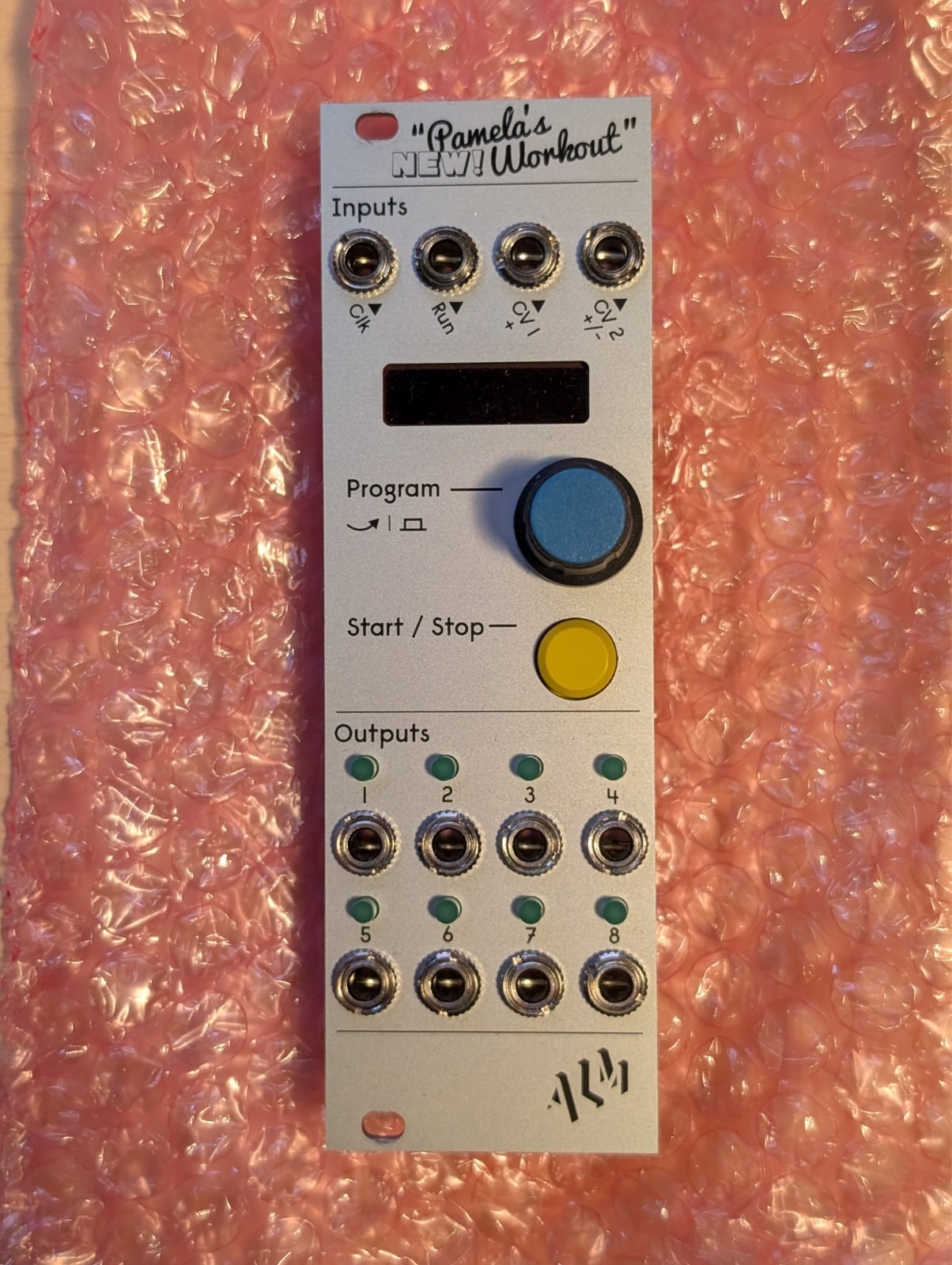
Where the original was a lean, trigger-only machine with a retro seven-segment display, the New Workout steps up with an OLED screen that’s not just prettier—it’s smarter. Navigation becomes intuitive, not cryptic. You can see what’s happening, tweak parameters in real time, and actually watch your rhythms unfold. But don’t mistake clarity for simplicity. Under that sleek black panel is a labyrinth of rhythmic possibility: Euclidean patterns that breathe like a snare roll, waveforms that morph from sine to random staircases, and clock divisions so deep they feel like time travel. It’s still 8HP—same compact footprint—but it’s denser, smarter, and far more expressive than anything that size has a right to be.
Positioned between the stripped-down original and the now-legendary Pro Workout, the New Workout was the sweet spot for years. It wasn’t the entry-level model, but it wasn’t the flagship either—it was the one that said, “You’re serious about rhythm, but you’re not ready to mortgage your synth for it.” It brought professional-grade timing, modulation, and programmability into a format that fit on even the tightest skiff. And while it’s been discontinued in favor of the Pro, it remains a cornerstone of Eurorack history—not just because it worked well, but because it changed how people thought about clock modules. It wasn’t a utility anymore; it was an instrument.
Specifications
| Manufacturer | ALM Busy Circuits |
| Production Years | 2015–2021 |
| Original Price | $275 USD |
| Form Factor | Eurorack |
| HP Size | 8HP |
| Depth | 32mm |
| Power Consumption | +12V: 50mA, -12V: 5mA |
| Outputs | 8 programmable CV/gate outputs |
| Clock Range | 10–300 BPM |
| Clock Division/Multiplication | /512 to x48 (including non-integer ratios) |
| Waveforms | Gate, triangle, sine, envelope, random, Euclidean, smooth random ("Mario hills") |
| CV Inputs | 2 assignable CV inputs (expandable via AXON-2) |
| Logic Operations | AND, OR, XOR per output (firmware 205+) |
| Memory Banks | 200 user banks (non-volatile) |
| Display | OLED, high-resolution |
| MIDI Integration | Dedicated MIDI clock output (via optional expander) |
| DIN Sync | Dedicated DIN Sync output (via optional expander) |
| Firmware Updates | USB port, field-upgradable |
| External Clock Sync | 48 to 1 PPQN |
| Weight | Approx. 150g |
Key Features
Waveforms That Think
Forget thinking of this as just a clock module—Pamela’s New Workout is a modulation powerhouse. Each of the eight outputs can generate not just triggers, but full waveforms: sine, triangle, envelopes, random staircases, and even a smooth random curve affectionately dubbed “Mario hills” by the community (and possibly by ALM themselves). That last one is pure magic—a gently undulating random voltage that feels organic, like a slow tide rather than a dice roll. It’s the kind of waveform you patch into a filter cutoff and suddenly your drone has a heartbeat. The ability to shape pulse width, level, and offset per output means you’re not just sending clock signals—you’re sculpting rhythmic motion, one parameter at a time.
Euclidean Rhythm & Beat-Based Logic
The inclusion of Euclidean rhythm generation was a game-changer. Instead of manually programming skips and rests, you tell Pamela how many pulses you want over how many steps, and it distributes them evenly—like a snare pattern that feels both mathematically perfect and humanly groovy. But ALM didn’t stop there. You can layer random step skipping, beat-based looping, and delay division to create shuffles that evolve over time. It’s not just about subdivision—it’s about feel. A simple 16th-note clock can become a lopsided, breathing groove that tightens and loosens like a jazz drummer. And because each output can have its own logic operation (AND, OR, XOR), you can cross-pollinate rhythms between channels, creating complex polyrhythms that react to each other in real time.
CV Control & Expandability
Two CV inputs might not sound like much, but in the hands of a clever patcher, they turn Pamela into a reactive brain. Assign any parameter—clock rate, pulse width, Euclidean steps, even waveform type—to a CV source, and suddenly the module is responding to your sequencer, your envelope, your LFO. Want the swing amount to increase as a note gets louder? Patch in a velocity CV. Want the modulation depth to shift with tempo? Route in a clock divider. The AXON-2 expander unlocks even more, turning those two inputs into four and adding MIDI and DIN Sync control. And while the base module doesn’t output MIDI or DIN Sync natively, the optional PPEXP1 and PPEXP2 expanders fill that gap, making Pamela the hub of a hybrid studio—just don’t expect to run everything off one without the extras.
Historical Context
When the original Pamela’s Workout launched, Eurorack was still finding its feet. Clock modules were utilitarian—dividers, maybe a reset input, and that was it. Then came Pamela: a module that treated rhythm as a creative playground, not just a metronome. It was the first to make clocking feel expressive, and it sold out instantly. The New Workout arrived in 2015, a time when modular was exploding in popularity and players like Make Noise, Intellijel, and Mutable Instruments were pushing the boundaries of what a module could do. ALM didn’t retreat into niche utility—they doubled down on innovation. The New Workout landed right as Eurorack users started demanding more from their timing modules. It wasn’t enough to divide a clock; you wanted to modulate it, shape it, make it part of the composition.
Competitors like the Qu-Bit Pulsar or the Intellijel Metropolis offered sequencing, but few touched Pamela’s rhythmic depth. And while the Doepfer MAQ16/3 was a sequencing beast, it lacked the immediacy and groove of Pamela’s interface. The New Workout carved its niche by being both powerful and immediate—no menu diving, no cryptic codes. You turned knobs, pressed buttons, and heard the change. It became the go-to for producers who wanted complex rhythms without the patching overhead. By the time the Pro Workout arrived in 2023, Pamela’s New Workout had already set the standard. It wasn’t just a module—it was a blueprint.
Collectibility & Value
Pamela’s New Workout has been discontinued, officially replaced by the Pro Workout, but it’s far from obsolete. On the used market, it trades between $220 and $320 depending on condition, with pristine units—especially limited colorway editions—sometimes creeping toward $350. It’s not a “rare” module in the sense of scarcity, but it’s not exactly common either. Because it was so widely adopted, most units show some wear: scuffed knobs, faded labels, or the occasional OLED burn-in if left on too long. But the hardware is solid—no widespread failure points, no known capacitor plague or CPU issues. The biggest risk is firmware-related: older units may need updating, and while ALM provides clear instructions, the USB update process can trip up first-time users. Still, it’s field-upgradable, so a low firmware version isn’t a death sentence—just a to-do list item.
What to check before buying? First, verify the OLED is clean—no dead pixels or ghosting. Second, test all eight outputs with a scope or meter to ensure they’re firing correctly. Third, confirm the firmware is up to date (v207 is the final), and that the USB port works. Some users report issues with early batches of the OLED display, but these are rare. The expanders (AXON-2, PPEXP1) are worth hunting down if you want full MIDI/DIN Sync integration, but they’re now even harder to find than the module itself. For most, the New Workout remains a complete package: deep, expressive, and stable. It won’t do everything the Pro can, but it does 90% of it—and for many, that’s more than enough.
eBay Listings



As an eBay Partner, we earn from qualifying purchases. This helps support our independent vintage technology research.