ALM Busy MFX (2023–)
A 6HP Eurorack time machine that resurrects four decades of digital effects—from pristine ’80s plates to glitchy bit-crushed chaos—with surgical control and a cult-worthy interface.
Overview
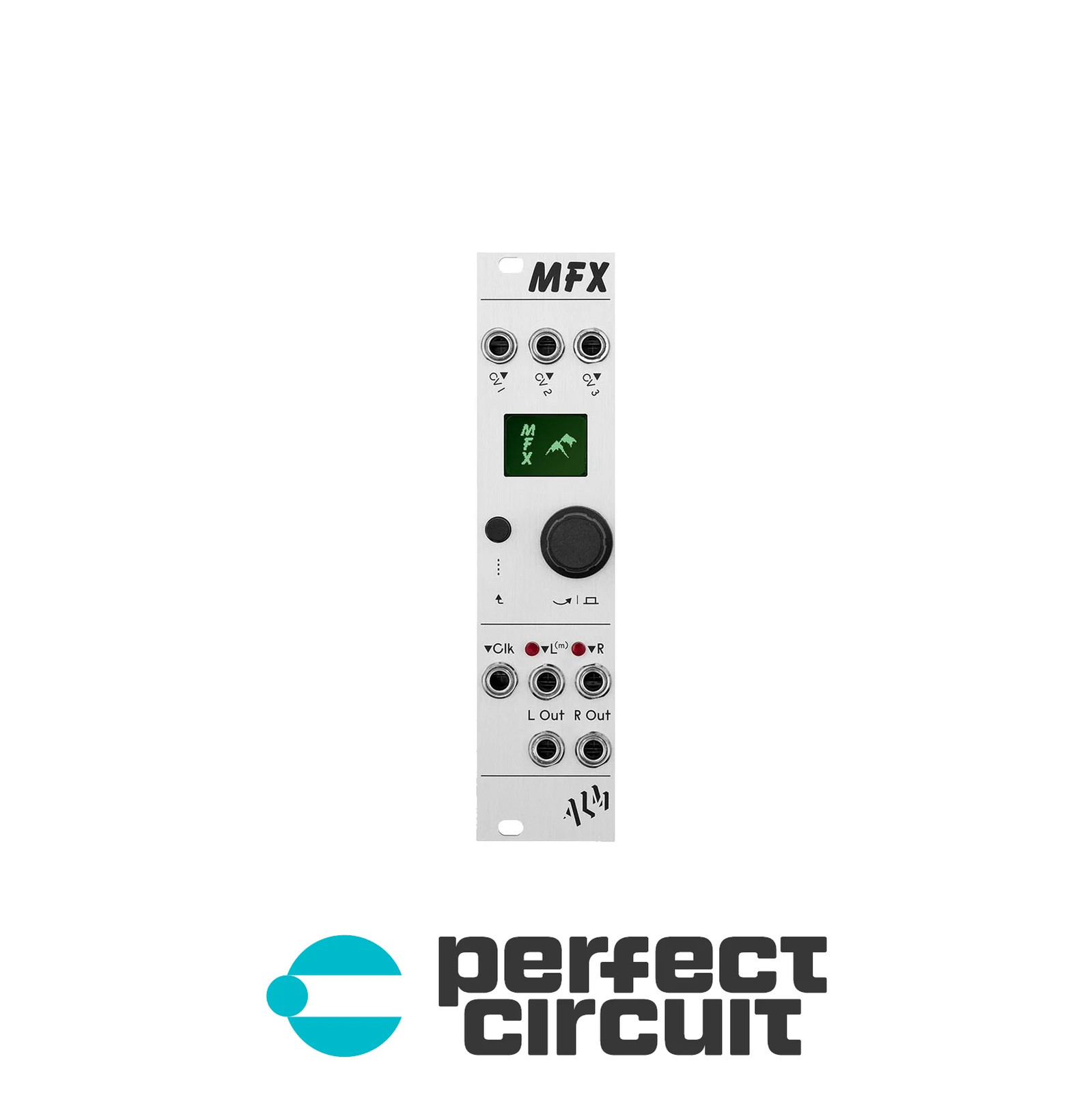
Plug in the ALM Busy MFX and you’re not just adding effects—you’re dropping a miniature museum of digital signal processing into your rack. This isn’t some sterile, modern “clean” reverb module; it’s a character-driven chameleon that can sound like a 1976 EMT 140 one minute and a malfunctioning DAT machine the next. At just 6HP, it’s a space-saving powerhouse, but don’t let the size fool you: the MFX is dense, opinionated, and demands attention. It doesn’t just sit in the background—it argues with your patches, colors your sound with vintage grit, and sometimes throws a digital tantrum if you don’t respect its gain staging. And yet, once you learn its quirks, it becomes indispensable.
The MFX doesn’t try to be everything to everyone. Instead, it picks a lane—historical digital effects emulation with a distinctly ALM flavor—and goes deep. That flavor? Think early digital: slightly crunchy, harmonically rich, and never quite “perfect.” It’s the sound of PCM delays with quantization artifacts you can almost dance to, reverbs that shimmer with metallic overtones, and bitcrushers that don’t just degrade the signal—they warp it into something new. It’s not neutral. It’s not transparent. It’s alive. And if you’re after that glassy, high-resolution sheen of modern plugins, look elsewhere. But if you want your modular system to sound like it was patched through a 1983 recording studio, a 1995 rack unit, and a 2002 glitch artist’s pedalboard—all at once—this is your module.
What sets the MFX apart isn’t just the sound, but the interface. That OLED screen isn’t a gimmick—it’s the command center. Unlike other multi-FX modules that bury parameters in endless menus, the MFX makes editing feel tactile and immediate. You turn the knob, you see the value change, you hear the difference. The three CV inputs are assignable per preset, letting you morph effects in real time, and the clock input syncs delays and modulation to your system. Firmware updates have been frequent and substantial, adding new engines, refining existing ones, and expanding functionality—proof that ALM is still actively shaping this module’s identity. It’s rare for a digital module to feel like it’s still evolving years after release, but the MFX does.
Specifications
| Manufacturer | ALM Busy Circuits |
| Production Years | 2023– |
| Original Price | €298 |
| HP | 6 |
| Depth | 32 mm |
| Power Consumption +12V | 50 mA |
| Power Consumption -12V | 15 mA |
| Processing Resolution | 16-bit / 44.1kHz |
| Audio I/O | Stereo In, Stereo Out |
| CV Inputs | 3 assignable (expandable to 7 with Axon-I or Axon-II) |
| Clock/Trigger Input | 1 |
| Firmware Update Port | USB-C |
| Effects Algorithms | 16 (including delays, reverbs, dynamics, distortion, modulation, utilities) |
| Preset Storage | Global user presets, factory presets per algorithm |
| Display | OLED |
| Expanders Supported | Axon-I, Axon-II |
| Software Version | Available for VCV Rack |
| Country of Manufacture | England |
| Reverse Power Protection | Yes |
Key Features
The Sound of Digital Evolution
The MFX doesn’t just offer effects—it curates them. Each of its 16 algorithms feels like a carefully preserved artifact from a different era of digital audio. The Digi-PCM Echo nails the slightly stiff, punchy repeats of early rack delays, while the Tape-Tech Echo layers a digital pitch shifter over a tape-style engine for warbly, unstable echoes that feel alive. The Pocket PL8 Reverb is pure early digital: bright, metallic, and slightly artificial, like a Lexicon PCM70 running on vintage firmware. Then there’s the Almicon Reverb, modeled after 80s studio staples—great for bright rooms and synthetic spaces that shimmer with character. The Quaidra Reverb pushes into the 90s with airy, atmospheric tails, while the Yetti Reverb brings in modern FDN (Feedback Delay Network) architecture, complete with a pitch shifter for alien textures. And for the experimentalists, the Crumbular Echo and 2051 Bit Corrupter turn audio into glitchy, granular artifacts that feel like the module is having a digital nervous breakdown—intentionally.
CV and Clock Flexibility
Where the MFX truly shines is in its modulation capabilities. The three assignable CV inputs aren’t afterthoughts—they’re central to the design. You can map them to almost any parameter in any effect, letting you morph from a tight slapback delay to a cavernous echo with a single envelope. The clock input syncs delay times, LFO rates, and modulation depths, making it easy to lock effects into your sequence. And with support for the Axon-I and Axon-II expanders, you can push that to seven CV inputs, turning the MFX into a fully CV-dense effects processor. This isn’t just “CV over a few parameters”—it’s deep, expressive control that makes the MFX feel like an instrument, not just a processor.
Utility as an Afterthought? Hardly.
Buried in the MFX’s effects list are a set of utilities that quietly make it indispensable. The spectral analyzer lets you visualize your signal in real time—handy for tuning oscillators or spotting resonances. The clock utility helps diagnose timing issues in your system. The simple oscilloscope gives you a basic waveform view, and the VCO tuner can calibrate your oscillators to concert pitch. These aren’t gimmicks; they’re practical tools that save you from needing additional modules. And because they’re tucked into the same interface as the effects, switching between processing and diagnostics is seamless. It’s the kind of thoughtful design that makes you wonder why more modules don’t do this.
Historical Context
The MFX arrived in 2023, a time when Eurorack was already saturated with effects modules—some analog, some digital, many trying to be the “ultimate” reverb or delay. ALM didn’t try to out-spec the competition. Instead, they leaned into history. The MFX is a love letter to the early days of digital effects, when 12-bit processing was cutting edge and every new reverb unit sounded like magic. It competes not with modern high-resolution modules like the Mutable Tides or the Expert Sleepers Disting, but with vintage units like the Roland SRV-2000, the Yamaha SPX90, and the Alesis Midiverb. It’s also a spiritual successor to ALM’s own philosophy: complex, characterful, and never afraid of a firmware update. While other companies release a module and move on, ALM has treated the MFX like a living project, adding new features, refining algorithms, and even introducing a standalone pedal version. In a market where “feature complete” often means “abandoned,” the MFX stands out for its ongoing development.
It also reflects a broader trend in modular synthesis: the desire for character over cleanliness. As more musicians use modular systems for live performance and experimental composition, they’re gravitating toward modules that don’t just process sound—they transform it. The MFX fits perfectly into this ethos. It’s not a transparent effect; it’s a collaborator. And in a world where digital perfection is easy to achieve, the MFX’s imperfections are its strength.
Collectibility & Value
The MFX is too new to be “vintage” in the traditional sense, but it’s already gained a cult following among modular enthusiasts who value its sound, flexibility, and ALM’s reputation for deep, thoughtful design. As of 2026, it sells new for around €298, and used units typically go for 20–30% less, depending on condition and firmware version. Early hardware revisions (like MFX-REV007) are known to have lower headroom and may require input attenuation to avoid clipping—especially on reverb algorithms. Later revisions and firmware updates (particularly v110 and beyond) have improved headroom and reduced noise, making them more desirable.
Common issues include digital noise on some units, especially when unpatched, and occasional firmware lockups when loading certain presets. A factory reset usually fixes the latter, and ALM’s support is responsive. The module’s low headroom is its biggest operational hurdle—many users report needing attenuators on the input and VCAs or preamps on the output to achieve optimal levels. This isn’t a flaw per se, but a design trade-off: the MFX prioritizes character and processing depth over line-level convenience.
For collectors, the MFX’s value lies in its expandability and firmware evolution. Units with Axon expanders are more versatile, and those running the latest firmware offer the full feature set. The USB-C update capability means the module can grow over time, unlike older digital effects that are frozen in their original state. While it’s unlikely to become a “grail” module in the way a vintage Roland reverb might, the MFX is already seen as a modern classic—compact, powerful, and full of personality.
eBay Listings



As an eBay Partner, we earn from qualifying purchases. This helps support our independent vintage technology research.