ALM Busy Dinky's Taiko ()
A 12-bit digital drum voice that bites back — with a noise section that snarls and an oscillator that morphs, all shaped by a fully voltage-controlled analog EQ.
Overview
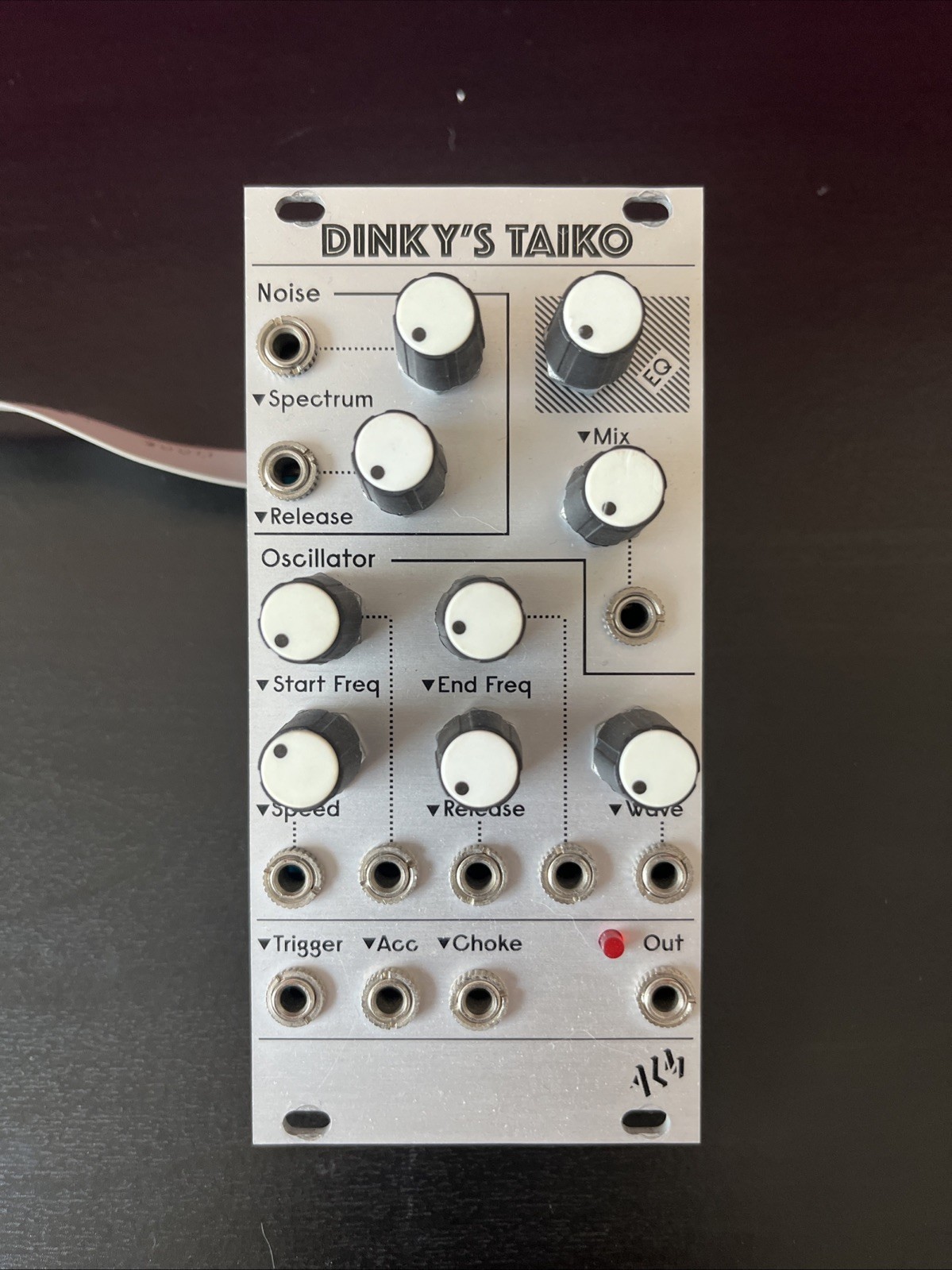
The ALM Busy Dinky's Taiko isn’t your polite little kick drum module. It’s a Eurorack-sized punch to the ribs — a digital drum voice built with the kind of surgical aggression that makes you want to rewire your entire rack just to hear it in context. Made by ALM Busy Circuits, this discontinued 14HP module blends 12-bit digital grit with a fully voltage-controlled analog EQ, giving you a rare hybrid beast: digital source material, analog shaping, and total CV access across nearly every parameter. It’s not trying to emulate acoustic drums; it’s trying to invent new ones, on the fly, with a twitchy, unpredictable energy that feels alive.
Functionally, it’s categorized as a digital drum, noise, and oscillator module — and that triple threat is no exaggeration. It doesn’t just generate noise; it lets you control the frequency and release time of that noise with precision, then layer it with a wave table oscillator that can independently shape the start and end of each hit. That kind of morphing capability means you can go from a tight snare crack to a gong-like decay swell in real time, all within a single trigger. And while the Tone knob stays local (no CV), everything else — frequency, release, mix — can be automated, sequenced, or modulated live. That’s the kind of flexibility that turns drum modules into lead voices, or percussion into evolving textures.
But here’s the catch, and it’s one owners either love or learn to work around: nothing updates while the sound is playing. Tweak a knob, send a CV — it won’t take effect until the next trigger hits. That means no mid-sound morphing, no real-time warping of a sustained hit. It’s a design choice, not a flaw, but it forces a certain discipline. You’re programming the next hit, not riding the current one. It’s like setting a trap and waiting for the next trigger to spring it. Some find it limiting; others swear it keeps their rhythms tight and intentional.
Specifications
| Manufacturer | ALM Busy Circuits |
| Format | Eurorack |
| Width | 14HP |
| Depth | 32mm |
| Current | 85mA@+12V, 85mA@-12V |
| Technology | 12 bit digital |
| Module functions | Digital, Drum, Noise, Oscillator |
| Original MSRP | $300 MSRP |
Key Features
Three-Part Sound Engine: Noise, Oscillator, Mix
Dinky's Taiko is built around three core sections, each feeding into the next like a tightly wound percussion engine. First, the Digital Noise Section gives you control over both frequency and release time — not just a static hiss, but a shaped burst you can tune from popcorn crackles to subby roars. Then there’s the Wave Table Oscillator, which stands out by letting you independently set the frequency and release for both the beginning and end of the sound. That means you can start with a high-pitched click and drop into a low drone, or reverse it for a swelling attack. It’s rare to see that level of morphological control in a drum module, especially one this compact.
Total CV Control (Almost)
Every parameter except the final Tone knob can be controlled via CV — and that’s a big deal. Want to sequence the noise frequency across a pattern? Patch it. Modulate the oscillator’s start/end frequency with an LFO? Go ahead. The module accepts trigger, accent, and choke inputs, making it responsive to dynamic playing and capable of fitting into complex rhythmic setups. The accent input lets you push levels dynamically, while choke allows for classic drum-layer muting behavior, like a hi-hat cutting off a cymbal. It’s thoughtful integration, treating the module not as a static sound source but as a responsive voice in a larger system.
No Real-Time Parameter Updates
Here’s the quirk that defines its personality: no control changes take effect until the next trigger. Turn a knob during a long decay? Nothing happens. Send a new CV voltage mid-sound? It waits. The module locks in all parameter states at the moment of triggering and holds them until the next hit. This prevents glitchy mid-sound jumps, but it also means you can’t sweep parameters like a filter cutoff in real time. It’s a trade-off — stability over fluidity. Some users work around it by using fast triggers or pre-programming changes, but it’s a behavior you need to design for, not fight.
Collectibility & Value
Dinky's Taiko is discontinued, and with that status comes a noticeable bump in price. While it originally carried a $300 MSRP, current market listings show it selling for $370.00 USD — a 23% premium that reflects both demand and scarcity. A Japanese retailer once listed it at ¥47,900 (tax excluded), suggesting regional pricing differences, but the $370 figure appears to be the going rate in active secondary markets. No data exists on common failures or maintenance issues, likely due to its solid-state digital/analog hybrid design and relatively low component count. Still, as with any discontinued Eurorack module, power supply compatibility and proper handling during installation remain critical. Given its unique sound-shaping capabilities and ALM Busy’s cult following, it’s unlikely to drop in value — especially if its rumored sibling, Haswell's Taiko, remains a limited edition.
eBay Listings
As an eBay Partner, we earn from qualifying purchases. This helps support our independent vintage technology research.