ALM Busy Circuits TAZM-O (2020–)
An analog triangle-core oscillator that turns through-zero FM into a sculptor’s chisel—dense, harmonically rich, and deceptively deep for 12HP.
Overview
You patch into the TAZM-O expecting a straightforward analog oscillator, and instead you get a beast that behaves like it’s been crossbred from a Serge, a Roland SH-101, and something that hums with the ghost of early digital FM. It doesn’t just oscillate—it interrogates. The first time you sweep the wave shape knob from triangle to sine to saw to pulse, you realize this isn’t a morphing waveform generator so much as a continuous redefinition of what the core tone actually *is*. It’s not a blend; it’s a metamorphosis, smooth and organic, thanks to its continuous crossfading topology inspired by the legendary Serge NTO. There’s no stepping, no digital interpolation—just a seamless glide through timbral identities, each one fully formed and electrically distinct.
And then there’s the through-zero FM. This isn’t just frequency modulation with extra steps. It’s the kind of FM that flips polarity, dives into negative frequencies, and comes out the other side with metallic sheen, bell-like inharmonic clang, or subharmonic growl, depending on how hard you push it. The TAZM-O doesn’t just accept through-zero FM—it *thrives* on it. The module includes both a direct FM input and a voltage-controlled FM index, which is rare in a standalone analog VCO. That means you can modulate not just the depth of the FM, but the intensity of the modulation itself, all in real time. Pair it with a second oscillator, and you’re not just creating movement—you’re building evolving, almost algorithmic textures that feel more like digital synthesis but with the warmth and instability of analog circuitry.
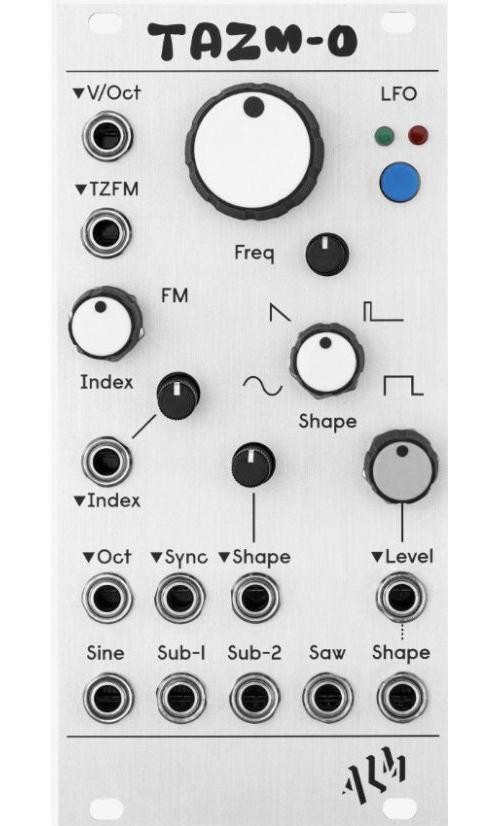
Despite its depth, the TAZM-O is compact—only 12HP—yet it refuses to feel stripped down. It’s got a primary output with a built-in VCA, so you can control amplitude directly from the module without needing an external VCA for basic shaping. The direct wave outputs (sine/triangle, saw, square) are all present and accounted for, making it easy to route different waveforms to different destinations. The dual sub-octave outputs at -1 and -2 are derived from the main oscillator and offer SH-101-style pulse variation, adding thickness and rhythmic grit when needed. It’s a design that rewards both minimalists and maximalists: you can run it as a simple, stable VCO with rich waveforms, or dive deep into FM patching and discover something that sounds like a modular synth fighting with a 1980s digital workstation.
The octave transpose CV input is another standout—offering 0, +1, and +2 octaves via control voltage, a feature more commonly found on ALM’s digital FM modules like Akemie’s Castle. It’s a subtle but powerful addition, allowing for dynamic pitch shifts that go beyond standard 1V/oct tracking. Combined with the hard sync input and LFO mode (with bipolar LED feedback), the TAZM-O becomes a multitimbral engine, capable of everything from precise melodic sequences to chaotic, self-oscillating noise experiments.
Specifications
| Manufacturer | ALM Busy Circuits |
| Production Years | 2020– |
| Model Number | ALM036 |
| Module Type | Analog Through-Zero Oscillator (VCO) |
| Form Factor | Eurorack |
| HP Size | 12 |
| Depth | 38mm |
| Power Supply | +12V / 70mA, -12V / 60mA |
| Core Type | Analog Triangle Core |
| Waveform Outputs | Primary (morphing), Sine/Triangle, Saw, Square, Sub-1 Octave, Sub-2 Octave |
| Wave Shape Control | Continuous manual and CV-controlled morphing |
| FM Type | Through-Zero Frequency Modulation |
| FM Inputs | Direct FM input, Voltage-Controlled FM Index |
| Primary Output | With built-in VCA and level control |
| CV Inputs | V/Oct, FM Index CV, Octave Transpose CV (0, +1, +2 octaves) |
| Sync | Hard Sync Input |
| LFO Mode | Yes, with bipolar LED indication |
| Rear Panel Switches | Sub-2 Pulse Width selection, Sine/Triangle waveform selection |
| Reverse Power Protection | Yes |
| Country of Origin | England |
Key Features
Continuous Wave Morphing with Analog Soul
The TAZM-O’s wave shaping isn’t a digital trick or a stepped approximation—it’s a fully analog, continuously variable crossfader between fundamental waveforms. Turn the knob, and the sound evolves from a soft triangle to a pure sine (selectable via rear switch), then stretches into a sawtooth with increasing harmonic content, before collapsing into a variable-width pulse wave. This design, borrowed from the Serge NTO philosophy, means you’re not just selecting a waveform—you’re exploring a spectrum. The transitions are smooth, musical, and free of digital stepping artifacts. Because it’s analog, small voltage fluctuations and temperature drift add character, not instability. Patch in a slow LFO to the wave shape CV, and you get a living, breathing tone that feels like it’s shifting under your fingers, not just cycling through presets.
Through-Zero FM with Voltage-Controlled Index
Most analog oscillators offer linear FM, but the TAZM-O steps into more sophisticated territory with true through-zero FM. When you modulate the frequency past zero, the waveform inverts and continues into negative frequency space, creating complex, metallic sidebands and inharmonic overtones that are impossible to achieve with standard FM. What sets the TAZM-O apart is the inclusion of a voltage-controlled FM index—essentially a depth control that can be automated. This means you can start with a subtle, warm FM shimmer and then, over time, ramp up to a full-on harmonic explosion using an envelope or sequencer. It’s a rare feature in analog oscillators and brings a level of dynamic control usually reserved for digital or hybrid systems. Pair it with a second oscillator or noise source, and the TAZM-O becomes a sound design powerhouse, capable of everything from glassy pads to industrial percussion.
Integrated Output VCA and Octave Transpose CV
Having a built-in VCA on the primary output is a small but significant convenience. It means you can shape amplitude directly from the oscillator—great for quick patches or when you’re short on VCAs. The VCA responds to the same wave shape and FM inputs, so the timbral changes are preserved even as you adjust level. Even more unusual is the octave transpose CV input, which lets you jump the oscillator up by one or two octaves via control voltage. This isn’t just for melodic transposition—it’s a performance tool. Imagine sequencing a bassline and then, at the drop, triggering a +2 octave shift to turn it into a lead. Or using an envelope to momentarily lift the pitch for a shimmering attack. It’s a feature that blurs the line between oscillator and effect, and it’s a nod to ALM’s love of digital synthesis techniques creeping into analog design.
Historical Context
The TAZM-O arrived in 2020 as ALM Busy Circuits’ first analog oscillator, which says a lot about the company’s design philosophy. Up to that point, ALM had built a reputation on digital and hybrid modules—Akemie’s Castle with its vintage Yamaha FM chips, Pamela’s Pro Workout with its precise clock manipulation, and the MCO series blending digital logic with analog sound. The TAZM-O was a statement: that analog wasn’t just a retro trend, but a living, evolving medium that could absorb ideas from digital synthesis. Its through-zero FM and voltage-controlled index reflect a desire to bridge the gap between the warmth of analog and the precision of digital modulation.
It also arrived at a time when Eurorack was saturated with oscillators—many of them rehashes of classic designs or digital emulations. The TAZM-O stood out by being neither. It didn’t try to clone a Minimoog or a Prophet-5. Instead, it drew inspiration from modular greats like the Serge and Roland while adding its own twists. The wave morphing recalls the Serge NTO, the sub-octaves nod to the SH-101, and the FM depth control feels like something from a Yamaha DX7—but combined, they create a voice that’s uniquely ALM. Competitors like Mutable Instruments’ Braids (discontinued) or XAOC’s Orogen offered complex digital oscillators, but the TAZM-O proved that analog could still surprise.
ALM’s British engineering background is evident in the build quality and attention to detail. The rear-mounted switches for sine/triangle and sub-octave pulse width are small but meaningful—allowing users to tailor the module’s behavior without cluttering the front panel. It’s a module designed by people who patch, not just design.
Collectibility & Value
The TAZM-O is not a vintage module in the traditional sense—it’s still in production as of 2026—but it has already achieved cult status among Eurorack enthusiasts. New units sell for around £315 GBP (approximately $400 USD) directly from ALM’s web store, and they tend to stay in stock, though popular runs can sell out quickly. On the used market, prices range from $320 to $380 depending on condition and location, with units in the US often commanding a premium due to import costs.
Because it’s a relatively recent module, failures are rare, but service technicians note that the main risks come from power issues. While the module includes reverse power polarity protection, older or poorly regulated power supplies can still cause stress on the analog core. There are no known widespread component failures, and the PCB layout is clean and serviceable. The rear switches are mechanical and could wear over many years of use, but they’re not user-serviceable without desoldering.
For buyers, the biggest consideration is authenticity. ALM modules are occasionally counterfeited or misrepresented on auction sites, so it’s wise to verify the serial number and purchase from authorized dealers when possible. The module ships with a printed manual and firmware update instructions, and ALM maintains excellent documentation on their website.
The TAZM-O holds its value well, not because it’s rare, but because it’s *useful*. It’s not a novelty—it’s a workhorse oscillator that fits in almost any system. Collectors aren’t hoarding it for scarcity, but for functionality. If you’re building a compact case or want a single oscillator that can do everything from bass to FM leads, the TAZM-O is a compelling choice. And because ALM continues to support it with firmware and documentation, it’s likely to remain relevant for years.
eBay Listings



As an eBay Partner, we earn from qualifying purchases. This helps support our independent vintage technology research.