ALM Busy Circuits Tangle Quartet (2016–)
Four silent, surgical VCAs in 8HP—so clean you’ll swear your patch just got smarter.
Overview
Plug in the Tangle Quartet and the first thing you notice isn’t a sound—it’s the absence of one. No hiss, no hum, no faint bleed from channel two into three when you’re routing delicate control voltages. That silence speaks volumes: this isn’t a VCA that colors your signal, it’s a VCA that *respects* it. In a format where compromises are baked into every millimeter of panel space, the Tangle Quartet feels like a quiet rebellion—four THAT 2164-based linear VCAs packed into a mere 8HP, each operating with such fidelity that they disappear into the patch, doing their job without announcing themselves. And yet, for all its restraint, it’s one of the most revealing modules in a system. It doesn’t add character; it reveals what was already there, stripping away noise and crosstalk so your oscillators, envelopes, and LFOs speak with unnerving clarity.
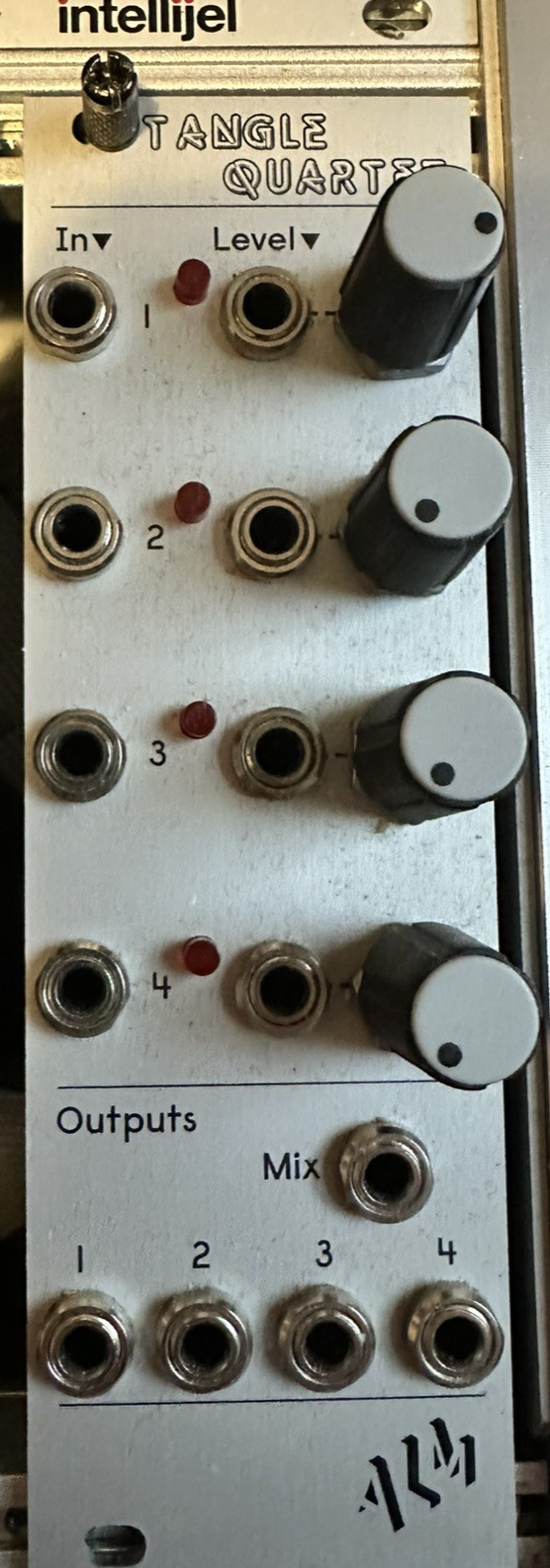
It’s not flashy, and it’s not trying to be. No flashy LEDs, no modulation routing matrix, no digital trickery. Just four channels, each with an input, a manual attenuator, a CV input with attenuverter, an individual output, and a shared mix output that sums whatever isn’t being patched elsewhere. The normalization of the CV inputs to +5V is a small but vital detail—it means that if you leave a CV jack unpatched, the attenuverter defaults to acting as a manual offset, turning the module into a four-channel passive mixer the moment you need it. That’s utility elevated to elegance. You can use it to shape four drum voices with individual envelopes, blend LFOs for complex modulation warps, or mix audio-rate signals with surgical precision. And because it’s DC-coupled throughout, it handles control voltages as cleanly as it does audio—no rolloff, no phase shift, just pure voltage transfer.
It’s the kind of module that makes you reevaluate your whole approach to patching. When every signal path is this transparent, you start to hear flaws you never noticed before—noisy oscillators, jittery envelopes, grounding issues that were masked by dirtier VCAs. That’s not a flaw in the Tangle Quartet; it’s a feature. It’s honest. It doesn’t flatter. But if your sources are clean, the results can be breathtaking—crisp, dynamic, and startlingly present. And while the panel layout is undeniably tight—knobs and jacks cheek-by-jowl—owners report that after the first few adjustments, it settles into the background, both physically and sonically. You stop noticing the density because you’re too busy listening to what it’s revealing.
Specifications
| Manufacturer | ALM Busy Circuits |
| Model | Tangle Quartet |
| Production Years | 2016– |
| Original Price | £165 / $275 |
| Form Factor | Eurorack |
| Width | 8 HP |
| Depth | 32 mm (including power header) |
| Power Supply | ±12V |
| Current Draw | +12V: 80 mA, –12V: 80 mA |
| 5V Draw | 0 mA |
| Number of Channels | 4 |
| VCA Type | Linear, DC-coupled |
| VCA IC | THAT 2164 |
| Inputs | 4 signal inputs, 4 CV inputs with attenuverters |
| Outputs | 4 individual outputs, 1 mix output |
| Normalization | CV inputs normalized to +5V |
| Signal Path | Non-inverting, bleed-free |
| Reverse Polarity Protection | Yes |
| LED Indicators | 1 per channel (attenuation level) |
| Manual | Available via ALM website |
| VCV Rack Module | Available (freeware) |
| Made In | United Kingdom |
Key Features
The 2164 Advantage: Silence as a Feature
The heart of the Tangle Quartet’s performance lies in its use of the THAT 2164 VCA IC—a chip long favored in high-end professional audio gear for its near-perfect linearity, ultra-low distortion, and exceptional dynamic range. In a Eurorack world where many VCAs use discrete designs or cheaper ICs that can introduce subtle artifacts, the 2164 stands apart. It doesn’t saturate, it doesn’t color, and it doesn’t breathe noise into quiet passages. This isn’t a VCA for people chasing analog warmth or soft clipping—it’s for those who want signal integrity above all. When modulating a filter cutoff with a slow LFO, you won’t hear zipper noise. When fading between two oscillators, there’s no thump or pop. The transitions are seamless, the control absolute. And because the channels are completely isolated, you can route unrelated CVs—say, an envelope into channel one and a random sample-and-hold into channel two—without worrying about crosstalk muddying the results.
DC-Coupled Everywhere: Beyond Audio
While many VCAs are optimized for audio signals and roll off low frequencies or distort when fed control voltages, the Tangle Quartet is fully DC-coupled from input to output. That means it handles 0 Hz with the same precision as 20 kHz. This opens up a world of utility beyond simple amplitude shaping. You can scale and offset modulation sources—taper an LFO’s output to only affect part of a filter’s range, or attenuate a sequencer’s voltage before it hits a VCO. You can use it as a four-channel CV mixer, blending modulation sources before they reach a destination. Or patch it as a voltage-controlled offset generator, using one channel to add a controllable bias to a pitch CV. The mix output becomes especially useful here: if you’re only using two channels for active CV processing, the other two can sit idle, their manual attenuators summing into the mix out as a passive control voltage blender. It’s a level of flexibility that turns a “simple” VCA into a Swiss Army knife for voltage manipulation.
Normalization Done Right: From VCA to Mixer in a Patch
The normalization of the CV inputs to +5V is a masterstroke of thoughtful design. Leave a CV jack unpatched, and the associated attenuverter defaults to injecting a steady +5V into the control path, effectively turning the manual attenuator into a standard level control—just like a mixer channel. This means the Tangle Quartet can switch roles on the fly. One patch might use all four channels as envelope-controlled VCAs for a quad drum setup. The next might repurpose it as a four-channel passive mixer for audio or CV, with the mix output summing whatever isn’t being individually patched. There’s no mode switch, no menu diving—just the physics of patching. And the LED on each channel, which responds to the level of attenuation, serves as a crude but effective visual meter. With no CV patched, it glows steadily in proportion to the manual level. With an envelope or LFO driving it, the LED dances in time, giving a real-time view of the modulation shape. It’s not a scope, but it’s often enough to tell if your envelope is snappy or sluggish, or if your LFO is bipolar or unipolar.
Historical Context
When the Tangle Quartet launched in 2016, Eurorack was already deep into its expansion phase—modules were getting more complex, more colorful, and often more expensive. In that climate, a four-channel VCA with no effects, no digital brains, and no flashy interface could have been dismissed as underwhelming. Instead, it was quietly celebrated. At a time when many manufacturers were chasing novelty, ALM (Alan M. from the UK) doubled down on fundamentals. The Tangle Quartet wasn’t trying to be the most feature-rich VCA; it was trying to be the most *reliable*. It arrived alongside a wave of renewed interest in utility modules—clean mixers, precise attenuators, stable clock dividers—as users began to value signal integrity over spectacle. Competitors like Intellijel’s Quad VCA or Mutable Instruments’ Veils offered different flavors—some with exponential response, some with additional processing—but none matched the Tangle Quartet’s combination of size, silence, and simplicity. It wasn’t the cheapest quad VCA on the market, but it was arguably the most transparent. And in a format where every module adds noise and color, sometimes the most radical choice is to do nothing at all.
Collectibility & Value
The Tangle Quartet has never been a “rare” module—ALM has maintained steady production since its release, and it remains available from major Eurorack retailers. But its reputation has only grown, and used prices reflect that. In excellent condition, a secondhand Tangle Quartet typically sells for $180–$220, just below its original $275 MSRP. Mint units with original packaging or early serial numbers might fetch slightly more, but there’s no collector’s premium—this is a module people buy to *use*, not to flip. Failures are rare, but when they occur, they’re usually power-related. The module includes reverse polarity protection, but a misaligned power cable or a faulty distribution bus can still damage the board. Technicians note that the THAT 2164 chips are robust, but the dense layout makes repairs tricky—replacing a damaged IC requires precision and patience. The most common user complaint isn’t reliability, though—it’s ergonomics. The tight spacing between knobs and jacks makes simultaneous adjustments difficult, especially with larger patch cables. Some users report accidentally nudging knobs while plugging nearby modules. It’s not a design flaw, exactly, but a trade-off: maximum functionality in minimal space. For skiff builders or anyone tight on HP, it’s a worthy compromise. For those who patch and repatch constantly, it might feel a bit claustrophobic.
Buying used? Check that all four LEDs respond correctly to CV input and that there’s no crackling in the audio path when turning the attenuators. Test each channel independently with a steady oscillator and envelope to confirm clean gating and no bleed. Since the module is DC-coupled, you can also verify CV handling by patching a slow LFO into the CV input and measuring the output voltage swing with a multimeter—any channel that doesn’t track linearly is likely damaged. Power draw should be a clean 80mA on both rails; anything higher suggests a short. Overall, it’s one of the most dependable modules in the format—no firmware, no hidden menus, no delicate components. If it powers up and the LEDs light, it’ll probably work for another decade.
eBay Listings
![ALM BUSY CIRCUITS TANGLE QUARTET : NEW : [DETROIT MODULAR]](https://i.ebayimg.com/images/g/An4AAeSwaYhpa9k0/s-l960.jpg)

As an eBay Partner, we earn from qualifying purchases. This helps support our independent vintage technology research.