ALM Busy Circuits Pip LFO (2025–)
A tiny titan of modulation that punches way above its 4HP weight, humming with analog warmth and hiding a full VCO in plain sight.
Overview
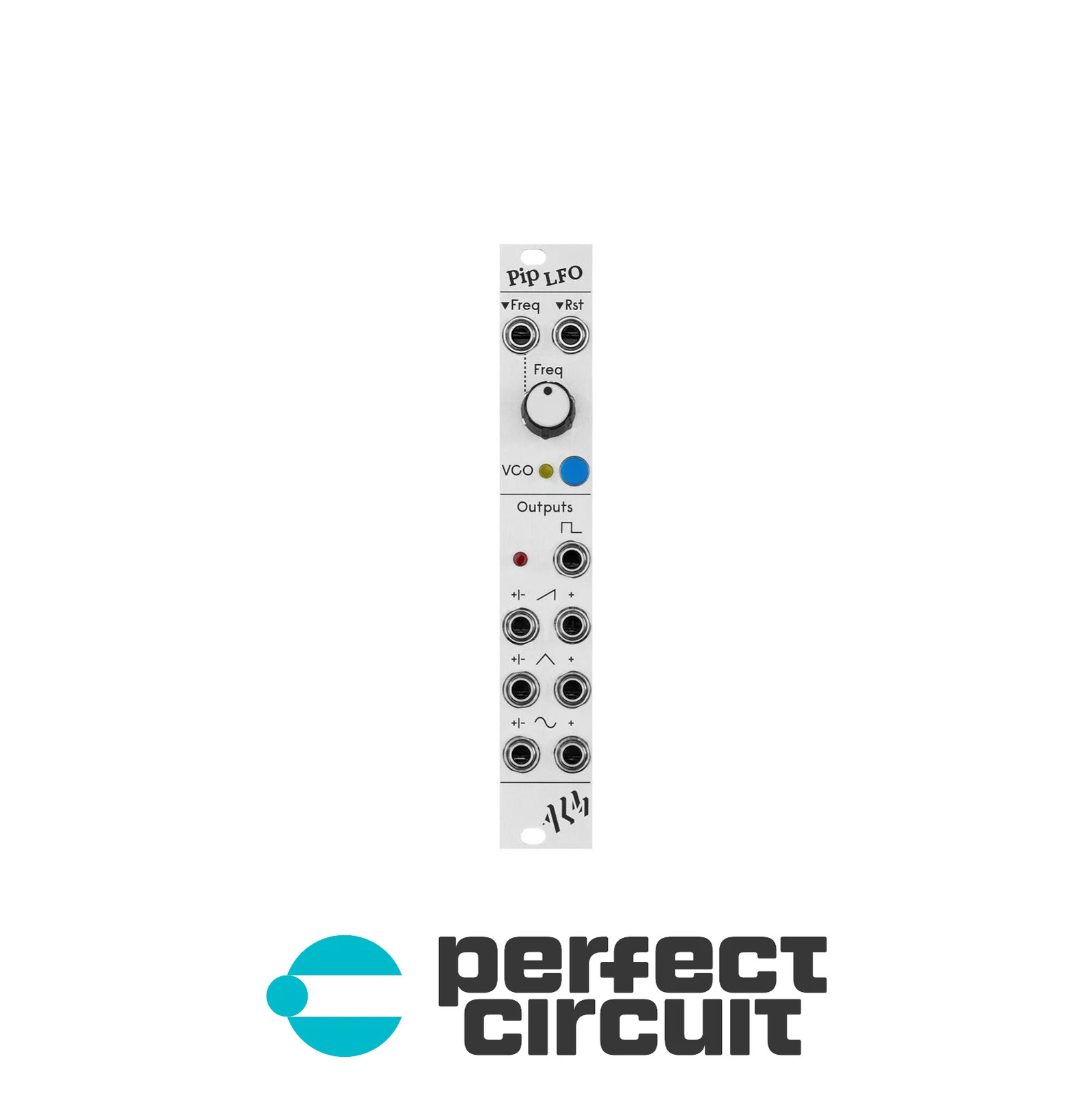
You know that moment when you’re staring at a packed Eurorack case, wishing you had just one more LFO—but there’s zero space left? The ALM Busy Circuits Pip LFO was built for that exact panic. It’s a 4HP sliver of analog circuitry that doesn’t just fill a gap—it redefines what a compact module can do. At first glance, it’s a humble low-frequency oscillator: square, triangle, saw, sine, all available simultaneously, both unipolar and bipolar. But twist the manual speed knob past the obvious range, and suddenly it’s not an LFO anymore—it’s a full-on voltage-controlled oscillator, tracking V/oct across roughly five octaves. That dual identity is where the magic lives: it’s like carrying a Swiss Army knife that turns into a katana when needed.
And it’s not just flexible—it’s smart. The reset input doesn’t just restart the cycle; it gives you hard sync in VCO mode, letting you lock waveforms with surgical precision. The LED above the speed knob isn’t just decorative; it pulses with the waveform, giving instant visual feedback even in dimly lit studios. That kind of thoughtful design runs through the whole module. It’s made in England, built with reverse power protection, and backed by a two-year warranty—no flimsy boutique vibes here. This thing feels like it was engineered, not just assembled.
Still, it’s not pretending to be something it’s not. It’s not a complex multi-stage modulator like ALM’s own QUAID GIGASLOPE. It won’t morph waveforms or add FM like a modern digital beast. What it does, it does with clarity and reliability. The analog core delivers smooth, organic waveforms—none of the digital stepping or aliasing you might get in a budget VCO. The sine is clean, the triangle is even, the saw has that slight softness that keeps it from being harsh, and the square snaps with authority. When you patch it into a filter sweep or pan mod, the movement feels alive, not robotic. It’s the kind of LFO that reminds you why you went analog in the first place.
Specifications
| Manufacturer | ALM Busy Circuits |
| Model | Pip LFO |
| Model Number | ALM048 |
| Production Years | 2025– |
| Original Price | £110 GBP / $145 USD |
| Format | Eurorack |
| Width | 4HP |
| Depth | 32mm |
| Power Supply | ±12V |
| +12V Current Draw | 40mA |
| -12V Current Draw | 20mA |
| Function | Analog LFO / VCO |
| Frequency Range | Approx. 0.01Hz – 20kHz+ |
| Waveforms | Square (unipolar), Triangle (bipolar and unipolar), Saw (bipolar and unipolar), Sine (bipolar and unipolar) |
| Control Inputs | Frequency CV input, Reset/Sync input |
| Outputs | Multiple simultaneous waveform outputs |
| Voltage Control | Manual and CV control over frequency |
| V/Oct Tracking | Approx. 5 octaves in VCO mode |
| Indicators | LED frequency indication |
| Protection | Reverse power protection |
| Warranty | 2 years |
| Country of Origin | England |
Key Features
The Analog Heart in a Digital Age
While many modern Eurorack modules lean into digital complexity, the Pip LFO sticks to a refreshingly straightforward analog signal path. There’s no microcontroller generating waveforms here—just op-amps, integrators, and comparators doing their classic jobs. That means the waveforms have a subtle imperfection, a slight drift and warmth that digital LFOs often lack. The triangle doesn’t snap with laser precision; it rounds just enough to feel natural. The sine wave isn’t mathematically perfect, but it doesn’t need to be—it’s smooth, musical, and free of harsh harmonics. This analog character shines when you’re modulating pitch or filter cutoff; the movement feels organic, like a hand turning a knob, not a machine ticking through steps.
And because it’s fully analog, it responds instantly to voltage changes. No latency, no digital processing delay. When you patch in a CV to control speed, the response is immediate and smooth. This makes it ideal for dynamic, expressive patches—say, using an envelope to slowly speed up an LFO over time, creating evolving textures that feel alive. It’s not just a utility; it’s a performance tool.
From Subsonic to Supersonic: The VCO Mode
The real surprise is the VCO mode. Flip the switch (metaphorically—it’s a mode activated via voltage range, not a physical toggle), and the Pip LFO jumps into audio rate, tracking V/oct with impressive stability. For a module this size, that’s no small feat. It won’t replace your main oscillator, but it’s more than capable of generating usable tones—especially for drones, percussive hits, or layered textures. Pair it with the Pip Filter (ALM039), and you’ve got a complete synth voice in just 8HP. That kind of density is rare in Eurorack, where most oscillators start at 8HP and go up from there.
In VCO mode, the reset input becomes a hard sync input, letting you sync the waveform to a clock or another oscillator. This opens up classic sync sweep sounds, metallic timbres, and rhythmic pulsing effects. It’s not just an LFO that can go fast—it’s a real oscillator with real musical utility. And because it’s already patched into your system, you’re not wasting space or power.
Outputs for Every Occasion
The Pip LFO doesn’t make you choose between unipolar and bipolar signals—it gives you both. Each waveform (except square, which is unipolar only) has both unipolar and bipolar outputs. That might sound like overkill, but in practice, it’s a huge time-saver. Need a triangle wave to modulate a filter cutoff from 0V to 5V? Use the unipolar output. Want to wobble pitch up and down symmetrically? Grab the bipolar one. No need for offset modules or mixers to convert signals—just patch and go. This kind of thoughtful routing is what separates a good module from a great one.
The simultaneous outputs mean you can send the same LFO to multiple destinations without buffering issues. Want to modulate pan with a sine wave, pitch with a triangle, and amplitude with a square? All outputs are available at once. It’s not just convenient—it encourages experimentation. You’re more likely to try complex, layered modulation when the tools are right in front of you.
Historical Context
The Pip LFO arrived in mid-2025 as part of ALM Busy Circuits’ push to refine their “Pip” series—compact, skiff-friendly modules that pack high functionality into minimal space. At a time when Eurorack was trending toward larger, more complex modules with screens and menus, ALM doubled down on analog simplicity and utility. The Pip LFO wasn’t trying to be flashy; it was trying to solve a real problem: space. Eurorack users were hitting physical limits, and manufacturers responded with ever-smaller modules. But many of them cut corners—digital emulation, limited outputs, no voltage control.
The Pip LFO stood out by refusing to compromise. It offered full analog signal generation, wide frequency range, voltage control, reset, and VCO mode—all in 4HP. It wasn’t the first compact LFO, but it was one of the first to deliver professional-grade performance in such a small footprint. Competitors like Intellijel’s Quadrax or XAOC’s Batumi offered more complexity, but at triple the width. The Pip LFO carved its niche as the no-nonsense, high-performance option for builders who valued efficiency without sacrificing sound quality.
It also reflected ALM’s broader philosophy: modular tools for musicians, not just engineers. While other brands leaned into esoteric digital algorithms or generative sequencing, ALM focused on reliable, musical tools that worked intuitively. The Pip LFO fits that ethos perfectly—it’s not trying to surprise you with hidden features. It’s trying to be the LFO you reach for every day.
Collectibility & Value
As of 2026, the Pip LFO is still in production and readily available from authorized dealers and the ALM web store. It’s not a vintage item yet, but it’s already earned a reputation as a modern classic. New units sell for around £110 GBP or $145 USD directly from ALM, though North American retailers like Perfect Circuit or Nightlife Electronics may list them for $199 due to import costs and markup. Used prices on the secondary market are close to retail, typically ranging from $120 to $160 depending on condition and location.
There are no known failure points or common issues. The module uses standard through-hole components and has reverse power protection, making it robust against typical Eurorack mishaps. The only moving part is the front-panel potentiometer, which could wear over many years of use, but there are no reports of premature failure. Firmware isn’t involved, so there’s no risk of bricking or update problems.
For collectors, the Pip LFO isn’t about rarity—it’s about utility. It’s the kind of module that gets used, not stored. Its value lies in how often it gets patched, not how pristine it looks. That said, original ALM packaging and manuals may add a small premium for completists. Because it’s made in England and carries a two-year warranty, international buyers should verify voltage compatibility and shipping costs before purchasing.
If you’re building a skiff or traveling case, the Pip LFO is a no-brainer. At 32mm deep, it fits in shallow cases, and its 4HP width means you can fit three or four in the space of a single standard module. For live performers or touring musicians, that kind of density is priceless.
eBay Listings

As an eBay Partner, we earn from qualifying purchases. This helps support our independent vintage technology research.