ALM Busy Circuits Pamela's Workout (2012–2018)
The unassuming 8HP module that quietly became the heartbeat of a thousand modular systems—and rewrote the rules for rhythmic control in Eurorack.
Overview
You power up your rack, patch a drum module to a sequencer, and realize something’s missing—not a sound, but a pulse. A brain. That’s when you remember Pamela. Not a synth, not an effects unit, but the quiet architect behind some of the most intricate, human-feeling rhythms in modular synthesis. The original Pamela’s Workout didn’t just offer clock division; it redefined what a clock module could be. Before this, most of us were stuck with basic dividers or jerry-rigged logic circuits to get syncopation, triplets, or swing. Pamela dropped in like a seasoned session drummer with a PhD in math, giving you eight independent, programmable trigger outputs, each capable of its own time signature, pulse width, delay, and rhythmic quirks—all locked to a single BPM-controlled master clock.
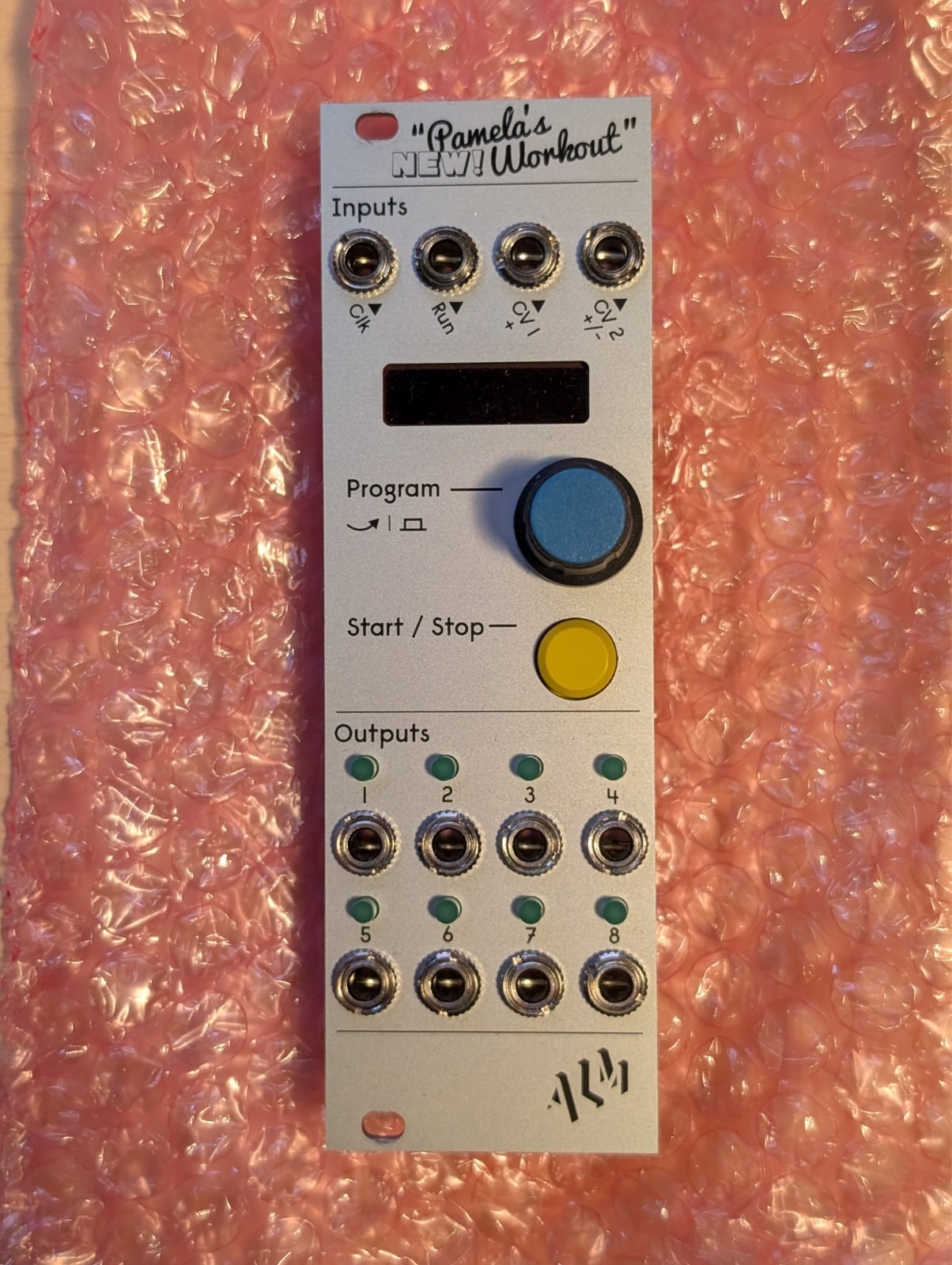
And it looked like a relic from a 1980s test bench. That chunky, amber “NOS” (new old stock) seven-segment LED display wasn’t chosen for nostalgia—it was part of the charm, a no-nonsense interface that forced you to think in steps, divisors, and multipliers. No menus, no submenus—just turn the knob, watch the numbers, and feel the groove tighten or loosen in real time. It was immediate. It was tactile. It didn’t coddle you, but it never lied either. You could dial in a 5:4 polyrhythm on output three while output seven fired off triplet delays with randomized skips, and the whole thing stayed rock-solid. No jitter, no drift—just precision with personality.
Pamela’s Workout wasn’t flashy, but it was transformative. It sat in your rack like a utility module, but it played like an instrument. Want a hi-hat pattern that stutters every third bar? Done. Need a snare that occasionally doubles with a delayed ghost note? Patch it. Want to sync an external drum machine, a vintage synth, and a delay pedal—all to a tempo that can be voltage-controlled or slaved to MIDI? Pamela handled it without breaking a sweat. It wasn’t just a clock; it was a conductor, a metronome with imagination, and for a lot of early Eurorack adopters, it was the first module they realized they couldn’t live without.
Specifications
| Manufacturer | ALM Busy Circuits |
| Production Years | 2012–2018 |
| Original Price | £180 GBP |
| Form Factor | Eurorack |
| HP Size | 8HP |
| Depth | 22mm |
| Power Supply | +12V 80mA / -12V 80mA |
| Outputs | 8 trigger outputs |
| Clock Range | 25–300 BPM |
| Clock Division/Multiplication | /512 to x48 |
| Trigger Pulse Width | Adjustable per output |
| Random Skip | Per output |
| Delay and Delay Division | For swing and shuffle |
| External Clock Sync | 24 to 1 PPQN |
| CV Control | Clock rate, start/stop, reset |
| Memory Banks | 5 non-volatile presets |
| Display | Four-digit vintage-style LED |
| Firmware Updates | Via audio interface (no special hardware) |
| Special Features | DIN Sync in/out (with adapter), skiff-friendly design |
| Country of Origin | England |
Key Features
The Eight-Armed Rhythm Machine
Eight outputs might sound like overkill for a clock module—until you patch one. Each output isn’t just a divided clock; it’s a fully independent rhythmic voice. You can set each to divide or multiply the master clock by any factor from /512 to x48, including non-integer ratios like triplets, evens, and odds. That means output one can pulse on every quarter note, output two on eighth-note triplets, output three on a 7:8 polyrhythm, and output four can fire only every other bar—while still staying perfectly in time. The ability to introduce random skips on a per-output basis turns rigid sequences into something alive, unpredictable, and deeply musical. It’s not just about precision; it’s about controlled chaos.
Vintage Display, Modern Brains
That amber LED display isn’t retro for show—it’s central to the workflow. Unlike later models with OLED screens and menus, Pamela’s Workout forces you to engage directly. No diving into layers; just turn the encoder, watch the digits change, and hear the rhythm shift. It’s a design philosophy rooted in immediacy. The display shows one parameter at a time—clock rate, divisor, pulse width—but because it’s always visible, you develop a feel for the numbers. You learn that 120 BPM with a /3 division on output five and a 30% delay on output two gives you that off-kilter funk backbeat you’ve been chasing. It’s not flashy, but it’s honest—and once you’re fluent, you can tweak an entire rhythmic arrangement in seconds.
Sync Everything, Control Anything
Pamela wasn’t built to live in isolation. It’s a hub. The module accepts external clock signals from 24 to 1 PPQN, making it compatible with everything from vintage Roland DIN sync to modern MIDI-to-CV interfaces. The clock rate can be voltage-controlled, so you can modulate tempo with an LFO or envelope for dramatic accelerandos or subtle warps. Start/stop and reset are also CV-controllable, allowing for complex performance gestures—like freezing a sequence during a breakdown and snapping it back into motion on the downbeat. And with a simple adapter, you can send and receive DIN Sync, letting Pamela talk to drum machines like the TR-808 or sequencers like the SH-101. It’s rare for a module to be both deeply integrated and universally compatible—but Pamela pulls it off.
Historical Context
When Pamela’s Workout debuted in 2012, Eurorack was still a niche within a niche. Most racks were cobbled together from DIY kits or boutique modules with limited interconnectivity. Clocking was often an afterthought—handled by basic dividers or the internal clocks of individual modules. What made Pamela revolutionary wasn’t just its feature set, but its philosophy: that timing shouldn’t be a utility, but a creative tool. At a time when modules like the Make Noise Maths were pushing the boundaries of modulation, Pamela showed that rhythm itself could be sculpted, layered, and modulated with the same depth.
It arrived alongside a wave of digital modules that proved microcontrollers could bring new levels of precision and programmability to analog systems without sacrificing musicality. Competitors existed—Intellijel’s Metropolis, for example, offered complex sequencing—but none focused so purely on the clock as an instrument. Pamela filled a gap so completely that it quickly became a standard. By the mid-2010s, it was common to see multiple Pamelas in a single rack, each handling different rhythmic domains. Its success paved the way for the “New Workout” and later the “Pro Workout,” but the original remained beloved for its simplicity and directness. It was a module that didn’t try to do everything—just one thing, and better than anyone expected.
Collectibility & Value
Pamela’s Workout has been discontinued since 2018, succeeded by the more advanced “New Workout” and then the “Pro Workout.” But in the used market, the original still commands respect—and a price to match. Expect to pay between £220 and £300 for a working unit, depending on condition and whether it includes the DIN Sync adapter. Units with firmware v108 (the final update) are preferred, as they include minor stability fixes and improved MIDI sync behavior. The module is solidly built, with through-hole components and a metal front panel, so physical wear is usually limited to scratched labels or loose jacks.
The most common failure point is the power connector, especially if the module has been frequently removed from a case. Some early units had slightly undersized PCBs that could cause wobbling in certain cases, but this rarely affects functionality. Because the firmware can be updated via audio (using a computer soundcard and a 3.5mm cable), there’s no risk of bricking—though few buyers will want the hassle of reflashing. Repairs are straightforward for technicians familiar with ALM’s designs, and replacement parts are still available through the manufacturer.
For collectors, the original Pamela’s Workout represents a turning point in Eurorack history—a moment when digital control modules proved they could be both musical and essential. It’s not the most powerful clock module ever made, but it’s the one that started the conversation. If you’re building a period-accurate 2012–2015 rack, or just want the module that defined a generation of rhythmic patching, the original Pamela remains a worthy investment. Just don’t expect it to do waveforms or Euclidean rhythms—that’s what the “New Workout” was for.
eBay Listings



As an eBay Partner, we earn from qualifying purchases. This helps support our independent vintage technology research.