ALM Busy Circuits Jumble Henge (2021–)
A patchbay that mixes, filters, and spatializes sound before you even turn a knob—like someone shrunk a mixing console down to 8HP and made it speak in riddles.
Overview
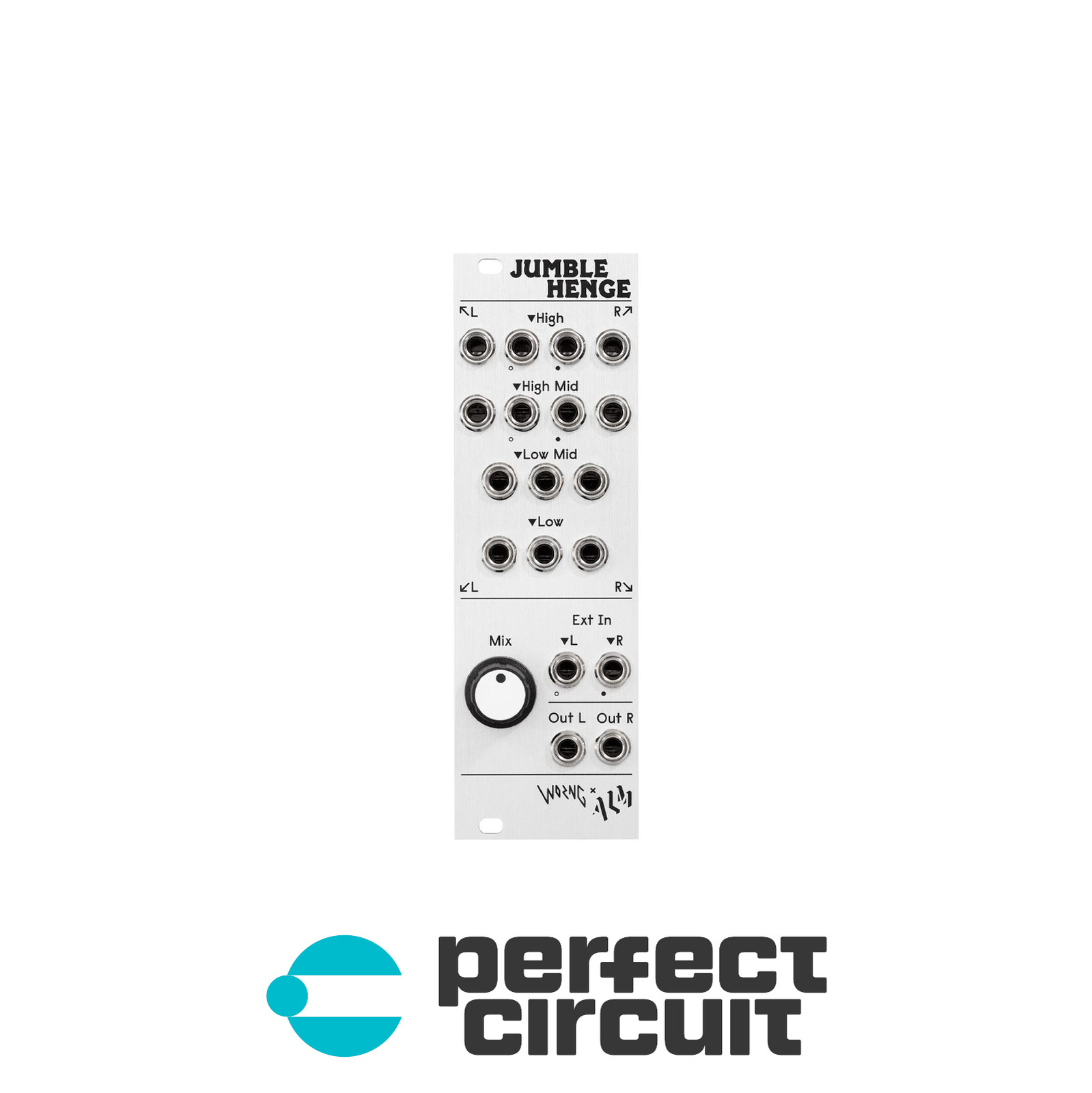
You don’t so much dial in a mix on the Jumble Henge as you discover it—by plugging things in and seeing what happens. There’s no level control per input, no pan knob, no EQ sweep. Instead, each of the 16 inputs has a fixed sonic identity: a specific analog filter curve and a precise pan position baked right into the circuit. Patch a signal into the top-right jack and it’s bright, resonant, and panned hard right. Plug into the bottom-left and you get a low-passed, center-heavy thump. It’s not a mixer in the traditional sense; it’s a spatial-spectral map, where placement equals processing. The whole thing feels like someone took the SP-1200’s famously characterful mixer section, folded it into a Eurorack module, and then let Worng Electronics sprinkle their stereo-imaging sorcery all over it.
This is a module built for immediacy. Turn the Mix knob up and the filters engage, each row responding with a different tonal flavor: the bottom row rolls off above 1.5kHz, giving you warm, rounded lows; the low-mid bandpass (50Hz–2kHz) adds body without muddiness; the high-mid bandpass (100Hz–7.5kHz) lets through just enough bite to cut through; and the top row applies a high-pass with a subtle resonant peak near 500Hz—oddly musical, not harsh. As you sweep the Mix knob past 12 o’clock, the output gains noticeable level, almost like a soft clip stage kicking in, which the manual acknowledges but doesn’t explain. It’s not a flaw, exactly—it’s just part of the module’s personality. At around 3 o’clock, the filtering is pronounced but not destructive; beyond that, things start to thin out, especially on transients like kick drums, so you learn to respect that sweet spot.
What makes the Jumble Henge more than a clever party trick is how it behaves when you stop treating it like a mixer and start treating it like an effect. Feedback routing is where it really sings: take the stereo output, run it back into two of the inputs via stack cables, and suddenly you’ve got a self-oscillating, stereo-widening feedback loop that can go from warm saturation to chaotic resonance depending on where you patch and how hard you drive the Mix knob. Pair it with a dual VCA and you can modulate which parts of the spectrum are fed back, creating evolving textures that feel alive. It’s the kind of module that rewards experimentation, not precision. You don’t fine-tune here—you explore.
And yet, for all its charm, it’s not without compromise. There are no CV inputs. No way to automate the Mix knob, no voltage control over levels, no modulation of pan or filter depth. The original Worng SoundStage had CV over mix depth; the Jumble Henge does not. ALM made the trade-off to save space—8HP instead of 14—and while that makes it skiff-friendly and easier to fit into compact systems, it also means you’re stuck turning knobs by hand if you want movement. Some owners work around this with external VCAs or manual manipulation, but it’s a limitation worth acknowledging. This isn’t a module for hands-off sequencing; it’s for hands-on performance, for tweaking in real time, for building mixes that feel tactile and immediate.
It pairs beautifully with ALM’s own Squid Salmple, whose eight individual outputs map neatly onto the Jumble Henge’s input grid, letting you mix and spatialize sampled drums or loops with zero latency and maximum character. But it’s not just a sample mixer. Use it to sum effect returns, blend multiple oscillators, or as a stereo imaging tool for mono sources—plug a single drone into different inputs and hear how each position reshapes its timbre and placement. It’s especially effective in live setups where you need quick, reliable stereo expansion without diving into menus or adjusting ten different faders.
Specifications
| Manufacturer | ALM Busy Circuits |
| Production Years | 2021– |
| Original Price | £250 GBP |
| Format | Eurorack |
| Width | 8HP |
| Depth | 38mm |
| Power | +12V 70mA |
| Power | -12V 70mA |
| Inputs | 16 total: 14 with fixed spectral/pan processing, 1 clean stereo input |
| Outputs | Stereo L/R mix output |
| Filter Types | Per-input analog resonant filters: low-pass, band-pass (low-mid), band-pass (high-mid), high-pass |
| Panning | Fixed per input, equal-power panning, wider at high frequencies |
| Control | Manual Mix knob (no CV control) |
| Normalization | Top two rows: center-right inputs normalized to center-left |
| Construction | COG/NPO capacitors, high-quality OPA audio op-amps |
| Protection | Reverse power protection |
| Country of Origin | England |
| Collaboration | Designed with Worng Electronics |
Key Features
A Fixed-Topology Mixing Matrix
The Jumble Henge doesn’t ask you to balance levels or tweak pans—it gives you a grid of sonic real estate, each plot with its own acoustic zoning laws. The 14 primary inputs are arranged in four rows, each with a distinct filter response and pan spread. The lowest row is tightly centered and low-passed, ideal for bass elements that need to stay mono-compatible. The top row opens up wide and bright, perfect for hi-hats or noise sources that should feel expansive. Because the panning is equal-power, switching between inputs doesn’t cause volume jumps, so you can repatch on the fly without blowing out your ears. This fixed architecture forces creativity: you can’t just turn everything up and hope it works. You have to think about where each sound lives in the stereo field and how its frequency content interacts with others. It’s mixing as composition.
The Mix Knob as a Spectral Sculptor
Turn the Mix knob all the way down and the Jumble Henge behaves like a clean, low-noise summing mixer—transparent, balanced, and quiet. As you rotate it clockwise, the filters progressively engage, coloring each input according to its row. The transition isn’t linear; there’s a noticeable lift in level around 12 o’clock, as if the circuit is gently compressing or soft-clipping. This isn’t documented, but it’s consistent across units, suggesting it’s an intentional part of the design. Dial it up further and the filtering intensifies, thinning out transients and emphasizing the resonant peaks. At maximum, it can sound almost lo-fi—useful for creating vintage-style mixes or deliberately degrading signals. The lack of CV control here is the module’s biggest omission, but also part of its charm: it keeps you present, engaged, hands-on.
Chaining and Feedback as Core Functionality
That clean stereo input above the main output isn’t just for adding an extra channel—it’s a gateway to complex signal routing. You can chain multiple Jumble Henges together, using one as a submixer feeding into another, building layered stereo images. More radically, you can patch the output back into the inputs, creating feedback loops that generate harmonics, resonance, and stereo chaos. Because each input applies a different filter and pan, feeding back into different jacks produces wildly different results. Patch the output into the high-mid inputs and you get singing, metallic overtones; route it into the lows and you get subby oscillation. With a dual VCA in the feedback path, you can dynamically control how much signal returns, letting you modulate the intensity without CV on the module itself. It’s a playground for experimental patching, and one of the few mixers that feels equally at home in noise, ambient, and rhythmic contexts.
Historical Context
The Jumble Henge didn’t appear out of nowhere—it’s a distillation of ideas that had been brewing in the modular community for years. Worng Electronics’ SoundStage, a 14HP stereo spectral mixer with 21 inputs and CV control over mix depth, was already a cult favorite among Eurorack users who wanted to build immersive stereo fields without leaving the box. But it was big, and in a format where every HP counts, size matters. ALM Busy Circuits, known for their no-nonsense, utility-driven designs like the Befaco Oscilloom and Pamela’s New Workout, saw an opportunity: take the SoundStage’s core concept, strip it down, and make it accessible to smaller systems. The result, released in 2021, was the Jumble Henge—a leaner, more focused version with 16 inputs, no CV, and a cleaner layout. It also paid homage to the Akai SP-1200’s mixer, whose fixed-filter, pan-per-channel approach influenced early hip-hop production. By combining that philosophy with modern analog filtering and stereo imaging, the Jumble Henge became something new: a mixer that doesn’t just combine signals, but transforms them based on where you plug them in.
It arrived at a time when Eurorack was shifting from pure sound generation toward complex signal routing and mixing. Modules like the Intellijel Mixer 4, Mutable Instruments Veils, and ALM’s own Tangle Quartet were redefining what a “mixer” could be. The Jumble Henge stood out by rejecting traditional controls entirely, offering instead a fixed, almost architectural approach to mixing. It wasn’t for everyone—especially those who wanted automation—but for a certain type of patcher, it was revelatory.
Collectibility & Value
The Jumble Henge has settled into a stable secondary market, typically selling between $300 and $380 depending on condition and region. Since it’s still in production and readily available from ALM and major retailers, it’s not a rare find—nor is it likely to become one. But its reputation has grown steadily, especially among live performers and sample-based patchers who appreciate its immediacy. Used units are common on Reverb and eBay, and failures are rare. The module uses robust components—audiophile-grade COG/NPO capacitors and high-quality op-amps—and has reverse power protection, so it’s unlikely to die from a bad cable or power surge. There are no known firmware issues (it’s analog) and no wear-prone parts like potentiometers that degrade over time—just one central knob that sees regular use.
That said, buyers should test the Mix knob for smoothness and check for any crackling, which could indicate contamination or wear. Also verify that the normalization between the top-row inputs works as expected: patching a signal into a center-left jack should route it to the corresponding center-right if the right side is unpatched. Since there’s no user-serviceable calibration, any channel imbalance or filtering inconsistency usually points to a fault in the op-amps or passive components—rare, but not impossible. Repair costs are low if caught early, but given the module’s compact layout, it’s best left to technicians familiar with ALM’s build style.
For those building a compact or travel-friendly system, the Jumble Henge is a strong contender. It’s not a full mixing solution on its own—you’ll still need VCAs or a level-controlled mixer to balance inputs before they hit the Jumble Henge—but as a final stage for color, width, and character, it’s unmatched in its form factor. Pair it with a set of manual VCAs like the Mutable Veils mkII or ALM’s MEGA-TANG, and you’ve got a hands-on mixing desk that fits in a 3U row.
eBay Listings
As an eBay Partner, we earn from qualifying purchases. This helps support our independent vintage technology research.