ALM Busy Circuits Dinky's Taiko ()
A 12 HP punch of digital grit and analog shaping that builds drums from the ground up — then lets you warp them into something else entirely.
Overview
If you’ve ever wanted to sculpt a kick drum that starts at 40Hz and dives into subterranean feedback, or a snare that morphs from glassy click to industrial scrape with every trigger, the ALM Busy Circuits Dinky's Taiko (ALM005) is your chisel. This isn’t a preset drum module that hands you a sound and says “here you go.” It’s a workshop in 12 HP — a digital-analog hybrid that gives you the raw materials and says “build.” And then, crucially, it hands you voltage control over nearly every step of the process. It’s been called a module that “offers the basics and allows the user to build a drum sound, but go far beyond what might be considered the standard,” and that’s not marketing fluff — it’s how the thing actually works.
Built by ALM Busy Circuits, a UK-based name that’s earned quiet reverence in the Eurorack world for no-nonsense, function-forward designs, the Dinky's Taiko is a discontinued digital drum voice that packs a surprising amount of flexibility into its silver-panelled frame. It’s not flashy, but it’s deep. The core idea? Two sound sources — a digital noise generator and a wavetable oscillator with 24 waveforms — feeding into an analog EQ output path. That last bit matters: the tone shaping happens in the analog domain, which gives the final sound a warmth and character that pure digital modules sometimes lack. You’re not just generating sound; you’re finishing it like film.
And while the name might sound like a boutique collaboration (and it kind of is — more on that in a second), this is a serious tool. It’s skiff-friendly at 32 mm deep, reverse polarity protected (a small mercy when you’re plugging and unplugging in low light), and designed and made in the UK. The fact that it’s discontinued only adds to its quiet mystique — this isn’t a module that was overproduced and dumped on the market. It had a run, people noticed it, and now it’s gone. What remains is a tightly focused digital drum voice that doesn’t pretend to be everything — just something very specific, and very well done.
Specifications
| Manufacturer | ALM Busy Circuits |
| Technology | 12 bit digital drum voice with full voltage control and an analogue EQ output path |
| Dimensions | 12 HP, 32 mm deep |
| Current Draw | +12V current: 80 mA. -12V current: 0 mA. 5V current: 0 mA. |
| Sound source components | digital noise source and wavetable oscillator (24 waveforms) |
| Inputs | trigger input as well as accent and choke trigger inputs |
| Other features | Reverse polarity protection. Skiff friendly. Designed and Made in the UK. |
| Model number | ALM005 |
| Finish | Silver |
| Made in | United Kingdom |
Key Features
Three-part sound engine: noise, wavetable, mix
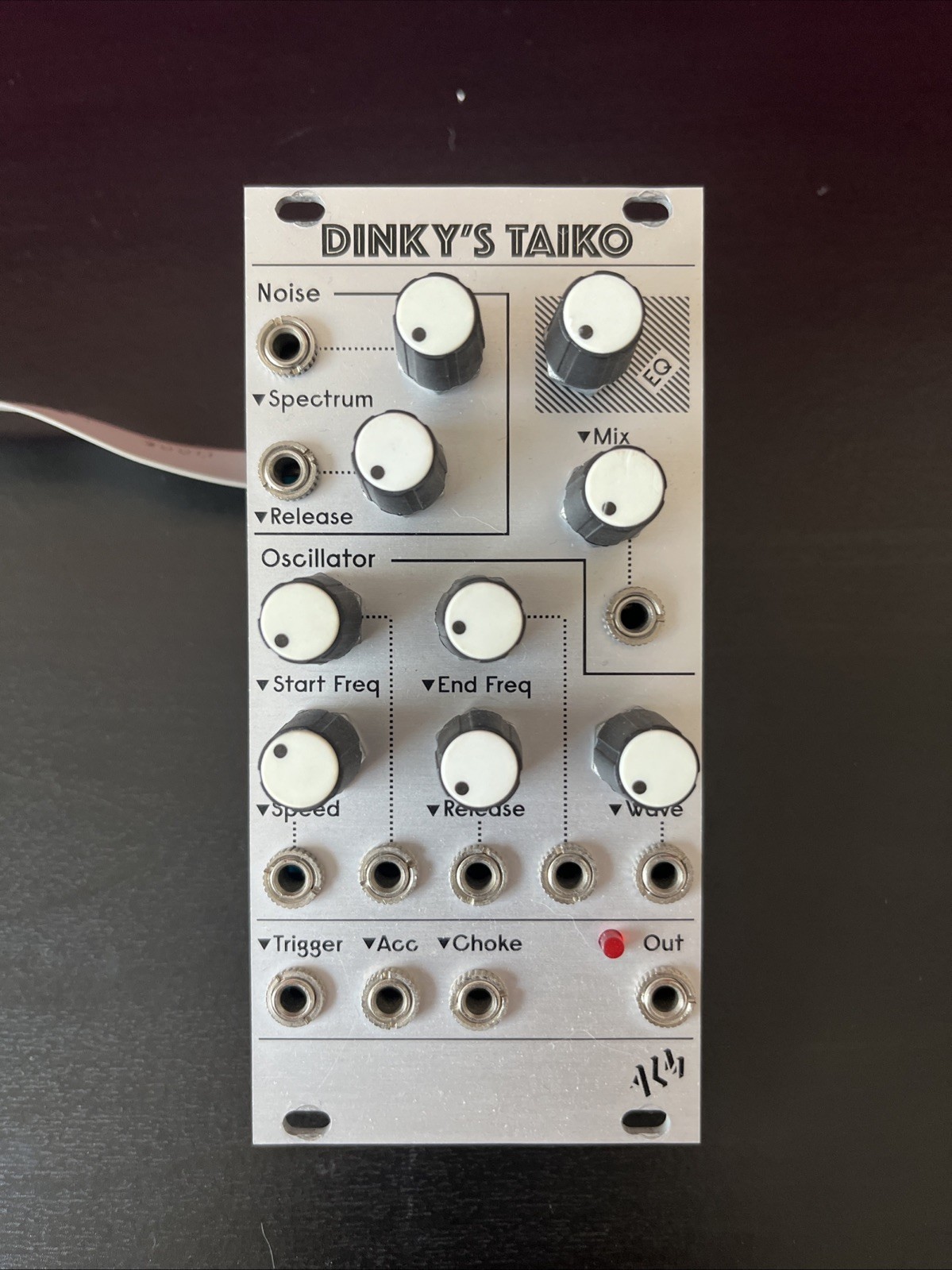
The Dinky's Taiko breaks down its voice into three clear stages — a design philosophy that makes it easy to understand, but hard to master fully. First, the digital noise source: not just white noise, but a frequency-controllable one, meaning you can dial in rumbles, hisses, or clicks, and shape their decay with a release time parameter. This isn’t background texture — it’s a foundational element, ready to be tamed or unleashed.
Second, the wavetable oscillator. With 24 waveforms on board, it’s not the most expansive library you’ll find, but it’s enough to generate everything from sine-like thumps to jagged digital stabs. The real magic lies in the start and end frequency parameters: when triggered, the oscillator begins at one pitch and sweeps to another, creating that classic drum “snap” or “thud” — but with voltage control, you can modulate that sweep in real time, making every hit subtly (or wildly) different. Pair that with a variable rate and release time, and you’ve got a dynamic core that responds to modulation like a synth voice, not a drum machine.
Finally, the mix and tone control. This is where the digital sources meet the analog world: a simple but effective mix knob balances noise and oscillator, while the tone control — the only parameter not voltage controllable — shapes the final output through an analog EQ path. That subtle warmth, that slight rounding of edges, is what keeps the Dinky's Taiko from sounding clinical. It’s digital at the source, but analog at the finish — a hybrid approach that feels deliberate, not compromised.
Full voltage control (almost)
What separates the Dinky's Taiko from simpler drum modules is its level of control. Every parameter — frequency, release time, start and end frequencies, rate, mix — is both manually adjustable and voltage controllable. That means you can sequence the evolution of a kick drum over eight bars, or modulate the noise color of a snare with an LFO, or have one drum’s accent trigger dynamically alter another’s sweep rate via choke. The accent and choke trigger inputs aren’t just for dynamics; they’re part of a larger ecosystem of interplay.
The only exception? The tone control. It’s a fixed analog knob, not CV-addressable. That might seem like a limitation, but in practice, it forces a kind of finality — you set the overall color once, then let the rest breathe. It’s a small trade-off, and one that likely helped keep the module’s depth and power draw in check.
Built for the rack, not the shelf
This is a utilitarian module. Silver finish, clean layout, no blinking lights or flashy graphics. It’s 12 HP wide and 32 mm deep — compact enough to fit in a skiff or travel case, and with reverse polarity protection, it won’t fry if you plug it in wrong. That’s not just convenient; it’s a sign of thoughtful engineering. It’s designed and made in the UK, which for many Eurorack users means tighter build quality and better support, though the fact sheet doesn’t confirm any specific location beyond that.
It draws 80 mA on the +12V rail and nothing on -12V or 5V — a modest load by modern digital standards. That efficiency makes it a good candidate for smaller cases or power-limited systems. And while it’s discontinued, its footprint and power use mean it’s still a practical addition if you can find one.
Collectibility & Value
The Dinky's Taiko is out of stock and officially discontinued — a status that’s already shaping its secondhand market. There’s no original launch price confirmed in the fact sheet (only a current AUD $389.00 price from a retailer, GST inclusive), so we can’t say how much it’s appreciated or depreciated. But the used market tells a story of steady demand.
Listings from 2024 to early 2026 show a wide but telling range: £135.00 in the UK, €145–€188 (plus VAT), and USD prices from $175 to $288. One Reverb listing even hit $287.91 — not cheap for a discontinued digital drum module, but not outrageous either. The spread suggests condition and region play a big role. A unit listed on Ctrl-mod was described as “fully tested, perfect working condition” with “minimal rack rash” — the kind of detail that justifies a higher price.
There’s no data on common failures or maintenance needs, which could be good (nothing to report) or a gap (too early to tell). But given ALM’s reputation for robust design and reverse polarity protection, catastrophic failure seems unlikely. The real risk is simply scarcity: no new units are coming, and as Eurorack users keep building acoustic-emulating patches, modules like this — focused, flexible, and hybrid in design — only grow in appeal.
eBay Listings
As an eBay Partner, we earn from qualifying purchases. This helps support our independent vintage technology research.