ALM Busy Circuits CIZZLE (2023–)
That moment when a Casio CZ-101 wakes up in a Eurorack case, stretches, and starts making Detroit techno.
Overview
You know that sound—glassy, brassy, slightly clinical, but somehow warm in its own digital way? The kind of tone that cuts through a mix like a laser scalpel but still manages to feel alive? That’s the Casio CZ family’s legacy, and for years, replicating it in Eurorack meant compromises: approximations, emulations, or full-on FPGA rebuilds that never quite nailed the quirks. Then the CIZZLE showed up, and suddenly, that late-’80s phase distortion magic wasn’t just available—it was expanded, deepened, and given a new lease on life. This isn’t a nostalgic reissue; it’s a full-blooded reinterpretation, built with the precision of modern firmware but soaked in the character of a synth line that was too often dismissed in its day. And yes, it absolutely nails the squelch.
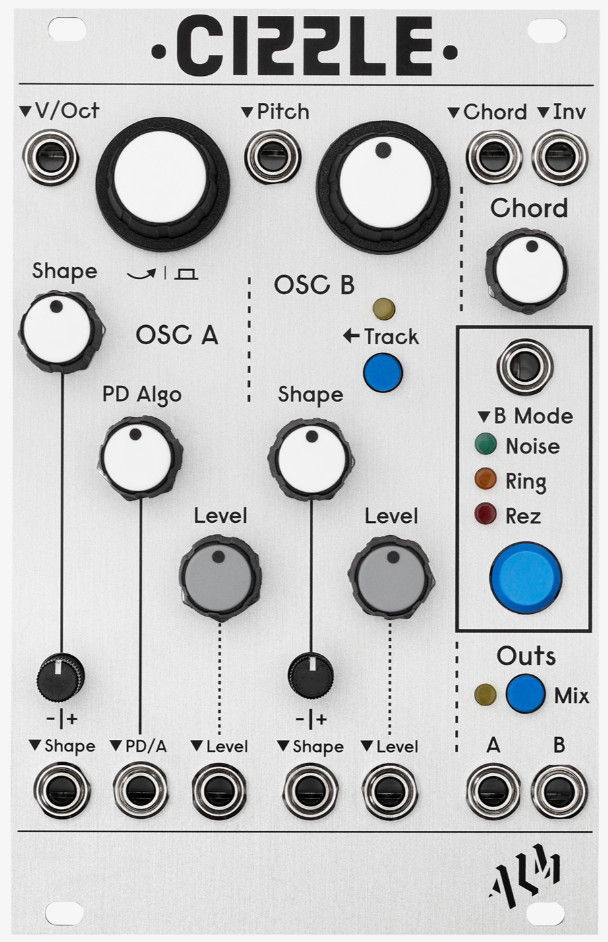
The CIZZLE doesn’t just mimic the CZ’s phase distortion synthesis—it weaponizes it. Two oscillators, A and B, work in tandem, with Osc A handling the core PD engine and Osc B stepping in as a resonance emulator, ring modulator, or noise source, just like the original CZs. But here, everything is voltage-controlled, tunable via encoder with surgical accuracy, and layered with features that push it far beyond vintage replication. You can morph through nine different phase distortion algorithms in real time, sweep the shape parameter with CV, stack up to eight-voice chords with inversion, and route Osc B to track Osc A or run independently. The result is a module that can go from shimmering ambient pads to Reese-laden bass growls to metallic percussion with a few twists and patches. It’s not just faithful—it’s *better*.
And yet, it doesn’t pretend to be analog. The CIZZLE owns its digital soul. There’s no smoothing over the edges, no added warmth or noise to “vintagify” the sound. What you get is clean, precise, and sometimes a little cold—until you dial in the faux resonance wave from Osc B, and then it *snarls*. That’s the trick: the resonance isn’t a filter sweep. It’s a waveform, generated digitally, that mimics the CZ’s famous “squelch” by modulating the phase distortion in real time. It’s a clever hack, and it works brilliantly. The module’s architecture lets you blend or separate the outputs, even applying a stereo widening effect to the mixed output, making it a centerpiece for lush, evolving textures. It’s rare for a digital oscillator to feel this expressive, but the CIZZLE pulls it off by giving you direct, immediate control over every parameter that matters.
Specifications
| Manufacturer | ALM Busy Circuits |
| Model | CIZZLE (ALM042) |
| Production Years | 2023– |
| Original Price | £290 GBP |
| Format | Eurorack |
| Width | 16HP |
| Depth | 32mm |
| Power Supply | +12V 65mA / -12V 25mA |
| Oscillators | Dual digital phase distortion VCOs (Osc A and Osc B) |
| Phase Distortion Algorithms | 9 morphable algorithms (Osc A) |
| Waveforms (Osc A) | Morphing PD waves via algorithm and shape control |
| Waveforms (Osc B) | Resonance (Rez), Ring Modulation, Noise |
| Tracking | Osc B can track Osc A with offset |
| Chord Mode | Voltage-controlled, up to 8 voices with inversion |
| Outputs | Separate Osc A and Osc B outputs, mixed output with stereo widening |
| VCAs | Dedicated output level VCAs per oscillator |
| CV Control | Algorithm, shape, chord, inversion, mode switching, level |
| Trigger Control | Mode switching via trigger input |
| Tuning | Encoder-based, accurate tuning with calibration routine |
| Firmware Updates | Yes, via USB (firmware v103 as of 2026) |
| VCV Rack Module | Available, fully featured emulation |
| Warranty | 2 years |
| Country of Origin | England |
Key Features
The PD Engine That Actually Feels Analog
Phase distortion synthesis has always lived in the shadow of FM, unfairly dismissed as “cheap Casio magic.” But the CIZZLE proves how expressive it can be when given the right interface. Osc A’s nine algorithms aren’t just static waveforms—they’re dynamic, morphable structures that respond to both manual and CV control over the “shape” parameter. This is where the magic happens: turning a sine wave into a pulse, a saw, or something in between by distorting its phase over time. The encoder makes it easy to dial in exact settings, and the CV input lets you sweep through the transformation in real time, creating evolving timbres that feel organic despite their digital origin. It’s not just about recreating CZ presets—it’s about exploring new sonic territory within a forgotten synthesis method.
Osc B: More Than Just a Sidekick
On the original CZ synths, the second oscillator was often an afterthought—used for noise or ring modulation, but rarely as a true voice. The CIZZLE reimagines Osc B as a full partner. It can generate the CZ’s unique resonance waveform (a digital approximation of filter resonance, but with its own character), act as a ring modulator, or inject noise—all switchable via CV or trigger. Even better, it can track Osc A, letting you create layered, detuned textures that thicken the sound without eating up extra HP. When you engage the resonance mode and modulate it, you get that signature CZ “squelch,” the kind of aggressive, almost filter-like sweep that made those synths so effective in techno and electro. It’s not a filter—it’s a waveform trick, but it works so well that it doesn’t matter.
Chord Mode Done Right
One of the CZ’s most underappreciated features was its built-in chord memory, and the CIZZLE brings it into the modular world with flair. The voltage-controlled chord mode lets you stack up to eight voices, with inversion and full CV control over chord selection. It’s not just a novelty—it’s a compositional tool. Patch in a sequencer, modulate the chord input with an LFO, and you’ve got evolving harmonic textures that would take multiple oscillators and mixers to replicate otherwise. Firmware updates have expanded the chord set (adding diminished, minor 9, and major 9) and smoothed out the response, making chord changes instantaneous. It’s rare for a module to offer this level of harmonic complexity in such a compact form, and it elevates the CIZZLE from “cool oscillator” to “main synth voice.”
Historical Context
The Casio CZ series arrived in 1984, just as analog synths were being priced out of the market by digital giants like Yamaha and Korg. Casio’s answer was phase distortion—a synthesis method that offered complex, evolving sounds without the cost or instability of analog oscillators. The CZ-101, CZ-1000, and later CZ-3000 series were affordable, portable, and packed with presets that leaned into the digital aesthetic: glassy pads, metallic basses, and percussive stabs. But they were also misunderstood. Critics dismissed them as “toy synths,” and their lack of a proper filter didn’t help. Yet, in the hands of artists in Detroit, Chicago, and later in UK rave and electro scenes, the CZ found its voice—especially the basses and chords that cut through dense mixes with surgical precision.
ALM, known for its love of obscure digital architectures (see: Akemie’s Castle with real YM21280 chips), saw the untapped potential. The CIZZLE isn’t just a tribute—it’s a correction. It takes the CZ’s DNA and rewrites it for the Eurorack era, where voltage control and patchability unlock what the original hardware couldn’t. Released in 2023, it arrived at a time when modular users were hungry for fresh digital voices beyond the usual FM and wavetable suspects. Competitors like Noise Engineering’s Loquelic Iteritas or Xaoc’s Belgrad offer digital character, but none replicate the CZ’s specific flavor. The CIZZLE fills that gap with authority, proving that a 40-year-old synthesis method can still feel radical when done right.
Collectibility & Value
The CIZZLE is too new to be “vintage” in the traditional sense, but it’s already established itself as a modern classic among Eurorack enthusiasts who value unique digital textures. New units sell for around £290 GBP directly from ALM, with US dealers marking them up slightly to $375. Used prices hover between $250–$300, depending on condition and whether the seller includes extras like the firmware cable. It’s not a flipping target—there’s no artificial scarcity—but it’s also not a module that loses value quickly. Demand remains steady, especially among fans of Detroit techno, electro, and anyone chasing that elusive CZ sound without hunting down a 40-year-old keyboard.
Reliability is solid. Being digital, it doesn’t suffer from analog drift or capacitor aging, but firmware updates are essential. Early units had bugs—like Osc B CV wrapping in track mode or sluggish chord changes—but firmware v102 and v103 fixed most issues. Owners report that calibration is straightforward but necessary, especially after firmware updates. The module includes a calibration routine for both oscillators, and skipping it can lead to tuning inaccuracies. There are no known catastrophic failure points; the biggest risk is physical—damaging the encoder or output jacks during case installation. It’s skiff-friendly at 32mm depth and reverse power protected, so power issues are unlikely.
For buyers, the main advice is to check the firmware version. Anything below v102 should be updated immediately. Also, verify that the encoder clicks cleanly and that all modes (Rez, Ring, Noise) switch correctly when triggered. The module doesn’t degrade over time, but firmware is part of its DNA—buying used means you might inherit someone else’s outdated setup. That said, ALM’s support is excellent, with clear manuals and firmware tools available for free. This isn’t a module that will break your rack or your budget—it’s a reliable, forward-thinking addition that pays off in sonic versatility.
eBay Listings

As an eBay Partner, we earn from qualifying purchases. This helps support our independent vintage technology research.