ALM Busy Circuits Axon-1 (2020–Present)
A tiny 4HP expander that unlocks serious modulation freedom for Squid Salmple, MFX, and Pamela’s Pro Workout—don’t let the size fool you.
Overview
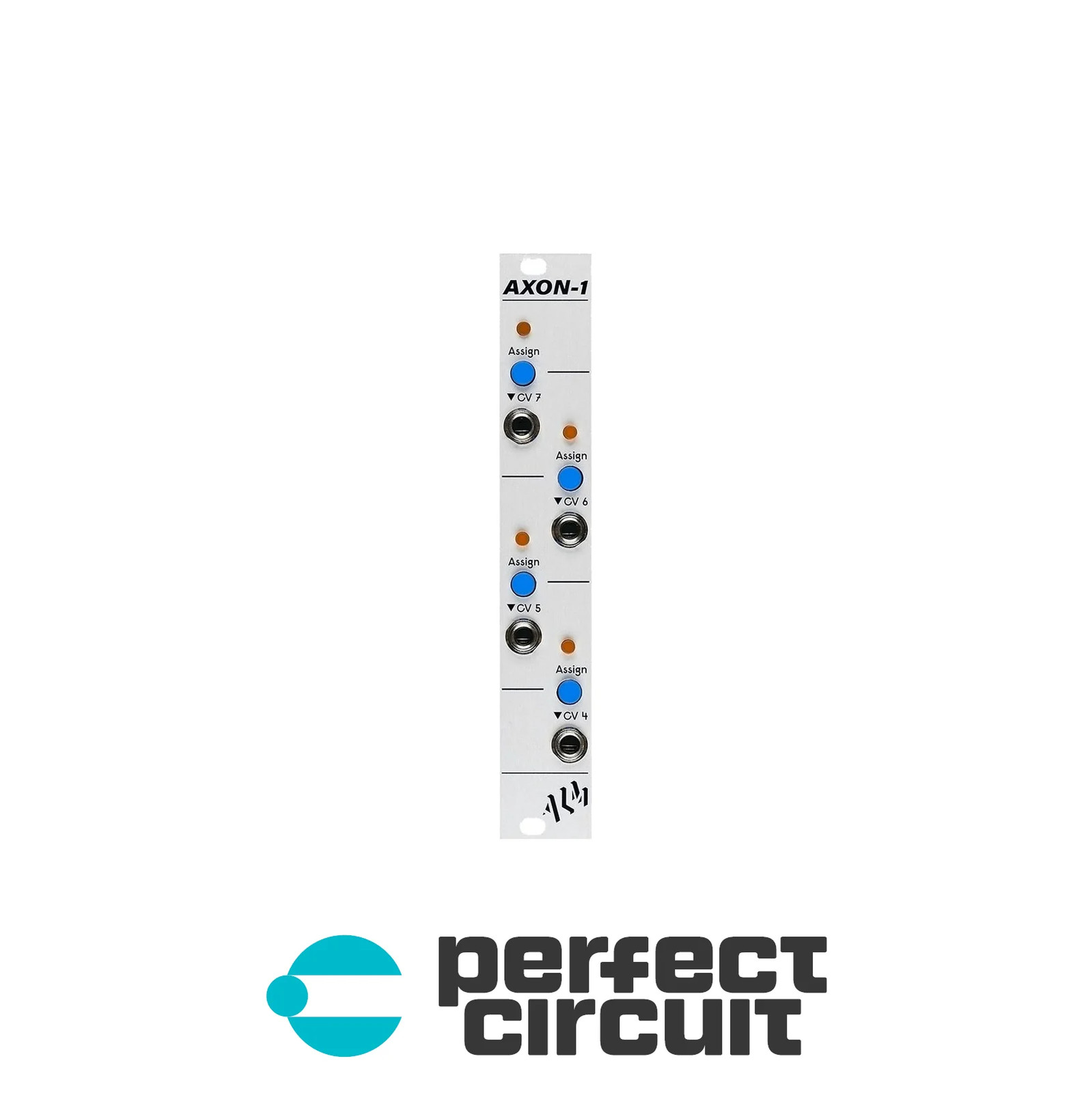
You know that moment when you’ve got your Squid Salmple cooking—gritty sample stutters, pitch-warping glitches, rhythmic chaos—and then you realize you’re out of CV inputs? That’s where the Axon-1 slides in, quiet and unassuming, like a stagehand who suddenly starts conducting the orchestra. It doesn’t make sound. It doesn’t process audio. But it hands you four additional freely assignable CV inputs, each with digital attenuation and offset, and suddenly your module has room to breathe. This isn’t just an add-on; it’s a liberation pass for anyone pushing ALM’s more complex modules to their limits.
The Axon-1 was designed specifically to expand three of ALM’s flagship units: the Squid Salmple sampler, the MFX multi-effects processor, and Pamela’s Pro Workout clock manager. All of these are dense, performance-oriented modules that thrive on modulation—but their front panels only offer so many jacks. The Axon-1 plugs into the rear expansion port (via a supplied ribbon cable), adding a quartet of CV inputs that integrate seamlessly into the host module’s modulation matrix. Each input behaves just like the built-in ones: you can assign it to any parameter, tweak its response with digital scaling, and offset its range. That means no compromise in control—just more ways to twist, morph, and automate your sound.
And while 4HP doesn’t sound like much, in the Eurorack world, that’s the difference between a cluttered, cable-choked build and a clean, expandable system. The Axon-1 doesn’t demand attention. It doesn’t have flashy lights or a touchscreen. It’s a utility player, but one with outsized influence. If your Squid Salmple feels like a race car with only three gears, the Axon-1 is the overdrive you didn’t know you needed.
Specifications
| Manufacturer | ALM Busy Circuits |
| Production Years | 2020–Present |
| Module Size | 4HP |
| Depth | 35mm |
| Current Draw +12V | 20mA |
| Current Draw -12V | 20mA |
| Expansion Target | Squid Salmple, MFX, Pamela’s Pro Workout |
| CV Inputs | 4 |
| CV Assignment | Fully assignable per host module |
| Attenuation | Digital per input |
| Offset | Digital per input |
| Connection Type | Ribbon cable to rear expansion port |
| Weight | 80g |
| Front Panel Material | Aluminum |
| Mounting Type | Standard Eurorack |
| Power Connector | 2x5 pin power header |
Key Features
Seamless Modulation Expansion
The Axon-1 doesn’t reinvent the wheel—it extends it. Each of its four CV inputs integrates directly into the modulation architecture of its host module, meaning you don’t lose any functionality or precision. On the Squid Salmple, for instance, you can now assign external LFOs, sequencers, or envelope followers to parameters like sample start point, playback speed, or filter cutoff without hijacking your primary CV jacks. The digital attenuation and offset per input mean you can fine-tune how much a CV affects a parameter, avoiding the all-or-nothing response that plagues some analog mixers or passive attenuators. This level of control is especially valuable when automating complex sample manipulations or syncing effects to tempo-based sources.
Compact Design, Zero Compromise
At just 4HP, the Axon-1 is a masterclass in efficient design. It doesn’t include a display, buttons, or menu system—everything is handled by the host module. This keeps the footprint minimal and the cost reasonable. The aluminum front panel matches ALM’s other modules, and the jacks are spaced for easy patching, even in tight systems. The ribbon cable connection to the host is robust and shielded, minimizing noise and ensuring reliable communication. It’s not a standalone unit, but it doesn’t need to be. It’s a precision tool, not a Swiss Army knife.
Multi-Module Compatibility
While often marketed alongside the Squid Salmple, the Axon-1’s compatibility with both the MFX and Pamela’s Pro Workout makes it a more versatile investment. On the MFX, it opens up deep real-time control over effects parameters—imagine modulating reverb decay with a random stepped CV or sweeping a bitcrusher’s resolution via an external sequencer. With Pamela’s Pro Workout, the extra CV inputs allow for dynamic tempo changes, swing modulation, or clock division shifts driven by external sources. This cross-functionality means the Axon-1 isn’t just a one-trick expansion—it scales with your system’s complexity.
Historical Context
ALM Busy Circuits has built a reputation on creating modules that feel both modern and deeply rooted in performance. Unlike many Eurorack manufacturers who focus on analog warmth or classic synthesis techniques, ALM leans into digital precision, real-time control, and experimental workflows. The Squid Salmple, released in 2018, was a standout for its hands-on sample manipulation and glitch-friendly interface. But as users began building complex patches, the limitation of only four CV inputs became apparent. The Axon-1, released in 2020, was a direct response to that feedback—a no-nonsense solution for modular performers who needed more modulation pathways without adding another full module.
At the time, the Eurorack market was seeing a rise in expanders and satellite modules, particularly from brands like Intellijel and Make Noise. But most were focused on adding voices or sequencing layers. The Axon-1 carved a niche by addressing a subtler but equally critical need: modulation density. In an ecosystem where every HP counts, ALM opted for surgical precision over grand gestures. It wasn’t trying to be the center of attention—just the quiet enabler behind the scenes.
Collectibility & Value
The Axon-1 isn’t a collector’s item in the traditional sense. It’s a relatively recent module (2020–present), still in production, and not prone to the kind of mythologizing that surrounds rare analog classics. But within the ALM ecosystem, it’s considered essential gear for serious users of the Squid Salmple, MFX, or Pamela’s Pro Workout. New units typically sell for around $140 USD directly from ALM or authorized dealers. Used prices hover between $100–$120, depending on condition and included ribbon cable.
There are no known failure points specific to the Axon-1. It has no moving parts, no displays to burn out, and minimal circuitry—just a microcontroller, four input jacks, and the power/CV routing logic. Service technicians note that the most common issue is physical damage to the ribbon cable or misalignment during installation, but these are user-serviceable. Because it draws power from the host module’s expansion bus, it’s critical to ensure the host has sufficient headroom—especially when daisy-chaining multiple expanders.
For buyers, the real consideration isn’t reliability—it’s necessity. If you’re using a Squid Salmple casually, you might never need the Axon-1. But if you’re building live sets, doing complex sample mangling, or integrating with external sequencers, skipping the Axon-1 means hitting a hard ceiling on expressiveness. It’s not flashy, but it’s one of those modules that, once you have it, you wonder how you lived without it.
eBay Listings

As an eBay Partner, we earn from qualifying purchases. This helps support our independent vintage technology research.