ALM Busy Circuits (2013–)
The modular underdog that grew up: playful, powerful, and built for patching without pretense.
Overview
It starts with a clock—just a simple pulse, really—but plug it into a Pamela’s New Workout and suddenly your whole system breathes in time. That was the spark: a DIY solution to sync nightmares that turned into one of Eurorack’s most enduring success stories. ALM Busy Circuits didn’t set out to conquer modular; they just wanted to make tools that worked, sounded great, and didn’t take themselves too seriously. Over a decade later, their modules are in studios from Berlin to Brooklyn, not because they’re flashy, but because they *do* things—complex modulation, digital mayhem, utility with attitude—all wrapped in that signature matte grey panel with a pop of color.
Matthew Allum, the mind behind ALM, began in 2013 with a humble batch of 50 Pamela’s Workouts, built around an Arduino and sold at a Brighton modular meetup. The fact that they sold out in a week wasn’t just luck—it was proof that people were hungry for smart, flexible clocking and modulation that didn’t cost a fortune or eat half your rack. From there, the company grew organically, expanding into full systems like the System Coupe and reimagining vintage digital synths with modules like Akemie’s Castle and the MCO (mk II). What ties it all together is a design philosophy that values usability, expandability, and a kind of joyful utility—tools that invite experimentation without locking you into rigid workflows.
You won’t find sterile minimalism here. ALM modules are dense with jacks, buttons, and sliders, often packed into surprisingly small footprints. The Quaid GigaSlope, for example, is a 16HP powerhouse that functions as a four-channel multi-mode modulator, each channel capable of morphing between complex envelopes, LFOs, or step sequences with up to 13 stages. It’s not just a modulation source—it’s a compositional engine. And then there’s the MCO (mk II), a 6HP digital VCO inspired by 90s and early 2000s digital synths, packing 12 waveshapes you can morph between, complete with PWM, sub-oscillator, and extensive parameter control. It sounds nothing like a boutique analog oscillator—and that’s the point. It’s bright, gritty, and unapologetically digital, perfect for metallic leads, FM-style textures, and rhythmic noise.
But for all their digital prowess, ALM hasn’t abandoned analog. The Mega Milton is a perfect example: a 24HP all-analog utility module that bundles a line-level converter, summing mixer, slew limiter, sample & hold with noise generator, and a buffered mult with polarity-indicating LEDs. It’s the kind of module you didn’t know you needed until you have it, solving real-world patching problems with elegance and a touch of humor. The fact that it can also be used to saturate signals, parallel-process audio, or create generative sequences speaks to ALM’s deeper ethos: tools should be *used*, not just admired.
Specifications
| Manufacturer | ALM Busy Circuits |
| Production Years | 2013–present |
| Origin | United Kingdom |
| Founder | Matthew Allum |
| First Module | Pamela’s Workout |
| Notable Modules | Pamela’s Pro Workout, Quaid GigaSlope, MCO (mk II), Squid Salmple, Akemie’s Castle, Mega Milton |
| Module Sizes | 6HP to 24HP typical |
| Power Supply | Eurorack ±12V |
| Depth | Varies by module (e.g., Cizzle: 32mm) |
| Current Draw +12V | Varies (e.g., Cizzle: 65mA) |
| Current Draw -12V | Varies (e.g., Cizzle: 25mA) |
| Control Interface | Rotary encoders, sliders, push buttons, USB-C (firmware updates) |
| MIDI Integration | mmMidi and mmT modules for MIDI-to-CV conversion |
| Firmware Updates | USB-C drag-and-drop (Pamela’s Pro Workout, Squid Salmple, etc.) |
| System Offering | System Coupe (84HP skiff with 11 modules) |
| Case Line | Custom Eurorack cases (grey finish, pink/blue knobs) |
| Software Support | Web-based patching tools, demo content, firmware updates |
| Distribution | Global via dealers like Perfect Circuit, Reverb, Nightlife Electronics |
Key Features
The Pamela’s Workout Legacy
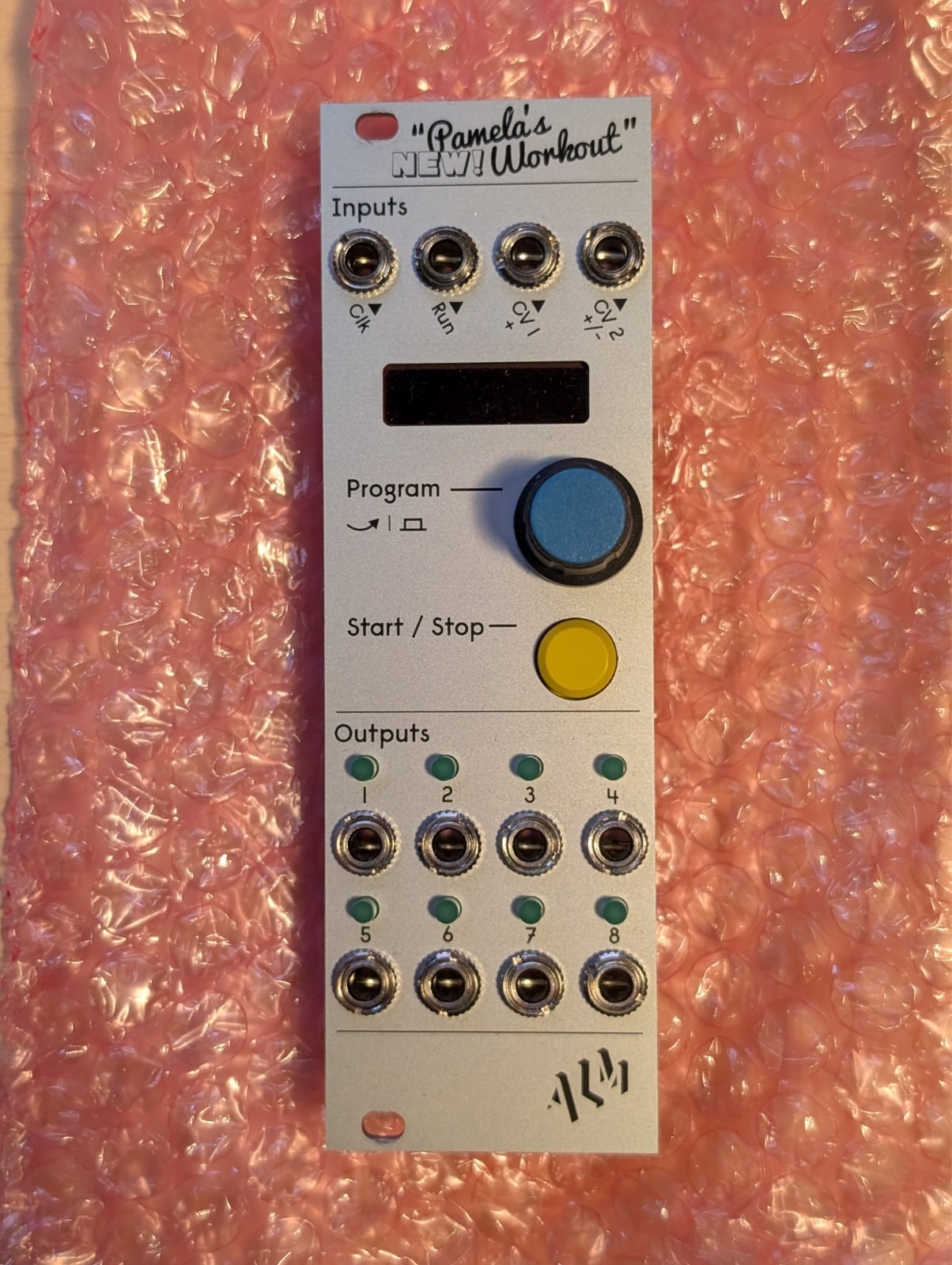
Pamela’s Workout isn’t just a module—it’s a cultural artifact. The original was a no-frills clock divider/multiplier with CV-controllable timing, built to sync gear across different clock domains. The New Workout added modulation routing, making it a full-featured CV powerhouse. Then came the Pro Workout: a complete overhaul with USB-C firmware updates, cross-output modulation, “off-grid” timing for humanized rhythms, and a vastly improved UI. It’s rare for a module to get three generations, but Pamela’s evolution reflects ALM’s commitment to long-term support. Owners report firmware updates adding features years after purchase, something almost unheard of in hardware. If you’re building a Eurorack system, having a Pro Workout is like having a conductor—everything locks in, but with room for expressive drift.
Digital Soul in a 6HP Space
The MCO (mk II) defies the expectation that small modules must be simple. For just 6HP, it delivers a full-featured digital oscillator with 12 waveshapes ranging from sine and square to noise and complex digital tones. The morphing capability between waveforms is smooth and musical, and the inclusion of a PWM output and 1-octave sub oscillator means you can build rich, layered sounds without patching in additional VCOs. It’s not trying to emulate analog warmth—it leans into its digital nature, with a crisp, sometimes harsh character that cuts through dense mixes. Paired with the MCF filter (a smooth, resonant multimode filter available in the System Coupe), it becomes a surprisingly capable lead or bass voice. And because it’s digital, it’s rock-solid in tuning, even in temperature-variable environments.
Utility as Inspiration
ALM’s utility modules don’t just sit in the background—they spark ideas. The Mega Milton, for instance, is a patchbay philosopher: it makes you rethink signal flow. The line-level converter can boost external audio to modular levels, but it also adds pleasant analog saturation when driven hard. The summing mixer’s fourth channel has its own attenuator and output, allowing for parallel processing tricks usually reserved for larger mixers. The slew limiter can smooth out sequencer steps for gliding basslines, while the sample & hold with built-in noise generator provides instant random voltages. And the buffered mult? It’s not just a passive splitter—its polarity-sensing LEDs give you visual feedback on CV movement, turning abstract voltage changes into something you can *see*. It’s this attention to detail that makes ALM modules feel alive, even when they’re doing “boring” jobs.
Historical Context
When ALM launched in 2013, Eurorack was still a niche within a niche. Doepfer had laid the foundation, but the ecosystem was fragmented, and many modules were either prohibitively expensive or overly academic in design. ALM arrived with a different ethos: practical, approachable, and deeply functional. Pamela’s Workout solved a real problem—syncing gear from different eras and manufacturers—using affordable, open-source hardware. That DIY spirit carried forward, even as the company grew. While other brands chased analog purity or esoteric algorithms, ALM embraced digital, open firmware, and modular as a *toolkit*, not a religion.
They also helped bridge the gap between modular and mainstream production. The System Coupe, released in 2021, was a bold move: a complete, self-contained Eurorack system in a compact 84HP skiff. Unlike many “starter systems” that feel limited, the Coupe packed serious firepower—Pamela’s New Workout, Squid Salmple, Quaid Megaslope, MCO, MCF—making it viable for both beginners and seasoned users. It wasn’t just a product; it was a statement that modular could be accessible without being dumbed down. At a time when many were questioning Eurorack’s sustainability, ALM proved there was still room for innovation and growth.
Collectibility & Value
ALM modules are not vintage in the traditional sense—most are still in production—but their collectibility lies in their impact and longevity. Early runs of Pamela’s Workout (original or New Workout) are sought after, though not at stratospheric prices. The Pro Workout, released in 2023, has become a de facto standard for clocking and modulation, and used units trade close to new ($300–$350 depending on condition). The System Coupe, priced at £1899 at launch, holds its value well, especially with the included custom case and curated module selection. Used systems typically sell for £1400–£1700, reflecting strong demand.
Failures are rare, but not nonexistent. The most common issue reported is with the USB-C port on newer modules like the Pro Workout—some units have had loose connections after repeated plugging. Firmware updates are generally smooth, but users are advised to follow ALM’s instructions carefully to avoid bricking. Power draw is modest across the range, with most modules staying under 100mA on +12V, making them rack-friendly. The biggest “failure” isn’t technical—it’s cognitive. ALM modules are dense. The Quaid GigaSlope, for example, has a steep learning curve. New users often underutilize them, treating them as simple envelope generators when they’re capable of generative sequencing, complex modulation, and even audio-rate processing.
Buying advice: Always check for firmware updates before purchasing used. ALM provides clear instructions and update files on their website. Avoid units with bent jacks or cracked PCBs—while rare, these can happen in heavily used systems. For the System Coupe, verify that all modules are original and not swapped out. And if you’re buying a Pro Workout, test the USB-C port with a cable to ensure it’s secure.
eBay Listings


As an eBay Partner, we earn from qualifying purchases. This helps support our independent vintage technology research.