ALM Busy Circuits AXON-1 ()
Four extra CV inputs with digital control—tiny footprint, big flexibility for those already deep in the ALM ecosystem
Overview
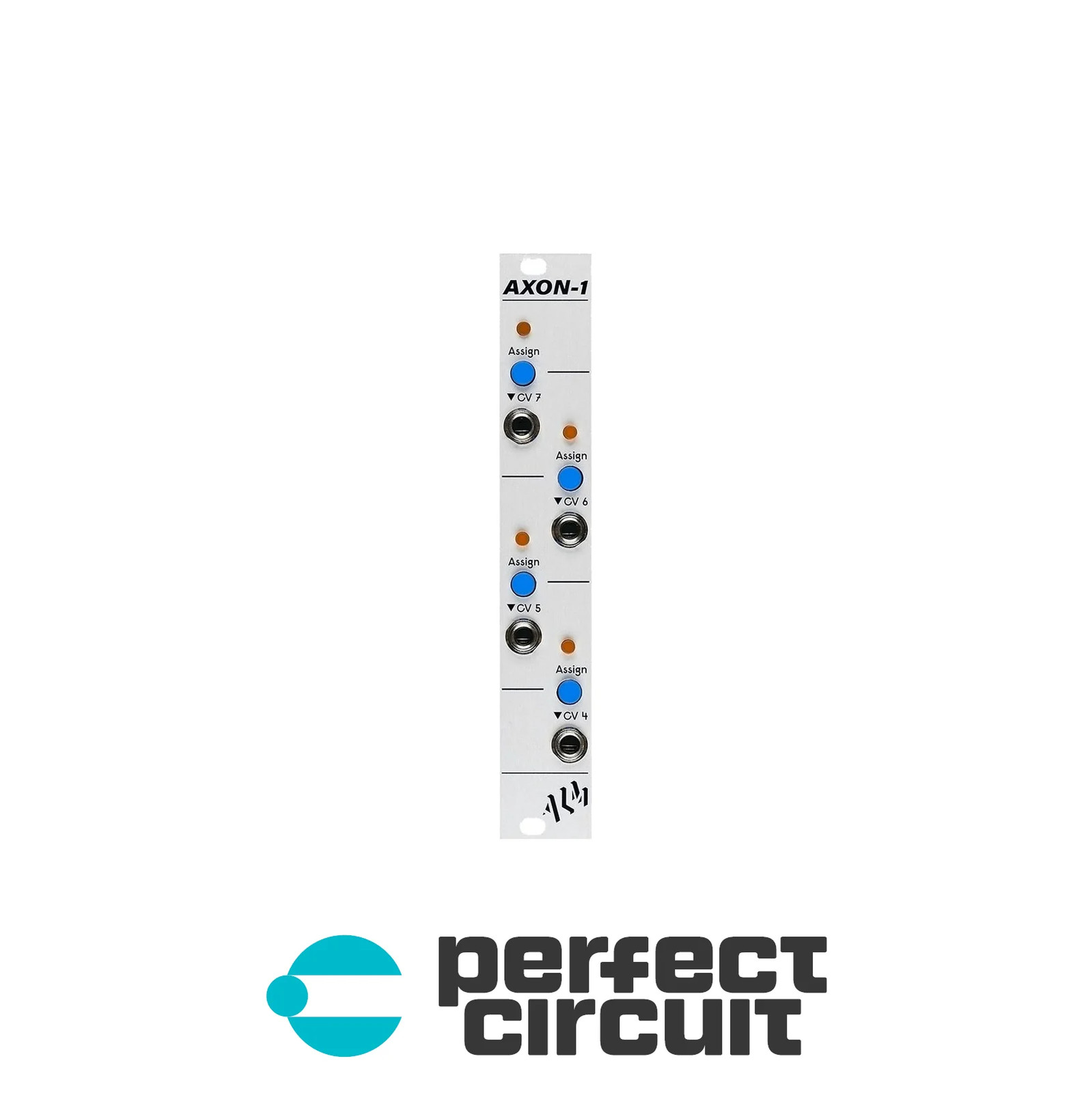
The ALM Busy Circuits AXON-1 isn’t a standalone hero—it’s the quiet utility player that shows up when your SQUID SALMPLE, MFX, or Pamela’s PRO Workout starts feeling a little short on modulation real estate. At just 4 HP wide, it’s barely there, but what it brings—four additional freely assignable CV inputs—can be the difference between a static sequence and something that breathes, evolves, and surprises. This isn’t a module for the casual browser; it’s for the tinkerer who’s already committed to ALM’s philosophy of deep, firmware-driven control and modular expansion. You don’t buy the AXON-1 because you want more knobs—you buy it because you’ve run out of ways to modulate what you’ve already got.
It slots directly into compatible modules, drawing all its power from the host—no extra cable, no fuss. That makes it skiff-friendly and clean on the bus board, which matters when you’re stacking modules like pancakes. But there’s a catch: if you’re pairing it with the Squid Salmple, you’ll need firmware 166 or later. No exceptions. That’s not a suggestion buried in a changelog—it’s a hard requirement. So while the AXON-1 itself doesn’t demand much, it assumes you’re already maintaining your gear, staying on top of updates, and treating your modular setup like a software-hardware hybrid, not just a box of analog circuits.
ALM Busy Circuits, based in England, built this as part of a tightly integrated ecosystem. The AXON-1 doesn’t shout for attention; it whispers efficiency. Each of its four CV inputs behaves just like the ones built into the host module, complete with digital attenuation and offset—meaning you can scale and shift incoming control voltages with precision, not just guesswork. And because everything is digitally managed, your assignments and settings stay put, saved with your banks. No losing your carefully tweaked modulation routing when you power down. That’s the kind of thing that sounds minor until you’ve lost a patch an hour into tweaking and cursed the gods of analog.
Specifications
| Manufacturer | ALM Busy Circuits |
| Model Number | ALM022-EXP1 |
| Dimensions | 4 HP, 38 mm deep |
| Current Draw | 40 mA +12V, 0 mA -12V, 0 mA 5V |
| Price | $140 |
Key Features
Four assignable CV inputs, no compromises
The AXON-1 gives you four extra CV inputs that aren’t afterthoughts—they’re full citizens in the modulation chain. Each one can be assigned to any parameter that accepts CV on the host module, whether that’s pitch, gate timing, probability, or something more obscure. And because they’re digitally controlled, you’re not stuck with fixed scaling. Digital attenuation means you can dial in exactly how much modulation is applied—say, 50% of an LFO to filter cutoff—without touching a physical knob. Offset lets you shift the baseline, so a bipolar LFO can be biased into unipolar territory, or a random voltage can be nudged into a specific range. This is precision modulation, not brute force.
Seamless integration, zero extra power
One of the quiet wins of the AXON-1 is how it connects. It doesn’t need a separate power header. It draws everything it needs directly from the module it’s expanding. That means one less cable to manage, one less point of failure, and one less thing to misalign on your power rail. In a skiff or a densely packed case, that’s not just convenient—it’s essential. The 38 mm depth is modest but not ultra-shallow, so it won’t fit in the most cramped builds, but it’s far from a power hog at 40 mA on the +12V rail and nothing on the others. For a digital expander, that’s lean.
Firmware-dependent, but worth the update
If you’re running a Squid Salmple, the AXON-1 won’t work unless you’re on firmware 166 or later. That’s not a soft recommendation—it’s a gate. No firmware update, no functionality. Some users might bristle at that, especially if they’re used to plug-and-play analog modules. But this is ALM’s world: firmware is part of the spec. The upside? Once you’re updated, the AXON-1’s settings save with your banks. Your modulation routings, attenuations, offsets—they’re all recalled when you load a patch. That’s a huge win for live use or complex setups where consistency matters. It’s not just an expander; it’s a memory extension.
Collectibility & Value
The AXON-1 doesn’t trade like a grail module, but it’s not disposable either. Current market listings show prices ranging from $126.40 to $178.83, with most hovering between $137 and $153. The official price sits at $140, so it’s not being marked up aggressively, nor is it being dumped. That suggests steady, low-volume demand—exactly what you’d expect for a niche expander. It’s not a standalone purchase; it’s an add-on for people who already own compatible modules. There’s no data on common failures, repair issues, or long-term reliability, but given its passive role and lack of moving parts or high-stress components, it’s likely to be trouble-free. No weight or original release year has been confirmed, and there’s no collector-driven premium—at least not yet.
eBay Listings

As an eBay Partner, we earn from qualifying purchases. This helps support our independent vintage technology research.