ALM/Busy Circuits MFX (2023–)
A 6HP Eurorack time machine that resurrects the ghosts of digital effects past—with all their charm, grit, and gain-staging headaches.
Overview
Plug in the MFX for the first time and you might think something’s wrong—the output’s quiet, the reverbs clip at half-gain, and there’s a faint digital hiss even when it’s sitting idle. Don’t panic. You’ve just met ALM’s idea of authenticity: a stereo multi-effects processor that doesn’t try to be transparent or pristine, but instead leans hard into the character of early digital hardware, from the metallic shimmer of 1970s rack delays to the lush, slightly unstable choruses of 1980s studio processors. It’s not a clean effects box. It’s a personality module—one that demands attention, careful patching, and a willingness to wrestle with its quirks. But when you get it right, the payoff is huge: a dense, textured, and often unpredictable sonic palette that feels more like a living synth voice than a utility insert.
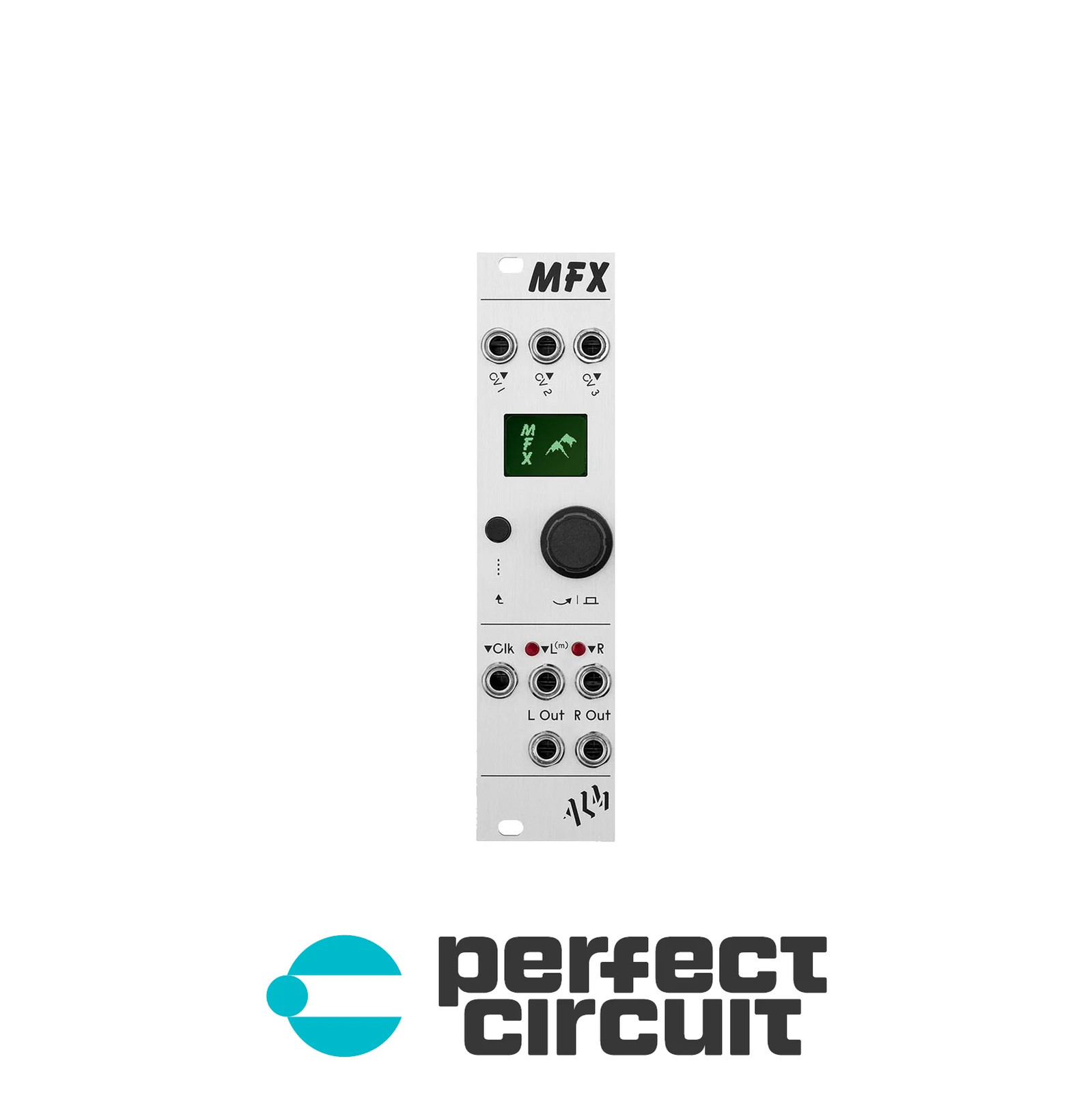
The MFX packs 16 distinct effects programs into a mere 6HP, making it one of the most densely packed digital modules in Eurorack. These aren’t lightweight emulations—they’re full-featured algorithms with deep parameter control, user presets, and real-time CV manipulation. You’ll find everything from faithful recreations of vintage hardware (like the Ursa Minor Space Station and early Lexicon-style reverbs) to original ALM-designed engines like the Crumbular Echo and 2051 Bit Corrupter, which turn audio into glitchy, fragmented artifacts. The interface centers on a small OLED display and a single rotary encoder, which might sound limiting, but in practice it’s surprisingly intuitive. Navigating presets, tweaking parameters, and assigning CV controls feels streamlined, almost retro-computer in its efficiency. It’s not flashy, but it’s functional—and it saves space.
Where the MFX really diverges from the crowd is in its sonic signature. ALM has never been about clinical accuracy. Their modules often carry a distinct “digital yesteryear” flavor—slightly aliased, harmonically rich, and full of subtle instability. The MFX doubles down on that. Its reverbs aren’t the vast, smooth clouds of modern plugins; they’re gritty, sometimes noisy, and full of character. The delays have pitch wobble, the distortions bite with digital fizz, and the ensemble effects shimmer with a slightly detuned, chorus-like haze. This isn’t a flaw—it’s the point. If you’re looking for pristine, modern effects, look elsewhere. But if you want something that sounds like it was pulled from a 1985 synth rack that’s been sitting in a damp basement for 30 years, the MFX delivers.
Still, it’s not without trade-offs. The most consistent complaint across user reports is the MFX’s low headroom. Eurorack signals typically swing around ±10V, but the MFX clips easily, often requiring input attenuation and output gain staging. Some users report having to knock signals down by 40% just to avoid distortion. This isn’t a module you can patch directly from a VCO or filter and expect clean results. It needs care—attenuators on the way in, a preamp or VCA on the way out. Later firmware updates have improved some of the clipping behavior, especially in reverb algorithms, but the fundamental gain structure remains a limitation. It’s not broken, but it’s not beginner-friendly.
And then there’s the noise floor. Even unpatched, some units exhibit a low-level digital hiss, particularly in newer production runs. While ALM has addressed some of these issues in firmware (Version 115 fixed noise on bypassed reverbs), the hardware itself seems to vary. Early adopters report quieter units, while more recent ones sometimes show higher noise—possibly due to component changes. It’s not deal-breaking, but it’s noticeable in quiet passages or when using the MFX as a subtle texture. Pair it with a noise gate or use it in more aggressive contexts, and it fades into the background. Use it on delicate pads or clean vocals, and you’ll hear it.
Despite these quirks, the MFX has carved out a loyal following. It’s not just an effects module—it’s a compositional tool. The Crumbular Echo, for instance, doesn’t just delay sound; it fractures it into granular shards that can be modulated into rhythmic chaos. The 2051 Bit Corrupter turns audio into glitchy artifacts that feel more like a sequencer than an effect. The TY-50 Dynamics engine combines compression and transient shaping in ways that can completely reshape a drum sequence. And the utility functions—oscilloscope, spectrum analyzer, VCO tuner—add practical value beyond pure sound design. It’s rare for a 6HP module to feel this expansive, but the MFX pulls it off.
Specifications
| Manufacturer | ALM/Busy Circuits |
| Model | MFX |
| Production Years | 2023– |
| Original Price | €298 |
| Format | Eurorack |
| HP | 6 |
| Depth | 32mm |
| Power Consumption | +12V @ 50mA, –12V @ 15mA |
| Audio I/O | Stereo Input, Stereo Output |
| CV Inputs | 3 assignable CV inputs (expandable to 7 with Axon-1 or Axon-2) |
| Clock/Trigger Input | 1 clock/trigger input |
| Digital Audio Processing | 16-bit, 44.1kHz stereo |
| Processor | ARM CPU-based DSP |
| Display | OLED |
| Connectivity | USB-C for firmware updates |
| Effects Programs | 16 (including reverb, delay, dynamics, distortion, modulation, glitch, and utilities) |
| Preset Storage | Factory and user presets per effect; global user presets (post v1.08) |
| Firmware Updates | Drag-and-drop via USB-C |
| Expandability | Supports Axon-1 and Axon-2 CV expanders |
| Weight | Approx. 200g |
| Country of Origin | England |
Key Features
A Living Museum of Digital Effects
The MFX doesn’t just offer effects—it curates them. Each of its 16 programs pays homage to a different era or archetype of digital processing. The Digi-PCM Echo draws from prime-time rack delays of the late 1970s and early 1980s, complete with pitch instability and subtle timing wobble. The Pocket PL8 Reverb emulates the dense, metallic character of early digital reverbs, the kind that made gated drums sound like they were recorded in a tin can. The Almicon and Quaidra reverbs channel 1980s and 1990s studio units, with bright, spacious tails that feel synthetic rather than natural. And the Yetti Reverb pushes further into the uncanny with FDN (Feedback Delay Network) architecture and a built-in pitch shifter for surreal, evolving textures.
But the MFX isn’t just about nostalgia. Its original algorithms—like the Crumbular Echo and 2051 Bit Corrupter—feel like extensions of that same digital philosophy, just pushed into more experimental territory. The Crumbular Echo doesn’t just repeat sound—it breaks it into tiny, modulatable grains that can be smeared, reversed, or frozen into rhythmic patterns. The 2051 Bit Corrupter turns audio into glitchy, bit-crushed artifacts that respond dynamically to clock input, making it as much a sequencer as an effect. These aren’t gimmicks; they’re deeply integrated into the module’s workflow, with parameters that can be assigned to CV and modulated in real time.
Deep CV and Firmware Flexibility
One of the MFX’s quiet strengths is its expandability. While it ships with three assignable CV inputs and a clock input, it supports the Axon-1 and Axon-2 expanders, which can bring the total CV control up to seven. This turns the MFX from a self-contained effects unit into a deeply integrated part of a modular system. Want to modulate reverb decay with an LFO? Assign it. Want to clock the Crumbular Echo to your sequencer? Done. Want to use an expression pedal to sweep through distortion intensity? The MFX supports that too—especially in its standalone pedal version, which adds MIDI, tap tempo, and expression control.
Firmware updates have also played a major role in the module’s evolution. Since launch, ALM has released numerous updates that add features, fix bugs, and improve performance. Version 1.08 introduced the Slinky spring reverb and global user presets. Version 1.11 overhauled the Crumbular engine with new parameters like ‘recycle’ and ‘shape’. Version 1.15 added stereo expansion to the TY-50 Dynamics engine. This level of ongoing support is rare in Eurorack and speaks to ALM’s commitment to the platform. It also means that buying an MFX isn’t just purchasing hardware—it’s joining a living project that evolves over time.
Utility Beyond Effects
Buried in the MFX’s menu system are a set of utility functions that feel almost like an afterthought—but they’re surprisingly useful. The module includes a simple oscilloscope, a clock utility, a spectral analyzer, and a VCO tuner. These aren’t high-resolution diagnostic tools, but they’re perfectly serviceable for quick checks in a modular environment. The oscilloscope lets you visualize incoming signals, the spectral analyzer gives a rough frequency readout, and the VCO tuner can help you dial in oscillators to concert pitch. In a format where dedicated utility modules take up precious space, having these tools baked into an effects processor is a smart design choice. It turns the MFX into more than just a color box—it’s a troubleshooting assistant, a tuning aid, and a signal inspector, all in 6HP.
Historical Context
The MFX arrived in 2023 at a time when Eurorack was saturated with effects modules—everything from compact delays to full-featured reverbs. What set the MFX apart wasn’t just its density or feature set, but its philosophy. While many manufacturers chased transparency, fidelity, and modern sound quality, ALM went the opposite direction. They embraced the limitations and artifacts of early digital processing—the aliasing, the noise, the instability—and turned them into virtues. This aligns with ALM’s broader design ethos, seen in modules like the Akemie’s Castle (which uses actual vintage Yamaha FM chips) and the BIA (a digital oscillator with deliberately lo-fi character).
The MFX also reflects a growing interest in “character” effects within modular synthesis. As Eurorack matured, users began seeking more than just clean processing—they wanted color, grit, and unpredictability. Modules like the Rossum Morpheus, the SynthTech 520, and the Noise Engineering Loquelic Iteritas began to blur the line between effects and synthesis. The MFX fits squarely in that lineage, treating effects not as static processors but as dynamic, modulatable sound sources. It’s less a reverb unit and more a sound design engine.
Competitors at the time included the Erica FX-MU, the Intellijel Rainmaker, and the Mutable Instruments Clouds (and its many clones). The FX-MU offered a more polished, modern sound. The Rainmaker focused on granular and spectral effects with a more intuitive interface. Clouds was a pioneer in granular processing but was discontinued in 2020. The MFX didn’t try to beat them at their own game—it carved out its own niche: a compact, firmware-upgradable, character-rich multi-effects unit that felt like a lost piece of 1980s studio gear reborn in Eurorack form.
Collectibility & Value
As of 2026, the MFX remains in production and readily available from dealers like SchneidersLaden and Perfect Circuit at its original price of €298. Used units appear on Reverb and eBay, typically selling for €200–€250 depending on condition and firmware version. Units with newer firmware (v1.15 or later) and no reported noise issues command a slight premium. Early revision units (marked MFX-REV007 on the PCB) are sometimes sought after for their reportedly lower noise floor, though this is anecdotal and not consistently verified.
The most common failure points aren’t mechanical—they’re sonic. The primary issue is digital noise and clipping, especially in reverb algorithms. This isn’t a hardware defect per se, but a combination of low input headroom and varying component tolerances across production runs. Users report that newer units sometimes exhibit more noise than early ones, possibly due to changes in analog circuitry. Firmware updates have mitigated some of this, but the core gain structure remains a limitation. Buyers should test the module with their own signal chain, ideally using attenuators on input and a gain stage on output.
Another consideration is firmware. The MFX relies heavily on updates for new features and bug fixes. A unit that hasn’t been updated may lack key functionality like global presets or improved reverb engines. Fortunately, firmware updates are drag-and-drop via USB-C, so restoring a unit is straightforward. However, buyers should confirm that the module boots properly and accepts firmware updates before purchasing.
For those considering the MFX, the real cost isn’t just the module—it’s the supporting gear. To use it effectively, you’ll likely need attenuators, VCAs, or a dedicated preamp module like the Erica Pico Input or ADDAC Vintage Pre. This adds to the overall footprint and cost, making the MFX less of a “plug-and-play” solution and more of a system-level investment.
Despite its quirks, the MFX has strong long-term collectibility. ALM’s reputation for thoughtful design and ongoing support suggests the module will remain relevant for years. Its unique sonic character, firmware expandability, and deep integration with the Eurorack ecosystem make it more than a passing trend. It’s not for everyone—but for those who value character over cleanliness, it’s already a modern classic.
eBay Listings
As an eBay Partner, we earn from qualifying purchases. This helps support our independent vintage technology research.