ADDAC307 Heart Sensing ()
It doesn’t just respond to your touch — it pulses with your heartbeat, turning biology into beats.
Overview
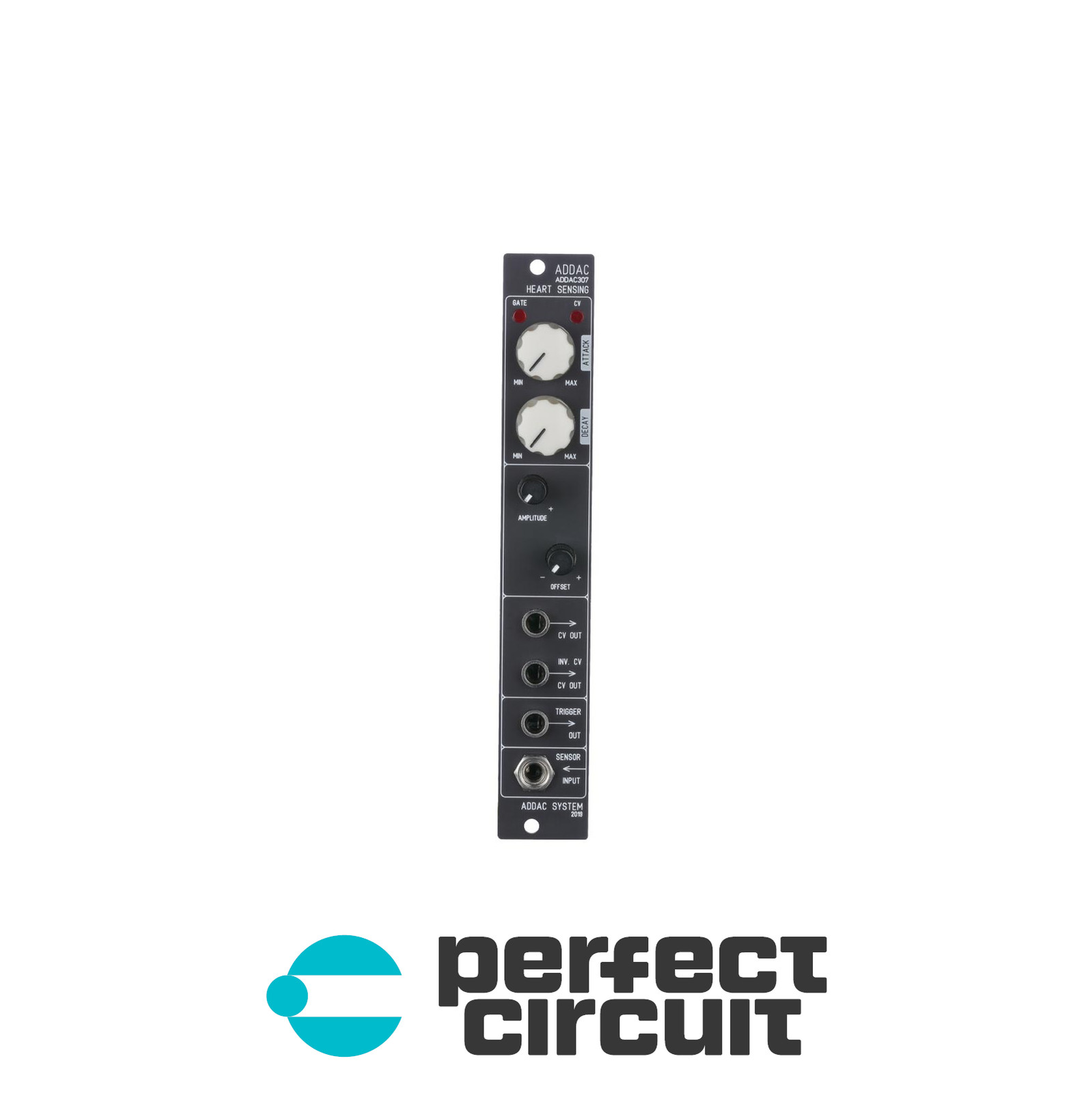
The ADDAC307 Heart Sensing module isn’t just another trigger source — it’s a biometric bridge between your body and your synth. Built as a Eurorack DIY kit by Lisbon-based ADDAC System, this compact 4 HP module uses a clip-on pulse sensor to transform your actual heartbeat into control voltage signals. You plug in the included earlobe or finger sensor, and suddenly your pulse becomes a rhythmic trigger, an Attack/Decay envelope, even a lopsided square wave LFO that breathes with you. It’s not just modulation — it’s literal life signs feeding your patch.
This is the second module in ADDAC’s Expressive Controls Series designed to turn physical biology into expressive control, following the ADDAC303 Muscle Sensing module. Where most synths respond to fingers on keys or knobs, the 307 flips the script: you become the sequencer. Your resting heart rate might clock in around 60 BPM, but climb a flight of stairs, get startled, or just get excited, and the module reflects it in real time — no programming needed. It’s equal parts novelty, performance tool, and biofeedback experiment, but in the right patch, it’s also deeply musical. One user demonstrated it with a Temps Utile module, multiplying or dividing their heartbeat to create evolving polyrhythms — a literal pulse-driven clock source.
And yes, it’s a DIY kit, so you’ll need to solder it yourself unless you buy it pre-built from a third party. But the build is straightforward, and the included sensor means you’re not hunting down obscure medical hardware. The module’s entire premise hinges on that little clip — technically a pulse-ox or pulse oximeter sensor — which detects blood flow changes with each heartbeat. That signal gets cleaned and converted on the module’s board into two outputs: a +5V trigger and a +10V envelope, each with dedicated LED indicators so you can see your heart flashing in time. Whether you're using it to gate a drum, modulate a filter, or warp a delay, the result feels less programmed and more alive.
Specifications
| Manufacturer | ADDAC System |
| HP Size | 4 HP |
| Depth | 35mm |
| Max current / Power consumption | 60mA +12V, 10mA -12V |
| Outputs | 0 +5v Trigger output; 0 +10v Envelope output |
| Envelope controls | Attack, Decay, Amplitude and Offset controls |
| Monitoring / Indicators | Two leds monitor the Trigger and Envelope Outputs |
| Includes | The clip-on sensor is provided as part of the DIY kit |
Key Features
Biological Signal Conversion
The core magic of the ADDAC307 lies in its ability to take a biological input — your heartbeat — and convert it into stable, usable control voltages. The clip-on sensor, attached to a finger or earlobe, detects blood flow changes with each pulse. That raw signal is processed by the module to generate both a clean +5V trigger and a variable +10V envelope. The result is a rhythm source that’s inherently organic, slightly irregular, and deeply personal. It’s not metronomic — it’s human.
Integrated Sensor and Power
The module includes the necessary pulse-ox (pulse oximeter) sensor, which connects via a dedicated input jack. Notably, the sensor is powered directly from the module — there’s a voltage output on the sensor input line, typically 5V, so no external power supply is needed for the sensor itself. This simplifies setup and ensures compatibility with standard pulse sensors used in medical or DIY bio-monitoring contexts.
Envelope Shaping and Modulation
Beyond just triggering events, the ADDAC307 gives you full control over the envelope derived from your pulse. With dedicated Attack, Decay, Amplitude, and Offset knobs, you can shape how the heartbeat translates into voltage. Want a sharp, snappy gate? Crank the Attack. Prefer a slow, swelling rise that mimics adrenaline? Dial in some lag. The Offset control lets you shift the baseline of the envelope, making it easier to interface with other modules that expect a specific voltage range. It’s not just a one-trick bio-gimmick — it’s a flexible modulation source.
Visual Feedback and Patch Integration
Two LEDs provide real-time visual feedback: one for the trigger output, one for the envelope. Watching them pulse in sync with your heartbeat is strangely mesmerizing — and useful during live performance when you need to confirm the signal is active. The module outputs standard Eurorack voltage levels, so it integrates seamlessly into any system. Whether you're using it as a clock divider, a dynamic filter modulator, or a generative sequencer trigger, the 307 speaks the same language as the rest of your rack.
DIY Ethos and Expandability
Sold as a DIY kit, the ADDAC307 invites hands-on engagement from the start. Building it yourself reinforces the connection between body and circuit — you’re not just using the module, you’re constructing a part of it. And because it’s open to experimentation, users have speculated about alternative uses: could a contact mic feed the input? Could a square LFO trick it into acting as a triggered envelope generator? The module doesn’t officially support those, but the input is receptive to voltage changes, leaving room for creative hacking.
Historical Context
The ADDAC307 Heart Sensing module originated from a simple but powerful idea: using one’s heartbeat as a control source. It’s part of the ADDAC300 Expressive Controls Series, which explores alternative, physical ways to interact with modular systems. It follows the ADDAC303 Muscle Sensing module, making it the second in a line of body-responsive controllers from ADDAC System. Based in Lisbon, Portugal, ADDAC has carved a niche in experimental Eurorack design, favoring tactile, performative interfaces over traditional knobs and sliders. The 307 continues that philosophy by turning the user’s own physiology into an expressive instrument.
eBay Listings
As an eBay Partner, we earn from qualifying purchases. This helps support our independent vintage technology research.