ADDAC306 VC Transitions (Introduced [VERIFY: year not confirmed])
Five little sliders, one big idea: a hands-on way to morph entire patches in real time, all from a single 8 HP module built for performance.
Overview
If your modular setup feels like a collection of moving parts that don’t quite move together, the ADDAC306 VC Transitions might be the glue you didn’t know you needed. It’s not a sequencer, not an envelope, not a mixer—instead, it’s a macro-level puppeteer, pulling five CV strings at once with one smooth slider motion. Made by ADDAC System in Portugal, this compact Eurorack module is part of their ADDAC300 Series, branded as "Expressive Controls," and it lives up to that name by putting tactile, real-time voltage shaping front and center. Owners report it’s especially potent in live performance, where sweeping changes across multiple parameters—filters, oscillators, effects, levels—can be choreographed with a single fader.
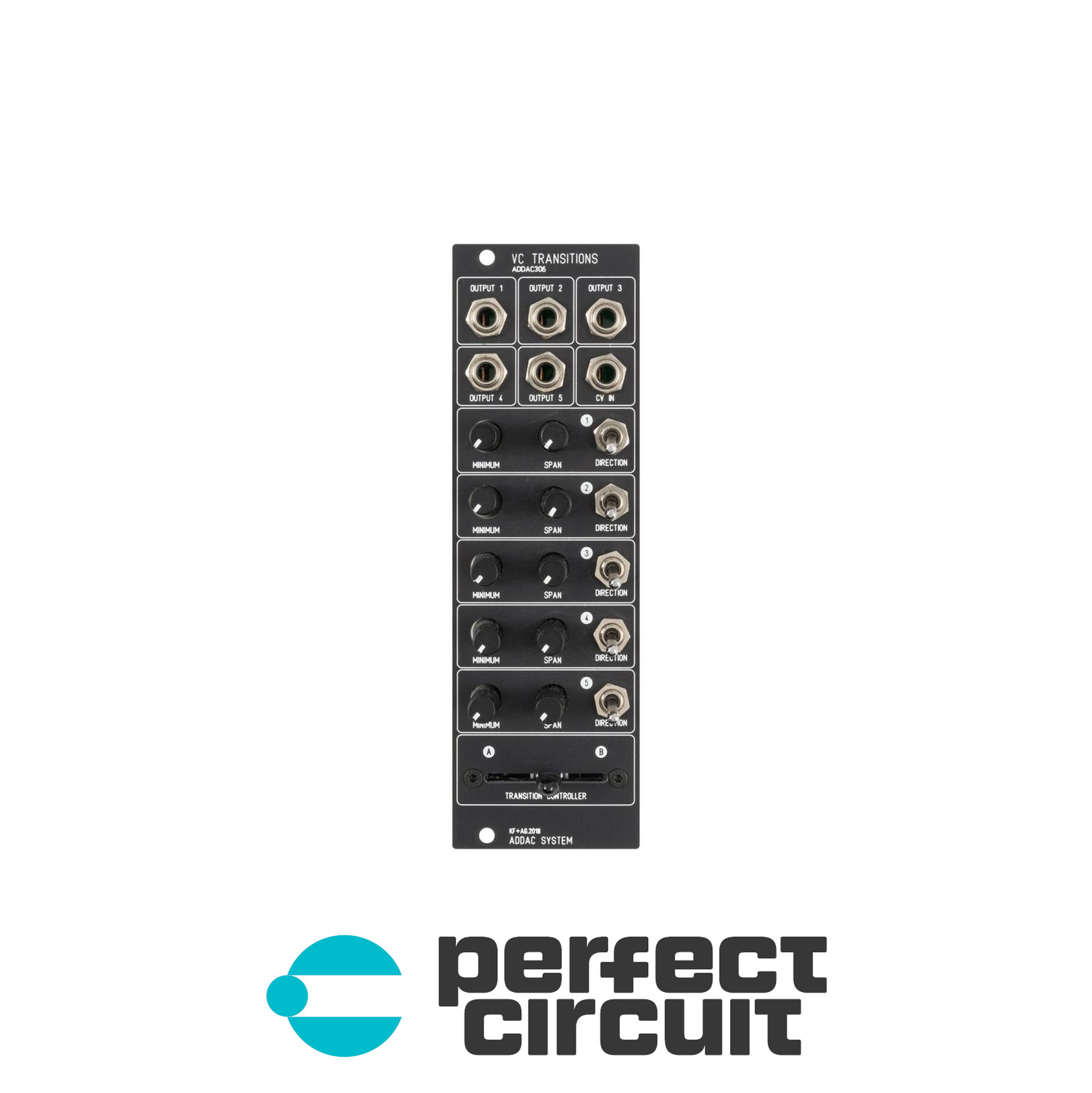
The concept is deceptively simple: five independent CV channels, each with its own minimum and span, all responding to a shared Transition Controller slider. Slide from A to B, and each channel moves from its minimum to maximum (or vice versa, depending on direction). It’s like an ADSR with five outputs, or a five-way attenuverter with memory—but without the digital complexity. There’s no screen, no menus, no patch programming required. You set it, tweak it, and perform with it. That simplicity is part of its charm. It’s been described as "nifty" and "super useful on a performance system," and one user put it plainly: “It’s super easy to set it up any way you want.” Another praised its hands-on nature: “One of the not-so-obvious strengths of the ADDAC module is that it’s really hands on.”
But it’s not without quirks. One user on MOD WIGGLER noted a limitation: as soon as you patch a CV signal into the input, the main slider stops acting as a manual controller and becomes an attenuator for the incoming CV. That means you lose direct manual control—unlike some comparable modules (like the MakeNoise Makenoise Lx, referenced in the forum post), where the knob remains active. It’s a trade-off: you gain external control, but sacrifice the tactile sweep. Whether that matters depends on your workflow. If you’re using it as a dynamic processor, it’s fine. If you rely on manual sweeps during performance, you’ll need to plan around it.
Still, the flexibility is impressive. Users have repurposed it as an ADSR/LFO multi-mangler, a sequence polyphonizer (by sending a monophonic sequence through it and into a quantizer like the ADDAC207), or even a chord progression generator. Found Sound suggests using it to “send a sequencer to five different destinations with different voltage levels for each” or to “dial in sweet spots on your favourite filters.” It’s also possible to daisy-chain two units via the CV input to control up to nine outputs with one slider, expanding its reach without adding complexity.
Specifications
| Manufacturer | ADDAC System |
| Format | Eurorack |
| Width | 8 HP |
| Depth | 4 cm / 40mm |
| Number of channels | 5 |
| CV inputs | +5v |
| CV outputs | jumper selectable: +5v or +10v |
| Output voltage range | Can be set to either 5 or 10 volts maximum per channel via jumpers on the back |
| Output polarity | Only positive voltages are generated at the output |
| Max current / Power consumption | +40mA/-20mA |
| Bus Board Cable | 8 x 2 IDC (Doepfer style) connector |
| DIY Kit price | 87€ (Excl. VAT) |
Key Features
Five Channels, One Slider
Each of the five channels features MINIMUM and SPAN controls, letting you define the starting voltage and the total range. The DIRECTION switch determines whether the channel ramps up (from minimum to maximum) or down (from maximum to minimum) as the Transition Controller slider moves from A to B. This per-channel direction reversal is a subtle but powerful feature—imagine one filter opening while another closes, or an LFO rate increasing as a wavefolder depth decreases, all in sync. The common slider ties it all together, making it easy to stage complex parameter shifts across your system with a single gesture.
CV Input as Control Expander
The CV IN jack lets you modulate the transition point with an external signal—say, an LFO, envelope, or sequencer. When patched, the slider becomes an attenuator for that incoming CV, not a direct voltage source. This turns the module into a dynamic processor: instead of manually sweeping, you’re shaping how an external control signal affects your five CV outputs. It’s a smart design for integration, though it does mean you can’t simultaneously use the slider manually and accept external CV. That limitation has been noted by users, but it’s a logical consequence of the architecture—there’s no mode switching, just clean, analog signal flow.
Jumper-Selectable Output Range
On the back of the module, five jumpers (one per channel) let you set the maximum output to either +5V or +10V. This is useful for matching different modules’ CV requirements—some VCOs respond better to 10V ranges, while others (like certain filters) might only need 5V. The ability to mix ranges across channels adds flexibility without cluttering the front panel. However, it’s worth noting that all outputs are positive-only—no negative voltages are generated. If your patch requires bipolar control, you’ll need to offset or invert externally.
Compact and Performance-Ready
At just 8 HP wide and 40mm deep, the Transitions fits easily into even the most crowded racks. Its small footprint belies its utility—this isn’t a utility module in the boring sense, but a performance-focused tool designed to be grabbed and swept during live sets. The slider is large and smooth, inviting interaction. And since it’s part of the ADDAC300 Series, it shares a design language with other expressive controllers, suggesting a family of tools meant to be used together for macro-level manipulation.
No Audio Mixing—Just Pure CV
Unlike some comparable modules (such as Mutable Instruments Frames, which can mix audio or pass CV per channel), the Transitions is strictly for control voltage. There’s no audio path here. That keeps the design focused and avoids crosstalk or noise issues that can plague mixed-signal modules. It also means you won’t accidentally route audio through it and wonder why it sounds thin—this module does one thing, and does it cleanly.
Historical Context
The ADDAC306 VC Transitions emerged in a landscape where macro control and performance-oriented modules were gaining traction. It’s been compared directly to the Mutable Instruments Frames and the Mannequins Cold Mac—both of which offer multi-channel control but with different approaches. Frames, for example, allows per-channel audio mixing or CV routing but requires menu navigation and programming. The Cold Mac is more of a dynamic voltage processor with logic-based behavior. In contrast, the Transitions stands out for its immediacy: no menus, no code, no setup. You turn it on, patch it, and move the slider. That simplicity, combined with its compact size and per-channel direction control, gives it a distinct niche. It was developed from an initial idea by Konstantine Fioretos, though the exact timeline of development hasn’t been documented.
eBay Listings
As an eBay Partner, we earn from qualifying purchases. This helps support our independent vintage technology research.