ADDAC304 Manual Gates ()
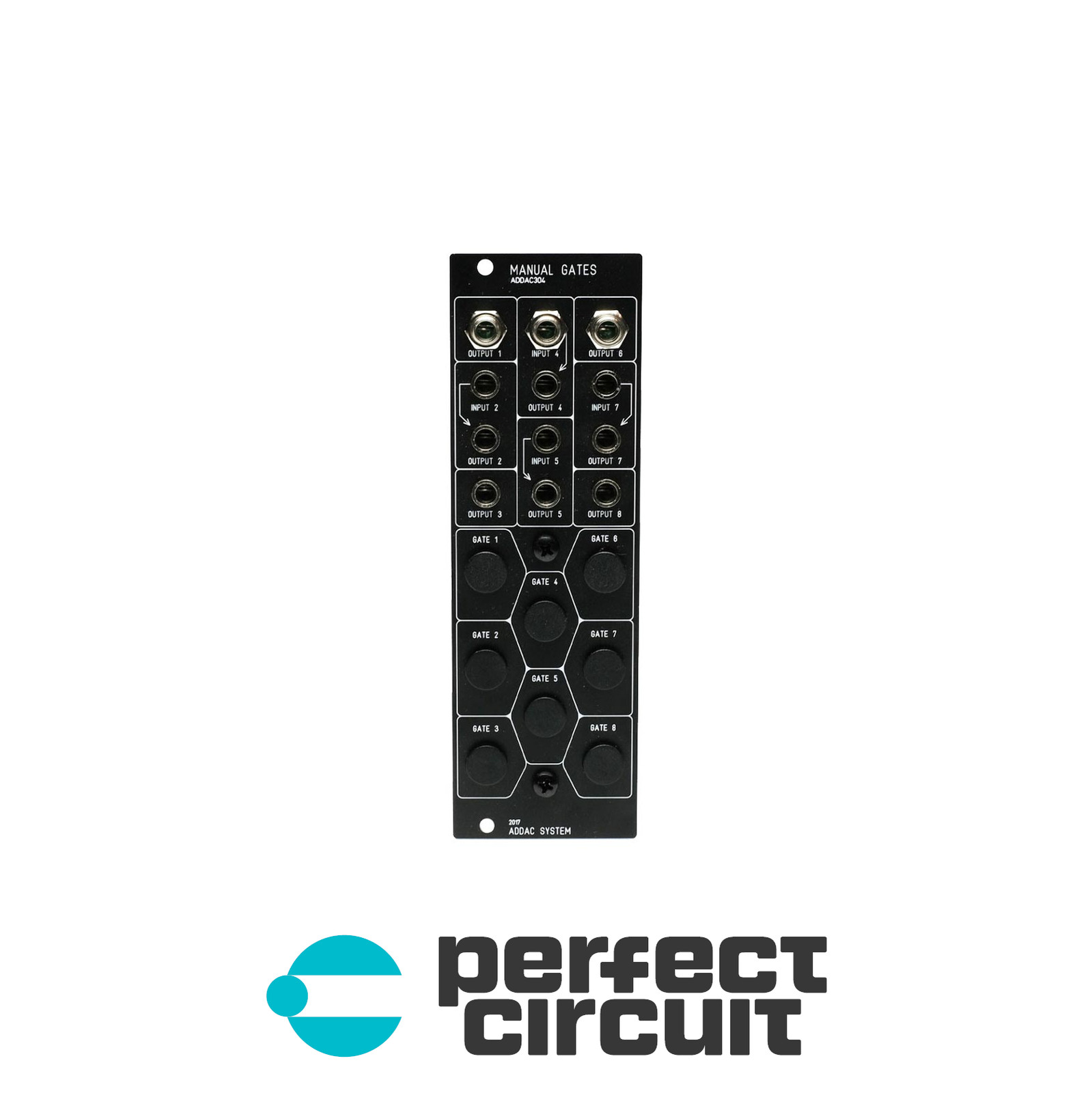
Eight tactile gate triggers in 8 HP—with a clever twist that turns half of them into momentary signal pass-throughs.
Overview
If your modular rig feels a little too hands-off—like you're more of a curator than a performer—then the ADDAC304 Manual Gates might be the jolt you need. It’s not flashy, it doesn’t make a sound, and it won’t modulate anything on its own. But plug it in, and suddenly you’ve got eight physical points of control, each one a gate launcher ready to fire off sequences, trigger envelopes, or nudge a sequencer forward with a firm thumb press. Owners report it’s “a perfect way to perform on and control your modular system,” and after spending time with one, that line doesn’t feel like marketing fluff—it feels like understatement.
What sets the ADDAC304 apart from a wall of simple momentary buttons is its hybrid design: four of the eight gates can do double duty. When you patch a signal into one of those channels, pressing the button doesn’t just send a +5V pulse—it momentarily passes the incoming signal through. That means you can use it to manually gate an LFO into a filter cutoff, trigger a sample playback, or even mute/unmute a noisy oscillator on the fly. It’s a small feature, but in practice, it turns the module into something closer to a performance-oriented switch matrix than a simple trigger source. The tactile feedback from the buttons is crisp and reassuring—no mush, no wobble—just clean actuation that feels built to survive gig use.
It’s part of the ADDAC300 Series, a family of utility-focused Eurorack modules designed for hands-on control and signal manipulation. While the fact sheet doesn’t clarify where it sits in the lineup—whether entry-level, flagship, or niche tool—it’s clearly built with practicality in mind. The entire module draws just 10mA on the +12V rail and nothing on the others, making it a power sipper in even the most crowded case. At 8 HP wide and only 2.5 cm deep, it tucks neatly into tight setups without hogging space. This isn’t a centerpiece module—it’s the quiet workhorse that makes everything else feel more alive.
Specifications
| Manufacturer | ADDAC System |
| Format | Eurorack |
| Width | 8 HP |
| Depth | 2.5 cm |
| CV inputs | ± 10v |
| Gate outputs | 0 +5v |
| Max current | 10mA |
| Bus Board Cable | 8 × 2 IDC (Doepfer style) connector |
| Current draw +12 V [mA] | 10 |
| Panel / Color | Black Alu |
| Power consumption | 10 mA +12V, 0 mA -12V, 0 mA 5V |
| Module height | 3U |
| Number of channels/gates | 8 |
Key Features
Eight Manual Gates, Two Modes
The ADDAC304 gives you eight independent manual gate channels, each activated by a physical button. When pressed, each outputs a +5V signal; when released, it drops back to 0V. This is straightforward gate generation—perfect for starting envelopes, advancing sequencers, or manually triggering drum modules. But half of these channels (four) have a smart twist: if you patch a signal into their input, pressing the button momentarily passes that signal through instead of outputting a fixed +5V. That means you can use them as momentary switches for audio or CV, letting you punch in an effect, reroute a modulation path, or briefly override a control voltage—all with a single press.
Signal-Aware Button Logic
The module’s behavior changes dynamically based on patching. If a jack is inserted into one of the four special channels and carrying a signal, the button acts as a momentary gate for that signal. No signal present? It defaults back to standard +5V gate output. This adaptive design means you don’t have to dedicate the module to one role—it can shift between being a pure manual gate source and a hands-on signal switcher, depending on how you wire it. It’s a subtle but powerful bit of flexibility that rewards creative patching.
Compact and Efficient Power Use
Despite packing eight channels, the ADDAC304 is incredibly space- and power-efficient. It only draws 10mA from the +12V rail and nothing from -12V or 5V, making it one of the lightest loads in a system where every milliamp counts. The 8 HP width is narrow enough to fit in almost any gap, and the 2.5 cm depth ensures it won’t bump into back panels or power supplies. The bus board uses a standard 8×2 IDC (Doepfer-style) connector, so compatibility with most Eurorack cases and power systems is guaranteed.
Build and Panel Options
The standard version ships with a black anodized aluminum panel—sleek, durable, and resistant to wear. But ADDAC System also offers custom panel colors: Green, Blue, White, Silver Gray, Yellowed Silver, and Dark or Light Bronze. These aren’t just cosmetic; they let builders color-code their systems or match a specific aesthetic. The module uses momentary switches across all eight channels, ensuring consistent tactile response and long-term reliability. While no data exists on common failures or maintenance needs,
Collectibility & Value
The ADDAC304 is available as a pre-built module and as a full DIY kit priced at 58€ (excluding VAT). The current retail price for the assembled version is listed at €75.00 (including VAT) by Exploding Shed, a representative figure among European retailers. Given its utility-focused design and lack of rare components, it’s unlikely to become a high-value collector’s item, but its versatility ensures steady demand among modular users. The availability of custom-colored panels adds a slight premium for those seeking visual uniqueness, though no data confirms price differences based on color. Original pricing at introduction was 90.00€ (excluding VAT), according to the manufacturer, suggesting a modest price reduction or regional variation over time. No information is available on production years, common failures, or long-term maintenance issues.
eBay Listings
As an eBay Partner, we earn from qualifying purchases. This helps support our independent vintage technology research.