Access Virus TI 2 Desktop
At 3300 presets and dual DSP power, it hums with the ghosts of a thousand festival risers.
Overview
The Access Virus TI 2 Desktop isn’t just a synth—it’s a time capsule of late-’90s electronic euphoria repackaged for the DAW era. Built by Access Music, a German company founded in 1997 by Christoph Kemper, this desktop module carries the DNA of the original Virus that helped define trance, progressive house, and psytrance with its searing leads and colossal supersaws. By the time the TI 2 arrived, the synth had evolved into a hybrid beast: a standalone hardware instrument with deep software integration, designed to sit both on a rack and inside your Cubase session. The “TI” stands for Total Integration, and that philosophy runs through every aspect of its design—patches, effects, automation, and project sync are all meant to move seamlessly between hardware and plugin. Owners report it sounds amazing, with presets so rich and finished they “really gave me goosebumps.” But it’s not just nostalgia; even today, the hands-on control and immediacy of twisting a physical knob while watching parameter values update on the LCD deliver a tactile thrill that pure software can’t match.
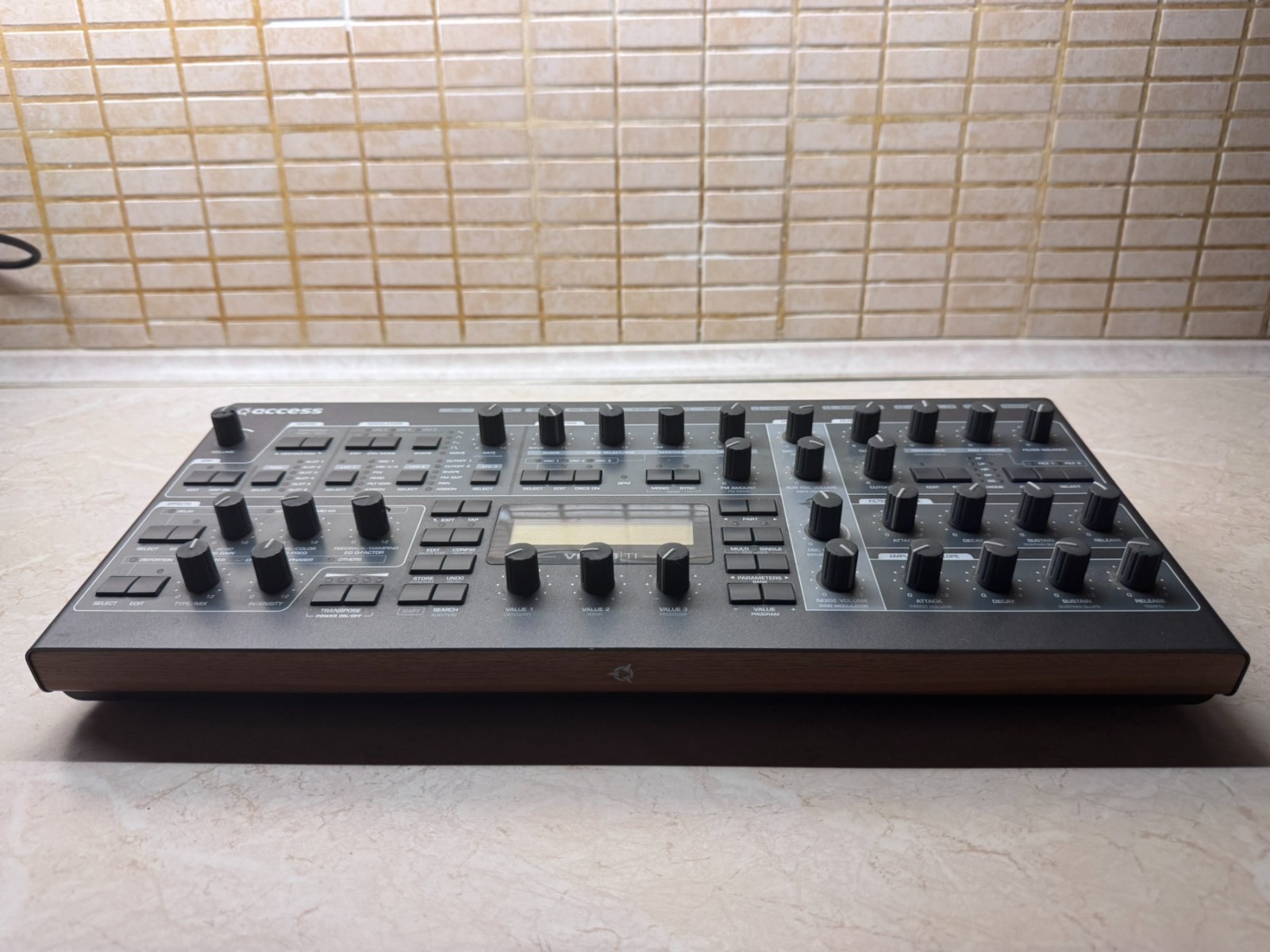
Yet for all its sonic prowess, the Virus TI 2 Desktop doesn’t hide its quirks. The build quality splits opinion: the knobs feel solid but plastic, with a noticeable resistance that some describe as smooth, others as cheap. The push buttons click loudly and feel wobbly, and the front panel glows with aggressive red LEDs and a central white Access logo that lights up when a parameter returns to its default. The I/O block on the back can be angled inward for tighter rack mounting, a thoughtful touch, but the packaging that delivered this machine was widely criticized as “really poor for such an expensive synth.” There’s a dissonance here—between the premium sound and the budget materials—that longtime users either accept or actively dislike. Still, few deny the effectiveness of the interface: templates for popular software synths allow it to double as a controller, and the LCD clearly displays names and values, making deep editing less of a guessing game.
Specifications
| Manufacturer | Access Music |
| Product type | virtual analog desktop synthesizer |
| Audio Interface | Features 1 stereo input and 3 stereo outputs, as well as S/PDIF I/O, with 192 KHz D/A conversion. |
| Oscillators | 3 oscillators. |
| Oscillator Models | Includes classic ones (sine, saw, pulse, triangle), HyperSaw, wavetables, granular and formant. |
| Filters | Dual multimode filters (Low Pass, High Pass, Band Pass and Band Stop), including four MiniMoog lowpass filter emulations in Analog Mode. |
| Modulation Matrix | Up to 6 control sources can modulate up to 3 destinations each. |
| Effects | Includes reverb, delays (including tape delay emulation), 6 chorus FX (including a rotary speaker emulation), a phaser with up to 6 stages, a frequency shifter module (modes: Ring Mod, Freq Shift, Vowel Filter and Comb Filter), 25 distortions and saturators, 3 band EQ, and 9 'Character' processors (including a speaker cabinet emulation). |
| Arpeggiator | Customizable 32 pattern arpeggiator. |
| Polyphony/Multitimbral | 16 multimode parts. |
| Plugin Compatibility | Virus Control plugin (AU/VST/RTAS). |
| Connectivity | MIDI In, Out and Thru ports, USB connection. |
| Physical Form | Desktop version is rack mountable. |
| Presets | Includes over 3300 preset sounds. |
| DSP System | Has a dual DSP system. |
Key Features
Total Integration with DAW Projects
The Virus TI 2 Desktop’s defining trait is its “Total Integration” system, which allows the hardware to sync completely with a DAW—specifically Cubase—so that patches, effects, and automation states are saved as part of the project. According to users, this feature is “incredible,” creating a workflow where the synth behaves like a plugin even when running externally. The matching Virus Control plugin (AU/VST/RTAS) enables full parameter control from within the host, and the hardware displays those values on its LCD. This two-way communication was ahead of its time, blurring the line between hardware and software in a way few synths had attempted. However, the implementation isn’t flawless: owners report that the plugin requires a dedicated USB 2.0 bus and still suffers from audio glitches and sync losses, especially in larger projects. Instability in Logic and lack of official support for Reaper have also been noted, making the integration feel powerful but fragile.
Dual DSP Architecture and Sound Engine
Under the hood, the dual DSP system drives a sound engine capable of producing everything from vintage analog emulations to digital chaos. With three oscillators per voice, including the legendary HyperSaw—a waveform synonymous with trance’s wide, shimmering leads—the synth delivers both precision and aggression. Wavetable, granular, and formant synthesis expand its range far beyond typical virtual analog fare. The dual multimode filters offer Low Pass, High Pass, Band Pass, and Band Stop configurations, with a special Analog Mode that emulates four MiniMoog-style lowpass filters for added warmth. Modulation is handled via a matrix allowing up to six sources to modulate three destinations each, giving advanced users deep control over movement and texture. The 16-part multitimbral capability makes it viable as a central sound module in complex arrangements, though the real magic lies in its presets—over 3300 are onboard, and more than 7,000 additional ones are available for free from Access, crafted by artists like Richard Devine and members of Depeche Mode.
Onboard Effects and Character Processors
The Virus TI 2 Desktop doesn’t just generate sound—it shapes it aggressively. The effects suite is extensive: reverb is described as “stunning,” delays include tape emulation, and there are six chorus effects, one of which mimics a rotary speaker. A 6-stage phaser, frequency shifter (with Ring Mod, Freq Shift, Vowel Filter, and Comb Filter modes), 25 distortion and saturation types, and a 3-band EQ round out the processing. Most distinctive are the nine ‘Character’ processors, including speaker cabinet emulation, which can add grit, warmth, or lo-fi coloration in one turn. These effects are not afterthoughts; they’re integral to the synth’s identity, especially in its heyday when producers relied on the Virus to deliver complete, polished sounds straight out of the box. That said, some users counter that the effects are only “average sounding,” particularly when compared to the brilliance of the oscillators and filters.
Physical Interface and Build Quirks
The hardware’s interface walks a tightrope between functionality and fragility. The knobs, while offering smooth turning action, are made of plastic and feel “a bit cheap,” with a surprising amount of resistance that divides users—some appreciate the tactile feedback, others find it fatiguing. The push buttons are worse: they click loudly, feel wobbly, and lack the precision expected at this level. A reported failure of the global reset switch on one unit underscores broader concerns about quality control, including a bottom C# key hitting the wood (out of tolerance) and dust trapped under the LCD. The bright red LEDs and central white logo light are functional—indicating parameter states and default values—but contribute to a somewhat clinical, even garish, aesthetic. Despite these flaws, the ability to use the unit as a controller for other software synths, with labeled templates and real-time feedback on the LCD, keeps it relevant for hands-on producers.
Historical Context
Access Music launched in 1997 in Dortmund, Germany, with the original Virus synthesizer, which quickly became a staple in electronic music production. By the late 1990s and early 2000s, the Virus was the “weapon of choice” for producers in trance, drum and bass, and psytrance, its “aggressive, buzzing leads and impossibly wide supersaws” defining the sound of festivals and clubs. The original Virus A’s supersaw patch became so iconic it effectively shaped a subgenre. The TI series evolved that legacy by adding USB audio and MIDI integration, allowing direct DAW connectivity—a forward-thinking move at the time. The Virus TI 2 Desktop represents the culmination of that vision: a standalone module designed to coexist with digital workflows, offering both analog warmth and digital precision in a compact, rack-mountable form.
Collectibility & Value
Market data is sparse, but a used unit was reportedly purchased for £1000, while another listing shows a sale price of $839.70, suggesting a secondary market that values the synth but doesn’t inflate it excessively. The Darkstar edition, a limited variant, was produced only until the end of March 2011, adding a niche collectible angle. However, long-term usability is hampered by software limitations: one user noted reduced usage after Mac support declined, highlighting dependency on the plugin ecosystem. Quality control issues—like failed switches and physical defects—are documented, and the lack of support for certain DAWs like Reaper limits reliability. While Access provided free updates for years, enhancing post-purchase value, the current state of the plugin remains a point of contention. Collectors seeking sonic excellence may overlook the flaws, but working producers weigh stability as heavily as sound.
eBay Listings


As an eBay Partner, we earn from qualifying purchases. This helps support our independent vintage technology research.
Service Manuals, Schematics & Catalogs
- Catalog (1919) — archive.org