Access Virus C (2002-2004)
A single twist of the filter cutoff exposes a texture that refuses to sit quietly in the mix.
Overview
The Access Virus C sits comfortably in the middle of the German manufacturer's golden era, balancing raw sonic capability with a workflow that demands attention. Released in 2002, this module arrived when virtual analog synthesis was peaking, offering a 32-voice architecture that doubled the polyphony of the original Virus A while refining the interface for hands-on manipulation. Owners report that the C series distinguishes itself through expanded modulation routing and a specific filter character that leans toward aggressive, clean analog emulation rather than soft digital warmth. The unit commands respect in trance and electronic production circles, where its ability to generate cutting-edge textures and overdriven lead lines remains relevant decades after production ceased.
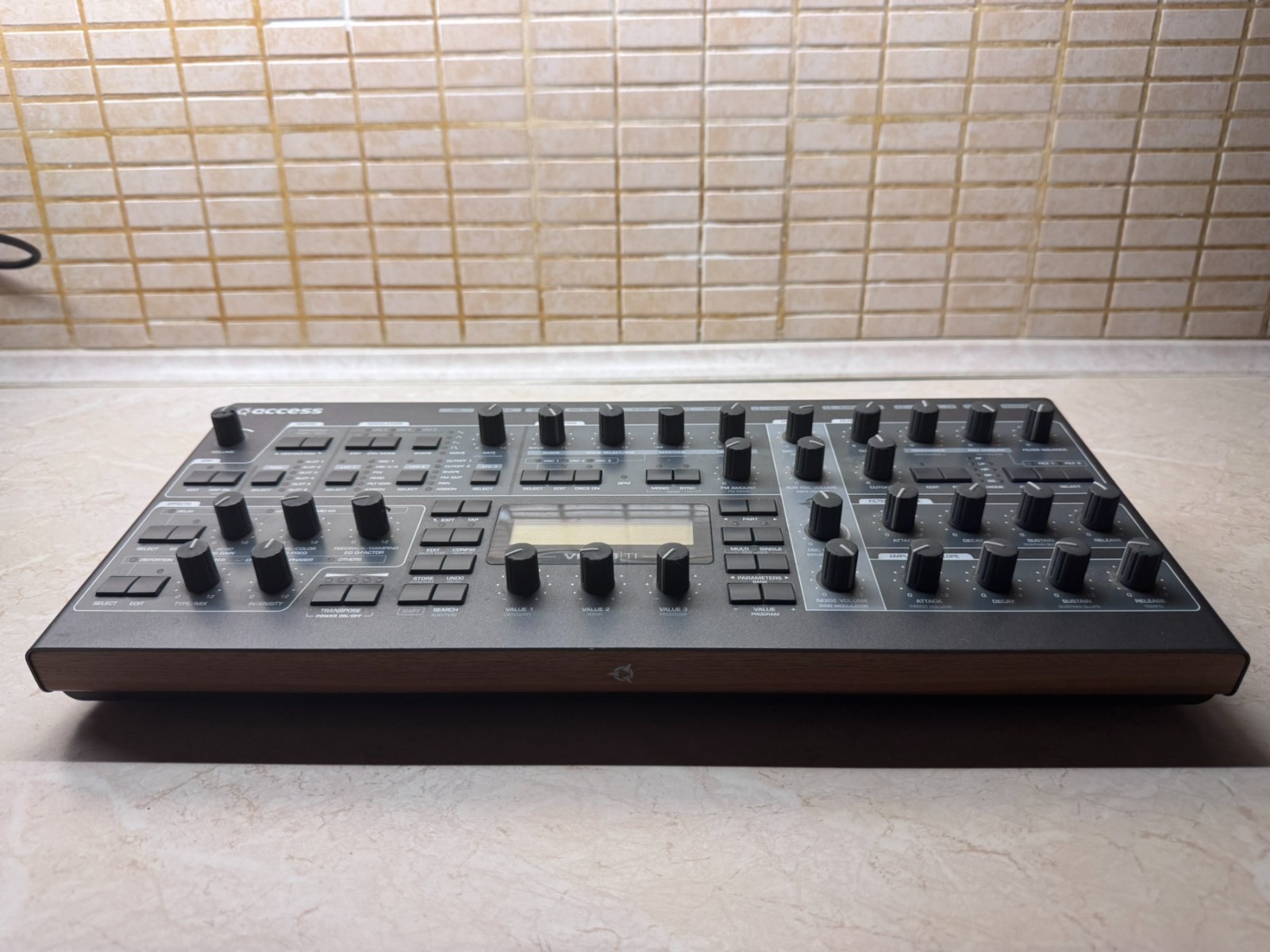
Physical design marks a departure from earlier iterations, incorporating wood side panels that signal a shift toward premium studio furniture aesthetics. Documentation shows the inclusion of an Undo/Redo function, a rare feature in hardware synthesizers of this period that saves programmers from accidental parameter wipes during live tweaking. While the front panel boasts improved access to the third oscillator and effects section, reducing the need for LCD menu diving compared to the Virus B, collectors note that patch navigation remains a friction point. The absence of a numeric keypad means scrolling through categories to locate specific sounds can feel tedious during performance, a trade-off for the compact desktop footprint.
Positioned within the family hierarchy, the Virus C acts as the sweet spot between the entry-level Virus A and the flagship Virus TI released later. It offers nearly the entire sonic palette of the subsequent TI generation without the inflated cost or computer-dependent architecture. Service technicians observe that the digital stability of the C series is robust, though the reliance on menu structures for deep editing requires patience. For those seeking the classic Access sound with expanded modulation depth but without the complexity of the TI's integrated software environment, the C represents a standalone hardware solution that retains value in the modern rack economy.
Specifications
| Manufacturer | Access Music Electronics |
| Production Years | 2002-2004 |
| Series Family | C Series (includes Virus C, KC, Indigo 2, Rack XL) |
| Polyphony | 32 voices |
| Oscillators per Voice | 2 Oscillators plus 1 Sub-Oscillator |
| Sub-Oscillator Waveforms | Sine, Triangle, Saw, Variable Width Pulse |
| LFO Count | 3 per voice (including 3rd LFO on front panel) |
| Filter Count | 2 independent resonant filters |
| Filter Modes | Lowpass, Hipass, Bandpass, Band Reject, Parallel, Split, Serial |
| Filter Slope | Up to 36dB per voice (6-poles) |
| Filter Modeling | Moog modeled filters available |
| Modulation Matrix Sources | 6 source slots |
| Modulation Matrix Destinations | 9 destination slots |
| Effects Library | 98 effects |
| Effects Types | Chorus, Global Reverb, Delay, Vocoder |
| EQ Section | 3-band EQ available |
| Multitimbral Parts | 16 parts |
| Control Interface | 32 knobs, 27 buttons, expanded front panel modulation |
| Patch Memory Architecture | ROM and RAM patch storage |
| MIDI Control | All parameters MIDI controllable |
| Design Materials | Wood side panels |
| Navigation System | Category search (no numeric keypad) |
| Undo/Redo Capability | Hardware Undo/Redo function included |
Key Features
Modulation Depth and Routing
The modulation matrix on the Virus C expands significantly over previous generations, offering six source slots and nine destination slots. This architecture allows for complex sound-mangling possibilities that competitors like the Novation Supernova often handle through multitimbral flexibility rather than internal routing depth. Owners report that the ability to assign multiple LFOs and envelope triggers to filter cutoff, pitch, and amplitude simultaneously creates moving textures suitable for ambient and trance production. The inclusion of a third LFO per voice, moved to the front panel for immediate access, reduces the reliance on screen navigation for common modulation tasks. This structural change acknowledges the workflow needs of performers who require tactile control over evolving soundscapes without interrupting the creative flow to dig through digital menus.
Filter Character and Modeling
Documentation shows the C series introduced "Moog" modeled filters alongside the existing Access filter topologies. This dual-filter system provides up to 36dB of attenuation per voice, allowing for steep slopes that carve out frequency space with surgical precision. The resonance behaves aggressively when driven, producing overdriven lead lines reminiscent of analog classics like the TB-303 or SH-101. Collectors note that the filter saturation adds harmonic richness without introducing the digital artifacts common in cheaper virtual analog units of the early 2000s. The parallel and split filter modes enable stereo widening techniques that remain effective in modern mixing environments, giving the Virus C a sonic signature that cuts through dense arrangements where softer synths might disappear.
Interface Workflow and Navigation
While the front panel improvements reduce menu diving for modulation and effects, the patch navigation system retains a limitation inherent to desktop modules of this size. Soundonsound reviews indicate that the lack of a numeric keypad makes calling up specific patches tedious, requiring users to scroll through sound categories to locate specific positions. This design choice prioritizes panel space for hardware control knobs over direct patch access, a trade-off that favors sound creation over sound retrieval. The Undo/Redo function mitigates some workflow risk, allowing programmers to revert accidental changes during live tweaking. However, users describe the search process as fairly tedious when managing large libraries, suggesting that external MIDI controllers or software editors often become necessary companions for efficient live performance.
Historical Context
Released in 2002, the Virus C arrived during the height of the virtual analog resurgence, where manufacturers sought to replicate classic circuit behavior using digital processing power. Access Music Electronics positioned this model against competitors like the Novation Supernova, which emphasized hardware control and multitimbral performance flexibility. The Virus C focused instead on detailed sound-mangling possibilities with more waveforms and modulation options, catering to producers seeking complex internal routing rather than just polyphonic breadth. This era saw electronic music genres like trance and ambient demanding synthesizers capable of evolving pads and aggressive bass lines, requirements the Virus C met with its 32-voice architecture and expanded effect library.
The industry moment favored German precision engineering, with the Virus brand quickly becoming a favorite synth for its aggressive analog sounds. Artists such as Astral Projection, BT, and Nine Inch Nails utilized Virus platforms during this period, cementing the reputation of the hardware in professional studios. The C series served as a bridge between the original 1997 Virus A and the later Virus TI, offering a standalone hardware experience that did not require computer integration for sound editing. This distinction matters in the historical timeline, as the subsequent TI generation shifted toward software-dependent workflows, making the C a last bastion of pure hardware control for enthusiasts who prefer offline synthesis.
Collectibility & Value
Current market value for the Access Virus C ranges between $750 and $900 depending on condition and included accessories. Reddit discussions from 2024 suggest that $750 represents a good trade value for units in working order, while Equipboard listings show best prices starting from $899.00. Compared to the Virus TI Polar, which costs over $2000 used, the C offers relative bargain pricing for users seeking the core Access sonic palette without the depreciation of newer models. The wood side panels and expanded modulation matrix make the C more desirable than the earlier Virus B or Indigo 1, which lack the 32-voice polyphony and updated filter models.
Common failures are not electrical but workflow-related. The absence of a keypad and the necessity of scrolling through patches constitute a functional weakness that buyers should anticipate. Maintenance costs are generally low as the unit is digital, though service technicians observe that power supply stability should be checked on older units from the 2002-2004 production window. Before buying, collectors note that verifying the functionality of all 32 knobs and the LCD screen is essential, as menu navigation relies heavily on these components. The unit does not suffer from the capacitor aging issues common in analog synthesizers, but the digital integrity of the sound engine should be tested against known patches to ensure no corruption in the ROM or RAM storage. For those willing to accept the menu navigation trade-off, the Virus C remains a high-value entry point into the Access ecosystem.
eBay Listings



As an eBay Partner, we earn from qualifying purchases. This helps support our independent vintage technology research.
Related Models
- Access Virus A (1997-1999)
- Access Virus B (1999-2002)
- Access Virus (1997-1999)
- Yamaha DX7 (1983-1987)
- Casio CZ-101 (1984-1988)
- Clavia Nord Lead (1995-2003)
- Ensoniq ESQ-1 (1986-1989)
- Korg Wavestation (1990-1994)
- PPG Wave 2.2 (1982-1987)
- Roland D-50 (1987-1992)