Access Virus (1997-1999)
The red desktop module that defined virtual analog modulation for a generation of producers
Overview
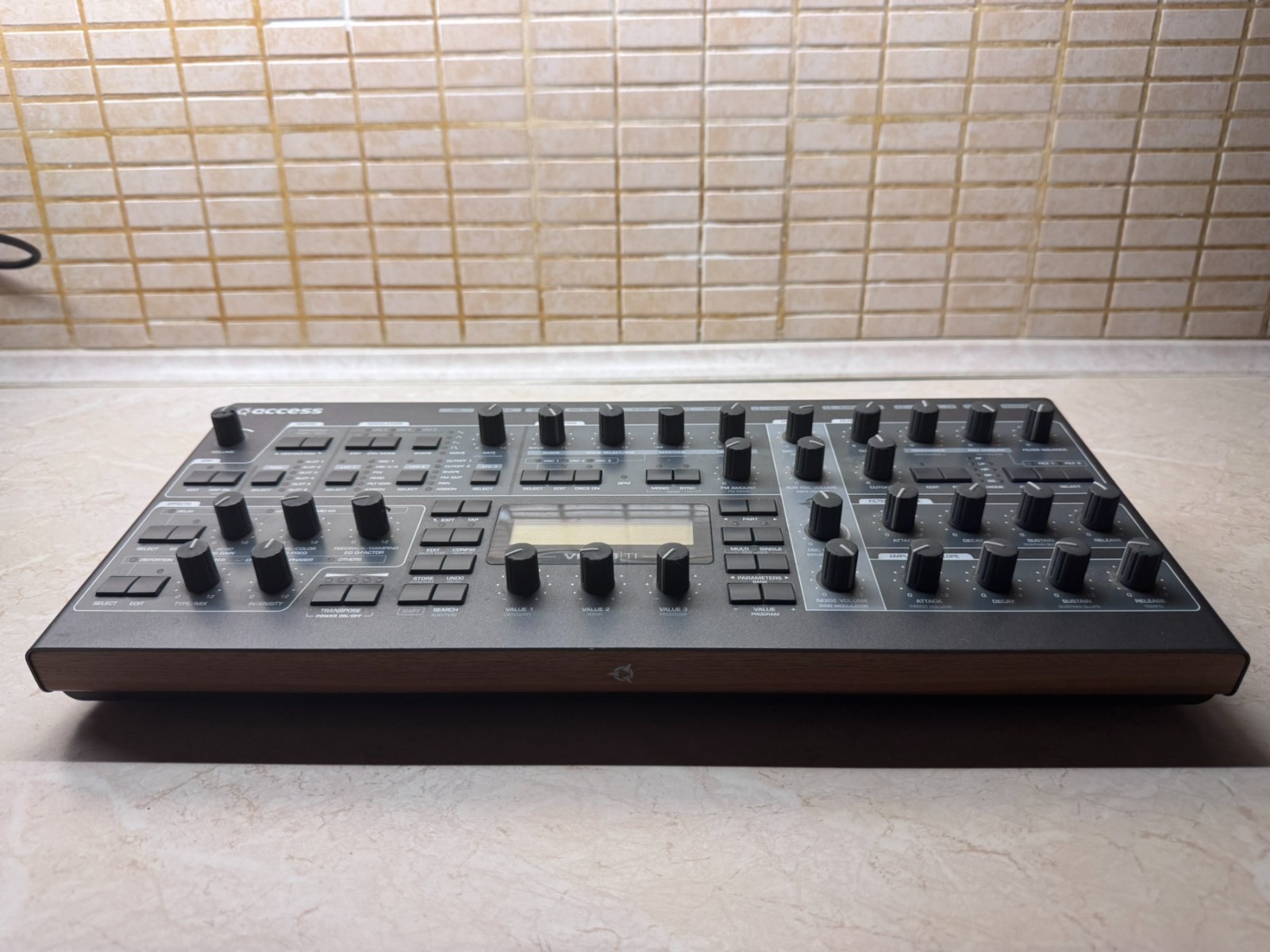
The first thing that catches the eye in a dimly lit studio is not the sound, but the glow. Fifty-two yellow LEDs pulse in rhythm with the modulation cycle, fading up and down like a breathing organism. This visual feedback was not merely decorative; it was a functional map of the synth's internal logic, offering immediate insight into waveforms and timing without digging through menus. When the Access Virus arrived in 1997, it presented a stark contrast to the muted grey aesthetics of Japanese competitors and the minimalist white panels of Swedish rivals. It was a German engineering statement wrapped in red aluminum, demanding attention through both its sonic weight and its physical presence.
Owners often describe the tone as possessing a digital clarity that refuses to muddy the low end, yet retains enough harmonic saturation to sit comfortably in analog mixes. The architecture relies on virtual analog synthesis, simulating the behavior of voltage-controlled circuits through digital processing. While contemporaries like the Clavia Nord Lead focused on immediate performance, the Virus prioritized deep sound design capabilities. The dual filter topology allows for serial or parallel configurations, creating complex spectral shapes that single-filter engines cannot replicate. This flexibility made the unit a staple for electronic producers seeking evolving textures rather than static presets.
Positioned within the Access family, this original desktop module serves as the foundational entry point. It sits below the Virus B, which doubled the polyphony and added a third oscillator, and far below the later Virus C and TI series which introduced extensive color displays and USB connectivity. However, collectors argue that the core sound engine remains consistent across these generations. The original model lacks the expanded voice count of its successors, but it retains the characteristic filter resonance and modulation matrix that define the Virus identity. For those seeking the classic sound without the premium price of later flagship models, this unit represents the sweet spot of vintage virtual analog ownership.
Specifications
| Manufacturer | Access Music Electronics (Germany) |
| Production Years | 1997-1999 |
| Original Price | Approx. 300€ (Early Market Data) |
| Polyphony | 12 Voices |
| Multitimbrality | 16 Parts |
| Oscillators per Voice | 2 Digital OSC + 1 Suboscillator |
| Waveforms | Sawtooth, Variable Pulse, Sine, Triangle, 64 Digital FM Spectral |
| Filter Type | 2 Independent Resonant Filters (LP, HP, BP, BR) |
| Filter Slope | Up to 36dB/voice (6-poles via serial/parallel) |
| Envelopes | 2 ADSTR Envelopes (Filter & Amp) |
| LFOs | 3 LFOs with 68 Waveforms |
| Effects | Chorus, Flange, Delay, Phaser, Distortion, Vocoder (OS dependent) |
| Memory | 1024 Programs (256 User / 768 ROM / 128 Multi) |
| Display | 2 x 16 Character LCD |
| Control Interface | 32 Knobs, 27 Switches, 2 User-Definable Knobs |
| Audio Outputs | 6 Outputs (3 StereoPairs) |
| Audio Inputs | 2 Inputs (for External Processing) |
| MIDI | MIDI In, MIDI Out (No Thru) |
| Power Supply | External Wall-wart PSU |
| Dimensions | 380 (w) x 250 (h) x 73 (d) mm |
| Weight | 1.5 kg |
| Modulation Matrix | 3 Sources, 6 Destinations (Expert Mode) |
Key Features
Dual Filter Topology
The sonic signature of the Virus relies heavily on its filter section, which distinguishes it from single-filter competitors of the era. Documentation shows two independent resonant filters capable of low-pass, high-pass, band-pass, and band-reject modes. Service technicians observe that the ability to run these filters in series or parallel creates a 6-pole rolloff capability, delivering 36dB of attenuation per voice. This configuration allows for aggressive resonance sweeps that maintain stability without the zipper noise common in early digital synthesizers. The inclusion of a shaper/distortion option on Filter 1 adds harmonic complexity, enabling users to drive the signal into saturation before hitting the filtering stage. This routing flexibility is often cited by sound designers as the primary reason for retaining the original model despite lower polyphony counts.
Modulation Architecture
Modulation depth defines the usability of any virtual analog instrument, and the Virus offers a robust matrix system. Three LFOs provide 68 waveform options, including smoothed sample-and-random variations that mimic the imperfections of analog circuitry. The modulation matrix allows three sources to target six destinations, encompassing pitch, pulse width, filter cutoff, and pan. Owners report that the visual LED feedback system correlates directly to LFO activity, pulsing in time with the cycle intensity. This hardware implementation reduces the need to rely solely on the LCD for modulation tracking. Expert Mode access via the menu system unlocks deeper parameter edits, allowing for complex routing that standard knob adjustments cannot achieve. The presence of two user-definable knobs on the front panel facilitates real-time control over portamento and delay send, though factory patches often default these to specific functions.
Operating System Evolution
Unlike static hardware synthesizers of the 1980s, the Virus was designed with upgradable firmware via MIDI input. Early production units shipped with operating system software that collectors describe as unstable, with occasional crashes during parameter changes. Research indicates that OS version 1.08 corrected many of these flaky behaviors and unlocked additional factory sound banks. This update capability transformed the unit from a fixed instrument into an evolving platform. Later OS versions introduced enhanced vocoder capabilities and expanded effect algorithms, though the core synthesis engine remained unchanged. This software architecture set a precedent for the synth industry, influencing later designs from competitors who adopted similar update paths. The ability to refresh the instrument's functionality without hardware modification remains a key selling point for vintage buyers.
Historical Context
The late 1990s marked a contentious period in synthesizer development, known as the virtual analog war. Manufacturers sought to replicate the warmth of vintage transistor circuits using digital DSP chips. Access Music Electronics, previously known for producing hardware programmers for Waldorf and Oberheim units, leveraged their controller expertise to create an interface that balanced complexity with accessibility. The Virus entered a market dominated by the Clavia Nord Lead, Korg Z1, and Roland JP-8080. While the Nord focused on performance and portability, the Virus emphasized sound design depth and multitimbral capabilities. German engineering prioritized robust construction and dense control surfaces, contrasting with the minimalist approach of Swedish designs.
Industry moments surrounding the release highlighted the shift towards studio-centric modules rather than keyboard-based instruments. The desktop form factor allowed integration into rack systems and computer-based setups, catering to the growing electronic music production sector. Artists like Nine Inch Nails and KMFDM adopted the platform, utilizing its aggressive filter resonance for industrial textures. The synth's ability to process external audio through its filters and effects via the stereo inputs expanded its utility beyond simple generation. This contextual positioning established the Virus as a processing hub as well as a sound source. By 1999, the release of the Virus B signaled the end of the original production cycle, doubling polyphony to meet demand for thicker pads and complex arrangements.
Collectibility & Value
Market values for the original Virus desktop module vary significantly based on condition and operating system version. Current listings often range between $400 and $700 USD, depending on cosmetic wear and functional integrity. Units with original wood side panels and intact knob caps command higher premiums than those with replaced components. Collectors note that the external wall-wart power supply is a common failure point; voltage irregularities can damage the internal power regulation circuit. Buyers should verify that the PSU outputs stable voltage before connecting the synth. Additionally, the rear jack connections on early models are sometimes soldered directly to the circuit board rather than bolted to the chassis, leading to socket wobble under lateral pressure. Careful inspection of audio ports is necessary to avoid intermittent signal loss.
Operating system version is a critical factor in valuation. Units running early firmware may exhibit stability issues or lack access to later sound banks. Documentation shows that free updates are available from Access, but the process requires a functional MIDI connection and computer interface. Buyers should confirm that the MIDI In port functions correctly to facilitate these updates. Memory retention is another consideration; while flash memory preserves patches, battery backup for volatile settings may degrade over decades. Service technicians observe that capacitor aging in the audio output stage can introduce DC offset or noise, requiring replacement during restoration. The 12-voice polyphony limit is acceptable for bass and lead work but may struggle with dense chordal arrangements compared to later B or C series models.
Restoration costs typically involve power supply replacement and potentiometer cleaning. The 32 knobs utilize conductive plastic contacts that can accumulate dust, leading to erratic parameter jumps during adjustment. Cleaning these contacts restores smooth operation, but replacement parts are scarce. The LCD display is generally robust, though backlight fading occurs in units stored in high-temperature environments. For those seeking the Virus sound without the vintage hardware risks, the Virus C or Indigo 2 offers similar engine architecture with improved reliability. However, the original red desktop module retains a specific aesthetic and tactile appeal that later black-livery models do not replicate. Ownership quirks include the heavy physical weight and the distinct glow of the LED array, which remains a bonding point for enthusiasts who value visual feedback in their studio workflow.
eBay Listings


As an eBay Partner, we earn from qualifying purchases. This helps support our independent vintage technology research.
Related Models
- Access Virus A (1997-1999)
- Access Virus B (1999-2002)
- Access Virus C (2002-2004)
- Yamaha DX7 (1983-1987)
- Casio CZ-101 (1984-1988)
- Clavia Nord Lead (1995-2003)
- Ensoniq ESQ-1 (1986-1989)
- Korg Wavestation (1990-1994)
- PPG Wave 2.2 (1982-1987)
- Roland D-50 (1987-1992)