Access Indigo (1996–1999)
The first synth that made virtual analog feel like a real instrument—not a simulation, but a new species.
Overview
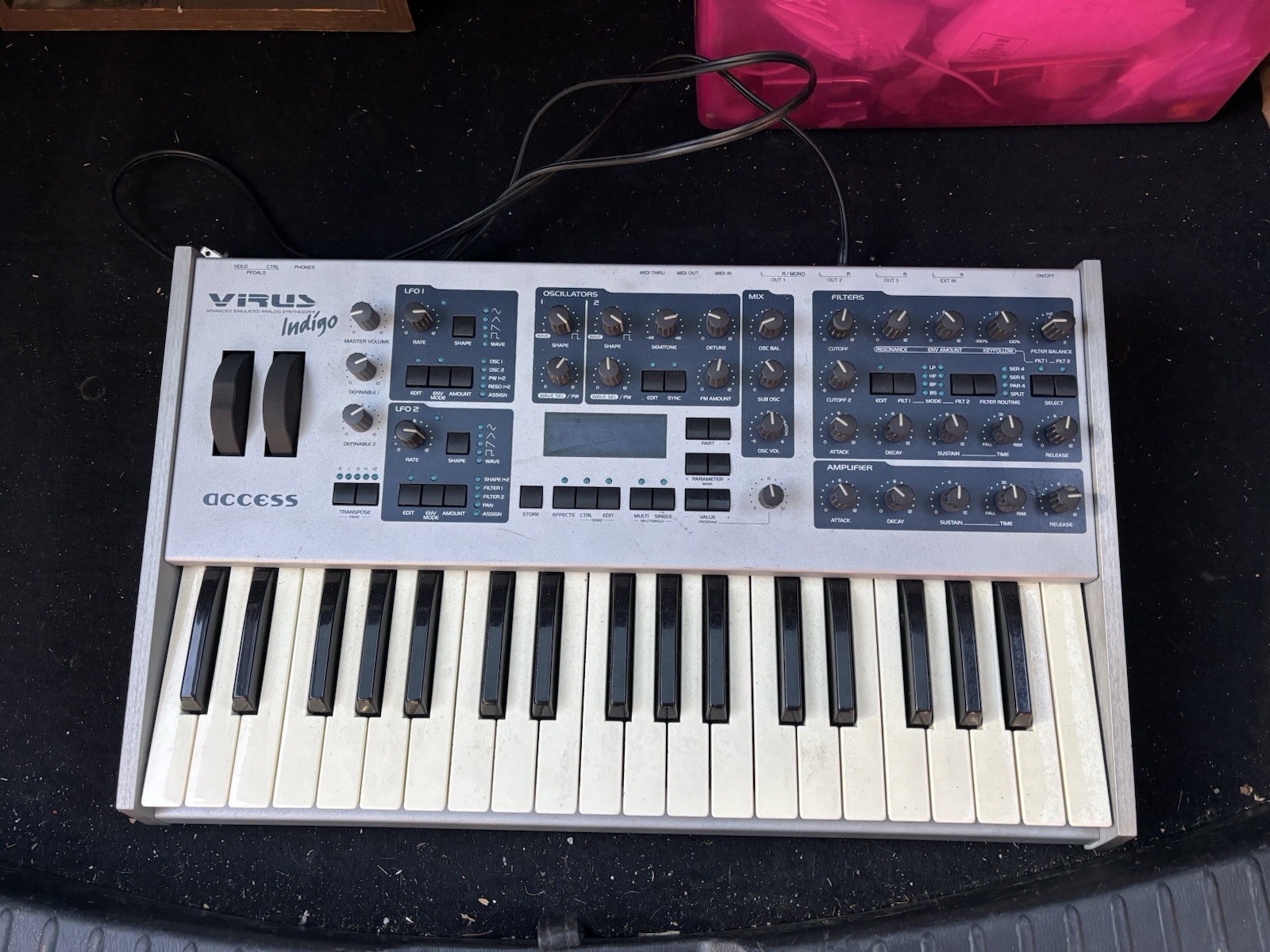
Plug in the Access Indigo, hit a chord, and you’re not just hearing oscillators and filters—you’re hearing tension. That brittle, almost unstable high end, the way the resonance bites just before it breaks, the way the stereo field seems to breathe with each note—it doesn’t emulate analog warmth so much as it invents its own kind of digital soul. Released in 1996, the Indigo wasn’t the first virtual analog, but it was the first to make the genre feel like it had artistic legitimacy. Before the Virus, before the Nord Lead 2X, before everyone realized you could make digital synths that didn’t just mimic the past but could define the future, there was this angular, silver-faced anomaly from a German company most people had never heard of.
Access didn’t come from the big synth dynasties. They weren’t Roland, Yamaha, or Korg. They were a small engineering-driven team out of Hamburg, and the Indigo was their declaration of independence from both the analog purists and the soulless digital workstations flooding the market. It was built on a proprietary DSP architecture that allowed for real-time wavetable scanning, complex modulation routing, and a stereo imaging engine that still sounds advanced today. It wasn’t trying to be warm or vintage—it was trying to be present, immediate, and a little dangerous. And it succeeded.
Positioned between the budget Nord Lead and the looming flagship Roland JD-800, the Indigo carved out a niche as the thinking producer’s synth. It wasn’t flashy, didn’t have a ribbon controller or a touchscreen, and its interface was famously cryptic. But once you learned it, the depth of control was staggering. The 4-voice polyphony (expandable to 8 with the rack version) felt tight, almost claustrophobic compared to the bloated multitimbrals of the era, but that constraint forced a kind of compositional discipline. You couldn’t just layer endlessly—you had to make each voice count. And when you did, the results could cut through a mix like a scalpel.
Specifications
| Manufacturer | Access Music GmbH |
| Production Years | 1996–1999 |
| Original Price | $1,995 (keyboard), $1,695 (rack) |
| Polyphony | 4 voices (8 with rack expansion) |
| Oscillators | 2 per voice, 64 wavetables with interpolation |
| Filter Type | 24dB/oct resonant low-pass, 12dB/oct band-pass, 6dB/oct high-pass |
| Effects | Reverb, chorus, delay, distortion, phaser, flanger |
| MIDI | In, Out, Thru |
| Keyboard Size | 61 keys (keyboard version) |
| Aftertouch | Channel aftertouch (keyboard) |
| Memory | 128 user patches, 128 factory |
| Display | 2-line LCD (16 characters) |
| Audio Outputs | 2 x 1/4" balanced (L/R), 1 x 1/4" headphone |
| Audio Inputs | 1 x 1/4" stereo (for external processing) |
| Weight | 12.5 kg (keyboard), 3.8 kg (rack) |
| Dimensions | 980 x 350 x 110 mm (keyboard), 482 x 44 x 240 mm (rack) |
| Power | 100–240 V AC, 50/60 Hz |
| Control Interface | Knobs, data wheel, 8 function buttons, patch select |
Key Features
Wavetable Engine with Analog Character
The Indigo’s oscillators weren’t just digital—they were smart digital. Each of the two oscillators per voice could access a library of 64 wavetables, many of which were derived from analog waveforms but enhanced with subtle digital artifacts that gave them a shimmering, unstable quality. Unlike the clean, static waves of early VA synths, the Indigo’s oscillators could scan across waveforms in real time, creating movement that felt organic rather than programmed. This wasn’t just for special effects; even basic sawtooth patches had a slight wobble, a sense of breath, that made them feel alive. And because the wavetables were processed through a high-resolution DAC before hitting the filter stage, the transition from digital source to analog-like output was seamless.
Dynamic Stereo Imaging
Most synths of the era treated stereo as an afterthought—panning, maybe a chorus effect. The Indigo treated it as a core sonic dimension. Each voice could be independently positioned in the stereo field, and the built-in effects engine included a stereo widener that didn’t just spread the sound—it created a sense of depth, like the synth was occupying physical space in the room. This wasn’t just useful for pads; even plucked basslines could feel three-dimensional. Producers working on trance, ambient, and electronic rock in the late '90s exploited this heavily, using the Indigo to create leads that seemed to orbit the listener. It was one of the first synths where stereo wasn’t a gimmick but a compositional tool.
Modulation Without Menu Diving
Yes, the interface was minimal. Yes, the LCD was tiny. But Access made a bold design choice: they put modulation routing within reach. Using a combination of dedicated buttons and the data wheel, you could assign LFOs, envelopes, and velocity to nearly any parameter in real time. It wasn’t as deep as a Nord or as immediate as a Jupiter, but it avoided the “press five buttons to change one setting” trap of contemporaries like the Korg Z1. The modulation matrix was implicit, not explicit—meaning you didn’t have to open a submenu to see what was modulating what. You just turned a knob, and if something moved, you knew it was being modulated. It was intuitive in a way that felt ahead of its time.
Historical Context
The mid-'90s were a crisis point for synthesizers. Analog was declared dead, but digital hadn’t filled the void. Workstations ruled the stage, but they were bloated, expensive, and musically limiting. The Nord Lead had proven that virtual analog could work, but it was still a compromise—thin, bright, and lacking the weight of real analog. The Indigo arrived in 1996 as a counterargument: that digital didn’t have to apologize for being digital. It could be precise, powerful, and emotionally resonant on its own terms.
It competed in a strange market. The Roland JP-8000 was still a year away. The Korg Z1 offered more polyphony but felt like a keyboardist’s synth, not a sound designer’s. The Ensoniq TS-10 was cheaper but sonically limited. The Indigo wasn’t the most powerful, nor the cheapest, nor the most user-friendly. But it was the most distinctive. It found a home in European electronic music studios, particularly in Germany and the UK, where producers were looking for something that could cut through dense mixes without sounding harsh. It became a staple in trance, IDM, and experimental pop—not as a lead synth, but as the secret ingredient that gave a track its edge.
Access followed the Indigo with the Virus in 1998, which refined and expanded on nearly every idea here. But the Indigo was the prototype, the proof of concept. It showed that a small company with a clear vision could out-innovate the giants. And it did it without chasing trends—no sampling, no ROM expansion, no onboard sequencer. Just pure synthesis, executed with obsessive attention to sonic detail.
Collectibility & Value
The Indigo is a cult classic, but not a common one. Fewer than 3,000 units were made before Access shifted focus to the Virus, and many were sold in Europe, making them rarer in the US. Today, a working keyboard version in good condition sells for $1,200–$1,800, while the rack version fetches $900–$1,300. Prices have stabilized in recent years—there’s enough supply to meet demand, but not so much that it’s become a budget option.
Condition is critical. The Indigo’s power supply is notorious for failing, especially in units that have been stored in humid environments. Owners report that the electrolytic capacitors degrade over time, leading to noise, channel dropouts, or complete failure. A full recap (replacing all capacitors) typically costs $250–$400, and should be considered part of the purchase price if the unit hasn’t already been serviced. The keyboard version’s aftertouch system is also prone to wear; if the rubber contacts under the keys dry out, aftertouch response becomes spotty or nonexistent.
Another issue: firmware. The original OS had bugs in the MIDI implementation and some wavetable scanning glitches. Access released updates, but many units were never upgraded. A synth with outdated firmware will have limited compatibility with modern DAWs and MIDI controllers. Always verify the firmware version before buying. The latest is v1.32, and it’s worth seeking out.
What to check before buying: power on with no issues, all keys respond, aftertouch works (if applicable), all knobs and buttons are responsive, audio outputs are clean, no crackling or distortion at high volumes. If it passes those, it’s likely solid. If it’s already been recapped and updated, consider it a premium find.
For collectors, the Indigo is more than nostalgia—it’s a milestone. It’s the moment when virtual analog stopped trying to be analog and started being its own thing. It’s not for everyone. It’s not warm. It’s not cuddly. But if you want a synth that sounds like the future felt in 1997—sharp, intelligent, and a little alien—this is it.
eBay Listings



As an eBay Partner, we earn from qualifying purchases. This helps support our independent vintage technology research.