Access Virus B (1999–2002)
The German-engineered digital synth that didn’t just survive the DAW revolution—it led the charge.
When the Access Virus B hit studios in 1999, it wasn’t just another virtual analog synth vying for attention in a crowded market. It was a statement: that hardware could not only coexist with the rising tide of computer-based music production but could actually enhance it. Crafted in Germany with surgical precision and a sonic character that straddled the warmth of vintage analog and the clarity of digital, the Virus B became the secret weapon of electronic producers, film scorers, and dance music architects during a pivotal shift in how music was made. This was the era when Pro Tools, Cubase, and Logic were transitioning from novelties to necessities—and the Virus B arrived with USB and optional FireWire connectivity, making it one of the first synths truly designed for the modern DAW studio.
Used by artists ranging from BT to Sasha to Moby, the Virus B wasn’t just respected—it was trusted. Its 24-voice polyphony was generous for the time, its triple-oscillator architecture per voice offered deep sound design potential, and its onboard effects engine was so robust you could print a mix-ready track straight from the synth. But beyond the specs, it was the sound that sealed the deal: rich, punchy, and harmonically complex, with filters that could go from buttery smooth to screaming acid with a twist of the cutoff knob. If the Roland JP-8000 was the populist face of virtual analog, the Virus B was its cerebral, slightly intimidating older sibling who aced quantum physics and still threw killer parties.
Specifications
| Polyphony | 24 voices |
| Oscillators per Voice | 3 |
| Filter Types | 24dB/oct resonant low-pass, 12dB/oct low-pass, 6dB/oct high-pass, 12dB/oct band-pass |
| Filter Frequency Range | 10 Hz to 20 kHz |
| Envelope Generators | 3 (2 ADSR, 1 AD) |
| LFO Count | 3 |
| LFO Waveforms | Sine, triangle, square, sawtooth, sample & hold, noise |
| Effects | Reverb, chorus, delay, distortion, EQ, phaser, flanger |
| Audio Inputs | 1 stereo line input |
| Audio Outputs | 2 balanced 1/4" TRS (L/R), 1 headphone out |
| Digital Connectivity | USB 1.1, FireWire (via optional card) |
| MIDI | In, Out, Thru |
| Display | 240x64 pixel backlit graphical LCD |
| Dimensions | 483 mm x 300 mm x 65 mm |
| Weight | 5.5 kg |
| Power Supply | External 15 V DC, 1.5 A |
Key Features
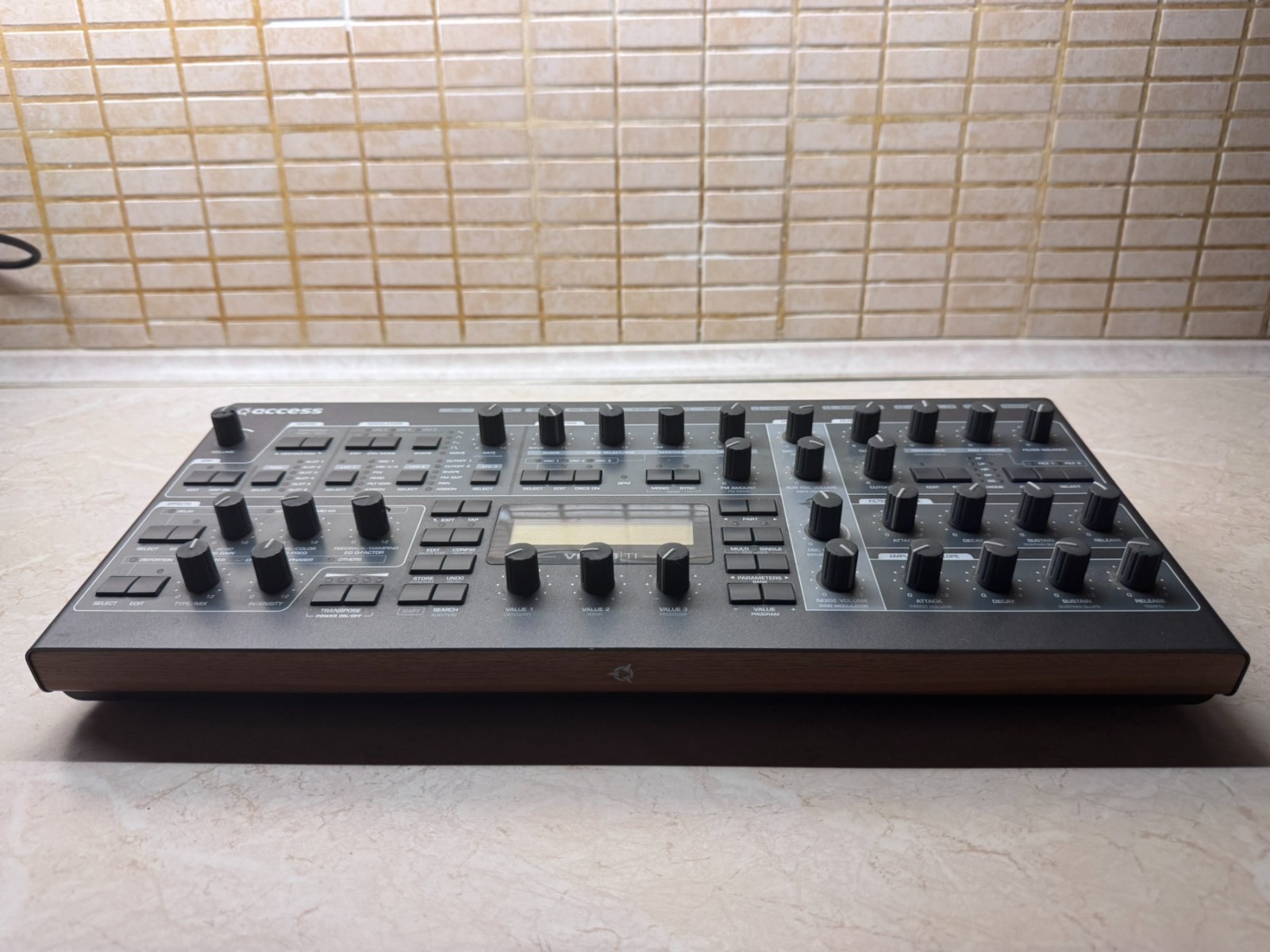
Let's get into the good stuff. The 24-voice virtual analog engine with three oscillators per voice was a massive leap over the original Virus A. This wasn't just about more notes; it was about density. You could stack those three oscillators thick, detune them into a wall of sound, and still have polyphony left for chords. Each oscillator could generate saw, square, pulse, and noise waveforms, with pulse-width modulation and oscillator sync, giving you the flexibility to mimic classic analog textures or generate entirely new ones.
The multi-mode resonant filters are where the Virus B truly sang. With four selectable types—including a 24dB/oct resonant low-pass that could self-oscillate with eerie precision—it delivered everything from deep Moog-style bass to brittle FM-like tones. The 10 Hz to 20 kHz frequency range meant it could handle sub-bass and airy highs with equal authority. Twist that cutoff knob and you're in filter heaven.
Now, the integrated multi-effects processor was a game-changer. This wasn’t just reverb and chorus tacked on—the Virus B’s effects engine was studio-grade. You could run reverb and delay in series, add distortion to fatten up leads, or use phaser and flanger for psychedelic sweeps. A quick heads-up, though: you couldn't run a global delay and reverb simultaneously—a limitation that drove some of us nuts until the TI models sorted it out. But what was there sounded fantastic, and the EQ was surgical enough to shape tones before they left the synth.
The USB and FireWire connectivity (via optional card) felt like science fiction in 1999. The Virus B didn’t just support it—it embraced it, allowing direct integration with DAWs for MIDI and even audio streaming (with FireWire). This made it a pioneer in hybrid workflows, letting producers treat it like a high-end sound module that could be tightly synchronized with their computer. No more MIDI jitter headaches.
Finally, the real-time control and feedback via 240x64 LCD made you feel like you were piloting something serious. While small by today’s standards, the backlit graphical display was a revelation at the time. It showed patch names, modulation routing, and real-time parameter changes, making deep editing far less guesswork than on synths with single-line displays. It was your window into the machine's brilliant, slightly complex German brain.
Historical Context
The late 1990s were a turbulent time for hardware synthesizers. Analog was still in the nostalgic shadows, digital workstations like the Korg Trinity were fading, and software synths like Native Instruments’ Reaktor were proving that powerful synthesis could live inside a computer. The market was skeptical: could a hardware box justify its cost when a $500 soundcard and a plugin could do “enough”? The Access Virus (1997–1999), the B’s predecessor, had already raised eyebrows with its rich sound, but it was the Virus B that answered the question with a resounding yes—if the hardware was fast, deep, and integrated.
The Virus B launched into a battlefield of digital synths. It faced stiff competition from the Novation Supernova II, which offered 24-voice polyphony and a generous effects suite of its own (and let you run more effects at once, to be fair), but lacked the Virus B’s seamless computer integration and slightly more aggressive sonic character. While the Roland JP-8000 had captured hearts with its supersaw, it maxed out at 16 voices and felt more like a performance synth than a studio powerhouse. The Virus B, by contrast, felt like a tool—engineered, reliable, and sonically versatile. It didn’t just keep pace with the DAW revolution; it anticipated it.
Its success paved the way for the Access Virus C (2002–2004) and later the Access Virus TI (2004–2013), which added motorized faders and expanded modulation matrices. But the B was the turning point—the model that proved Access wasn’t just another synth company, but a visionary force in digital synthesis. It was also a testament to German engineering: built like a tank, designed for longevity, and sonically uncompromising.
Collectibility & Value
Today, the Virus B is uncommon but not rare—enough units were made (exact production numbers remain undisclosed, but estimates suggest several thousand) that they surface regularly on the used market, but their desirability keeps prices firm. As of 2025, a fully functional Virus B in good condition typically sells for $1200 to $1800 USD, with units including the optional FireWire card or original packaging commanding premiums. The keyboard-equipped Virus KB variant (2000) is slightly more sought after due to its all-in-one convenience, though its weight (thanks to that 76-key Fatar keybed) makes it less popular with rack-mount purists. Just remember, on the KB, some front-panel functions like Transpose only affect the internal sound engine, not the MIDI output—a quirky holdover from its development.
Collectors should be wary of two well-documented issues: first, the external 15V DC power supply is prone to failure after two decades of use. Many have failed silently, taking the synth with them—so always verify the PSU outputs clean power before purchase. Second, the backlit LCD can degrade over time, leading to dim displays, ghosting, or complete failure. Replacement screens are available but require careful soldering. When buying, test all front-panel buttons, the encoder knob, and audio inputs/outputs—especially if you plan to use the line input for processing external signals, a beloved Virus B trick.
Despite its age, the Virus B remains a functional centerpiece in many modern studios. Its sounds—particularly its basses, leads, and atmospheric pads—still cut through mixes with authority. And unlike software, it’s a tactile, immediate instrument: no loading screens, no CPU spikes, just pure synthesis at your fingertips. If you can find one that’s been cared for, it’s not just a vintage synth—it’s a time machine with a killer distortion effect.
eBay Listings


As an eBay Partner, we earn from qualifying purchases. This helps support our independent vintage technology research.
Related Models
- Access Virus A (1997-1999)
- Access Virus C (2002-2004)
- Access Virus (1997-1999)
- Yamaha DX7 (1983-1987)
- Casio CZ-101 (1984-1988)
- Clavia Nord Lead (1995-2003)
- Ensoniq ESQ-1 (1986-1989)
- Korg Wavestation (1990-1994)
- PPG Wave 2.2 (1982-1987)
- Roland D-50 (1987-1992)