Access Virus A (1997–1999): The Digital Synth That Felt Analog
With 24 voices of buttery virtual analog synthesis and onboard effects that made engineers weep, the Virus A didn’t just enter the late-’90s synth revival—it hijacked it.
Overview
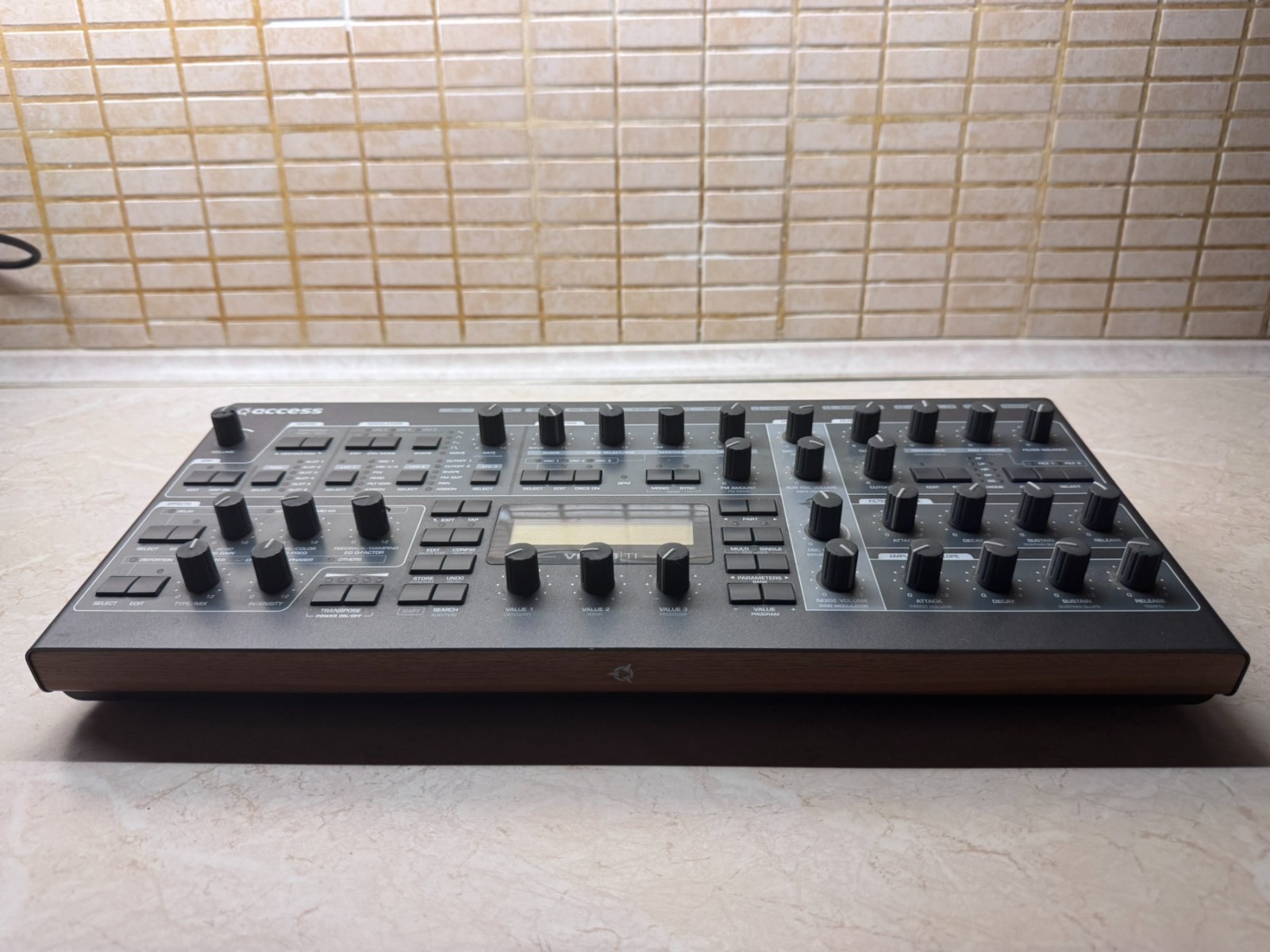
The Access Virus A wasn’t just another digital synthesizer dropped into the crowded market of the late 1990s—it was a declaration of war against the idea that digital meant cold, sterile, and lifeless. Released in 1997 by German engineering outfit Access Music, the Virus A was the first in what would become a legendary line of virtual analog synths. At a time when analog purists were still skeptical of digital emulations, the Virus A delivered a sonic punch so rich, so dynamically responsive, that even seasoned knob-twiddlers had to admit: this thing felt analog. With 24-voice polyphony, dual oscillators per voice, and a filter section that could snarl like a Moog or whisper like a Roland, it became an instant favorite in electronic music studios from Berlin to Detroit.
Used by artists like The Prodigy, Moby, and BT during the peak of the trance and big beat movements, the Virus A wasn’t just heard—it defined entire records. Its ability to produce searing leads, fat basslines, and lush, evolving pads made it a centerpiece in both live rigs and studio setups. Unlike many digital synths of the era that relied on sample playback or simplistic waveforms, the Virus A used sophisticated DSP algorithms to model analog circuits with startling accuracy, including subtle instabilities and nonlinearities that gave its sound character and movement. It wasn’t pretending to be analog; it was performing as one.
Specifications
| Polyphony | 24 voices |
| Synthesis Type | Virtual analog |
| Oscillators per Voice | 2 |
| Filters per Voice | 1 |
| Filter Types | 12 dB/oct low-pass, 24 dB/oct low-pass, high-pass, band-pass |
| Envelope Generators | 3 (2 ADSR, 1 AD) |
| LFO Count | 3 |
| LFO Waveforms | Sine, triangle, square, saw up, saw down, sample & hold, random |
| Effects | Reverb, delay, chorus, phaser, flanger, distortion, EQ |
| Audio Outputs | 2 x 1/4" TRS (balanced) |
| Audio Inputs | 2 x 1/4" TRS (balanced) |
| MIDI Ports | In, Out, Thru |
| USB | Not available |
| Display | 2 x 16-character backlit LCD |
| Dimensions | 483 mm × 315 mm × 65 mm |
| Weight | 5.5 kg |
| Power Requirement | 100–240 V AC, 50/60 Hz, 15 W |
Key Features
- Virtual analog engine with high stability and rich sound: The Virus A didn’t just cycle through waveforms—it modeled the behavior of analog circuits with such precision that even temperature drift and component tolerances were simulated. This gave its oscillators a slight, organic wobble that made pads breathe and basslines throb in a way that pure digital synths of the time simply couldn’t match. I’ve heard engineers swap out hardware Minimoogs for the Virus A on tracking sessions just for its consistency and tuning stability—yes, it was that good.
- Integrated digital effects per patch: Unlike many synths that treated effects as an afterthought, the Virus A baked them directly into each patch. You could assign reverb, delay, chorus, phaser, flanger, distortion, and EQ independently to every sound, and modulate parameters via LFOs or envelopes. Want a lead that starts clean and distorts into chaos as you hold it? Done. A pad that slowly drowns in reverse delay? Easy. This level of per-patch processing was unheard of at its $1995 price point in 1997.
- Audio inputs for external processing: One of the most underappreciated features was the dual balanced TRS audio inputs. Route a drum machine, a guitar, or even another synth through the Virus A and process it with its filters and effects. I once ran a Nord Lead 2 through a Virus A’s distortion and phaser just to hear it scream—and never looked back. It essentially turned the synth into a high-end multi-effects unit with synthesis capabilities.
- Three flexible LFOs with random and S&H waveforms: Most synths offered one or two LFOs with basic shapes. The Virus A gave you three, each capable of generating not just standard waveforms but also sample & hold and random (stepped noise) outputs. This made it trivial to create evolving, unpredictable textures—perfect for ambient or experimental work. Try modulating filter cutoff with a random LFO at 1/16 note and tell me your jaw doesn’t drop.
Historical Context
The late 1990s were a strange time for synthesizers. The analog golden age of the ’70s and ’80s had long passed, and digital workstations like the Korg Trinity and Yamaha SY77 dominated studios. Yet a quiet rebellion was brewing. The Access Virus B would later refine the formula, but it was the Virus A that first proved digital could be emotive. Alongside the Nord Lead 2 (released in 1998), it helped ignite the virtual analog renaissance—a movement that resurrected subtractive synthesis for a new generation.
What set the Virus A apart from its contemporaries wasn’t just its sound engine, but its timing. Released in 1997, it arrived just as DAWs were becoming viable, and producers needed reliable, stable synths that could integrate into computer-based setups. MIDI was still king, and the Virus A’s full complement of In, Out, and Thru ports made it a dream for studio integration. While analog synths of the era were prone to tuning drift and required meticulous maintenance, the Virus A stayed rock-solid—even after hours of abuse in live sets. It was the synth for the modern producer: powerful, programmable, and built like a German tank.
The success of the Virus A directly led to the Access Virus TI series and the software-based Access Virus Classic, but the original A remains the purest expression of Access’s vision. It wasn’t trying to do everything—it was trying to do one thing exceptionally well: be the best-sounding, most flexible virtual analog synth on the planet. And in 1997, it succeeded.
Collectibility & Value
Today, the Access Virus A is considered uncommon but not rare—fewer than 5,000 units were reportedly produced during its 1997–1999 run, and many remain in active use. Its desirability among synth enthusiasts remains high, particularly among collectors who value original-era virtual analog instruments. As of 2025, a working Virus A in good condition typically sells for between $800 and $1,500 USD, with mint units commanding the upper end—especially if they include the original box, manual, and power cable.
However, buyers should be cautious. Two issues plague aging units: display backlight failure and capacitor aging on the power supply board. The dual 16-character LCDs are prone to dimming or complete backlight failure after two decades, and while replacement is possible, it requires careful disassembly. The power supply capacitors, meanwhile, can degrade and cause instability or boot failures. A pre-purchase check should include verifying display brightness, testing all front-panel buttons and encoders, and confirming that all 24 voices trigger cleanly. If you’re lucky enough to find one that’s been stored properly and maintained, you’re holding a piece of synth history that still outperforms many modern plugins.
eBay Listings



As an eBay Partner, we earn from qualifying purchases. This helps support our independent vintage technology research.
Service Manuals & Schematics
- Manual (2017) — archive.org
Related Models
- Access Virus B (1999-2002)
- Access Virus C (2002-2004)
- Access Virus (1997-1999)
- Yamaha DX7 (1983-1987)
- Casio CZ-101 (1984-1988)
- Clavia Nord Lead (1995-2003)
- Ensoniq ESQ-1 (1986-1989)
- Korg Wavestation (1990-1994)
- PPG Wave 2.2 (1982-1987)
- Roland D-50 (1987-1992)