Access Virus TI2 (2009–2014)
The synth that made virtual analog feel like a muscle car—brutal, fast, and just a little too much for the city streets.
Overview
You fire up a Virus TI2 and it doesn’t whisper—it announces. That first stab chord, thick with HyperSaw detune and a slap of onboard distortion, feels like stepping into a jetway mid-takeoff. There’s no mistaking this sound: it’s the DNA of late-2000s electronic music, the growl behind Linkin Park’s industrial crunch, the shimmer in Depeche Mode’s revival era, the secret weapon in film scorers like Hans Zimmer’s sonic artillery. The TI2 isn’t just another virtual analog—it’s the full realization of Access Music’s “Total Integration” vision, where hardware and software don’t just coexist, they fuse. This is a synth built for composers who need orchestral weight, producers who demand club-shaking bass, and sound designers who want to twist waveforms until they scream.
Released in 2009 as the refined successor to the original Virus TI, the TI2 didn’t reinvent the wheel, but it did put wider tires on it and drop in a bigger engine. With a 25% boost in DSP processing power, it could handle denser patches, more complex effects chains, and deeper multitimbral setups without breaking a sweat. That extra headroom wasn’t just for show—it meant you could run massive supersaws with full stereo chorus, add a frequency shifter on the mod path, and still leave room for a tape-delay feedback loop, all while staying under the polyphony limit. And with up to 80 voices depending on patch complexity, it could swallow entire arrangements whole. The sound character leans dark and muscular—less “shiny plastic” and more “polished steel.” It’s not the brightest synth on the block, but that’s by design. Access wanted warmth, weight, and a certain analog-like saturation, even in a digital engine. So while it might not sparkle like a Nord Lead 4 or cut like a JP-8000, it carves space with authority, sitting perfectly in a mix without needing to scream for attention.
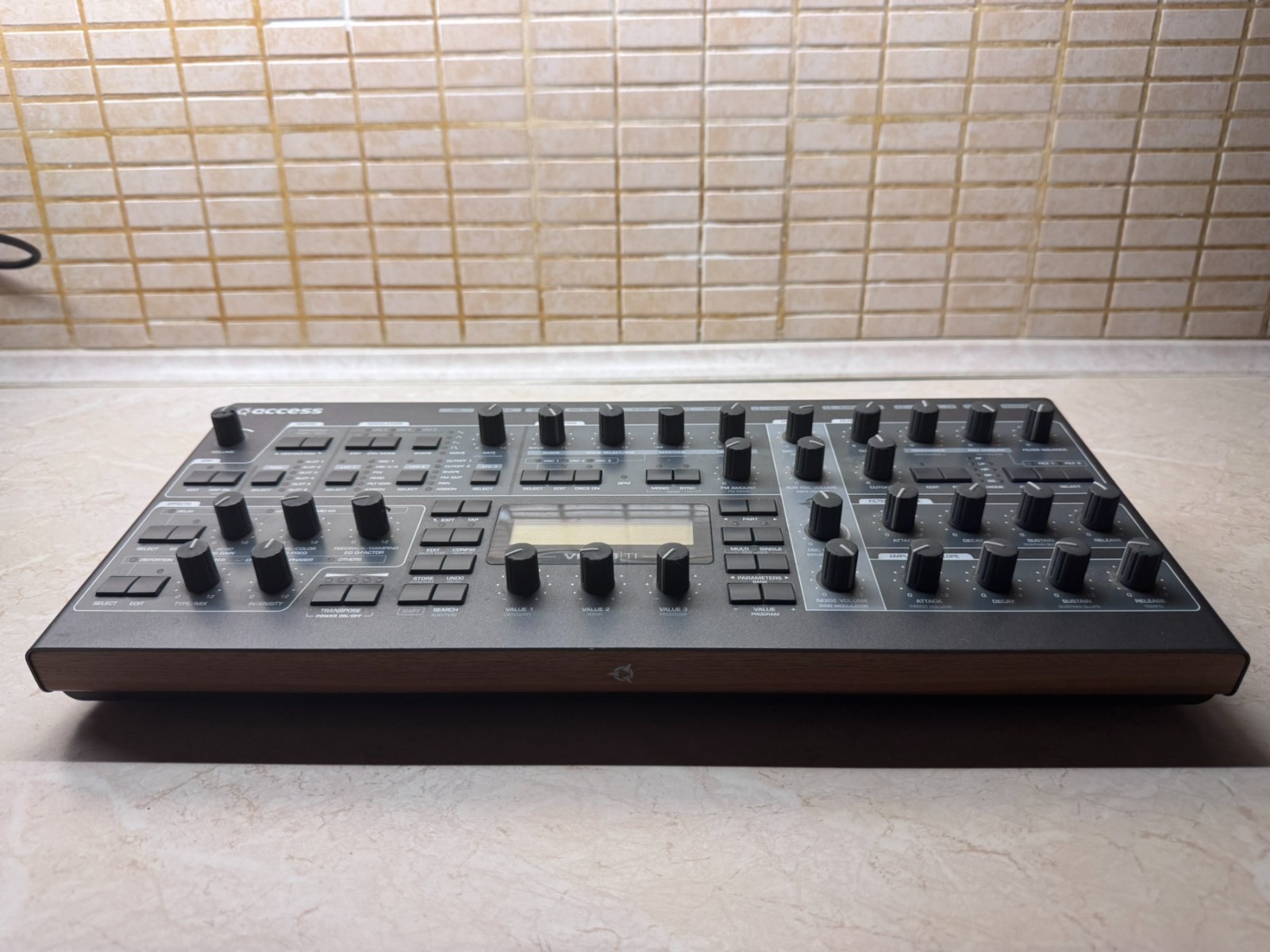
Three versions were offered: the 61-key Keyboard, the compact 37-key Polar, and the desktop module. All shared the same core engine, but the Keyboard was the flagship performer’s tool, with Fatar’s semi-weighted action and full pedal support. The Polar, with its white LEDs and sleek profile, was the boutique darling—small but fully loaded. The Desktop was the studio beast, rack-mountable and built for integration. No matter the form, the interface was a revelation for its time: 32 knobs, 43 buttons, and a 128x32 pixel display that actually showed you what you were doing. This wasn’t a synth that buried everything in menus—though you’d still need to dive for things like key tracking curves or envelope shapes—but it gave you enough hands-on control to tweak in real time without going blind. And then there’s the software: Virus Control 3.0, a full VST/AU plugin that mirrored the hardware, synced sample-accurately, and let you edit every parameter on screen. For 2009, that was witchcraft.
Specifications
| Manufacturer | Access Music |
| Production Years | 2009–2014 |
| Original Price | $2,499 (Keyboard), $1,699 (Desktop), $1,999 (Polar) |
| Polyphony | Up to 80 voices (varies by patch complexity) |
| Multitimbral Parts | 16 (Keyboard/Desktop), 4 (Snow) |
| Oscillators | 3 oscillators per voice + sub oscillator |
| Waveforms | Sine, triangle, sawtooth, square, pulse, noise, HyperSaw, 63 wavetables, granular, formant |
| Filters | Dual filters: lowpass, highpass, bandpass, band-reject, 1/2/4-pole analog emulations (including Minimoog-style) |
| LFOs | 3 LFOs with multiple waveforms and modulation routing |
| Envelopes | 2 main envelopes (Amp, Filter), plus 2 additional modulation envelopes |
| Effects | Reverb, delay (including tape delay), chorus, flanger, phaser, distortion (multiple types), EQ, frequency shifter, character control, vocoder |
| Arpeggiator | Programmable per patch, multiple modes (up, down, random, chord) |
| Keyboard | 61-note semi-weighted (Keyboard), 37-note synth-action (Polar) |
| Aftertouch | Monophonic (Keyboard and Polar) |
| Memory | 512 RAM patches, 26 banks of 128 ROM patches (3,328 total), 512 ROM patches on Snow model |
| Display | 128x32 pixel backlit LCD |
| Connectivity | USB 1.1 (audio/MIDI), MIDI In/Out/Thru, stereo analog input, 4 stereo outputs (Desktop/Keyboard), headphone out |
| Weight | 10.5 kg (Keyboard), 4.8 kg (Desktop), 5.2 kg (Polar) |
| Dimensions | 98 x 440 x 260 mm (Desktop), 100 x 985 x 320 mm (Keyboard), 98 x 440 x 260 mm (Polar) |
| Power | External 12V DC power supply |
Key Features
The 25% Faster DSP That Actually Mattered
Most spec bumps are marketing fluff, but the TI2’s 25% increase in DSP power wasn’t just a number—it changed how you composed. Where the original TI could choke on complex multitimbral arrangements or heavy effects stacks, the TI2 breathed easy. You could layer a gritty bassline with a modulated pad, throw a frequency shifter on a lead, and still have room for a stereo delay with modulation and tape saturation—all running simultaneously. This wasn’t just about polyphony; it was about sonic density. The extra headroom also meant the effects engine could run hotter without artifacts. Tape delay no longer felt like a compromise—it became a centerpiece. And with new effects like the frequency shifter and enhanced distortion algorithms (including the gritty “Character” mode), the TI2 didn’t just sound bigger, it sounded more dangerous. This was a synth that rewarded excess.
HyperSaw, But Make It Nasty
The Virus HyperSaw is legendary, and the TI2 refined it into something almost obscene. With nine detunable saw oscillators per voice—two more than the JP-8000’s original seven—it could generate pads so wide they’d fall off the sides of your monitors. But unlike Roland’s version, which high-passed the detuned oscillators to avoid mud, the Virus let the low end ride. That meant richer, thicker textures, but also the potential for a low-mid buildup that could clog a mix. The fix? A little EQ, sure, but also embracing the weight. This wasn’t a synth for polite music—it was built for EDM drops, metal riffs, and cinematic swells that needed to feel physical. Pair it with the onboard distortion and you could go from glassy shimmer to full-on fuzz in one knob turn. And with the third oscillator and sub, you could stack waveforms like a sound designer on a caffeine bender—sine waves under a formant sweep, granular textures modulating a wavetable lead, noise bursts gated by an envelope. The modulation matrix had 18 slots, but the real magic was in the 2D modulation wheel, which let you morph between two modulation destinations in real time. It was like having an expression pedal built into the synth’s DNA.
Total Integration: Hardware That Talks Back
The TI2 wasn’t just a synth—it was a control hub. Through USB, it acted as a 2-in/4-out audio interface, a MIDI interface, and a sample-accurate VST/AU plugin host, all at once. Load the Virus Control plugin in your DAW, and every knob turn on the hardware updated in real time. Save a patch in the software, and it appeared on the hardware. This wasn’t just convenience; it was a workflow revolution. You could sketch ideas on the hardware, then fine-tune them on screen without losing the tactile feel. And because the plugin ran on the synth’s own DSP, it didn’t tax your computer. For producers in 2009—when CPU power was still a real limitation—this was a game-changer. Even today, few hardware synths offer this level of integration. And Access didn’t abandon owners: free OS updates kept rolling for years, adding features and fixing bugs, long after the TI2 was discontinued.
Historical Context
The Virus TI2 arrived at a turning point. By 2009, software synths were dominant. Native Instruments’ Massive had redefined bass design, and Ableton Live was turning laptops into full studios. Hardware was supposed to be dying. But the TI2 proved there was still a hunger for physical instruments that didn’t sacrifice power for portability. It stood in contrast to the minimalist resurgence of analog—Moog’s reissues, Dave Smith’s Prophet ’08—not by rejecting them, but by offering a different path. Where analog was about warmth and unpredictability, the TI2 was about precision, power, and control. It competed with the Nord Lead 4, the Korg Radias, and the Novation SuperNova II, but it carved its own niche: not just a synth, but a production system. Its closest rival might have been the Waldorf Kyra, but that synth never achieved the same market penetration. The TI2, meanwhile, became a staple in high-end studios and touring rigs. It wasn’t cheap, but it wasn’t trying to be. This was a flagship for professionals who needed reliability, depth, and a sound that cut through modern mixes. And with artists like Dr. Dre, Sasha, and The Prodigy using it, its credibility was undeniable.
Collectibility & Value
Today, the TI2 trades in a strange space: too new to be a “classic,” too powerful to be ignored. Prices vary wildly by model and condition. A clean TI2 Desktop goes for $900–$1,300, the Polar $1,100–$1,600, and the Keyboard $1,400–$1,900. The Snow model, with reduced polyphony and multitimbral capability, is less sought after and sells for $700–$1,000. Condition matters—these units were built like tanks, but the wooden end caps can crack, and the white LEDs on the Polar are prone to flickering if the flex cable fails. The power supplies are also a known weak point; many have failed over time, and replacements aren’t always easy to find. More critically, the internal batteries that maintain patch memory can leak, causing board damage. Always check if the battery has been replaced—better yet, ask for proof. The OS is generally stable, but some early units had USB driver issues on modern systems, though firmware updates resolved most of these. For buyers, the real question isn’t whether the TI2 still sounds good (it does), but whether they need its particular flavor of overkill. If you want hands-on control, rich effects, and a sound that dominates a mix, it’s still unmatched. But if you’re looking for vintage warmth or analog drift, look elsewhere. This is digital power, refined to a point.
eBay Listings


As an eBay Partner, we earn from qualifying purchases. This helps support our independent vintage technology research.