Access Virus TI Snow (2008)
A desktop synth module the size of a hardcover book that punches like a grand piano dropped from a roof
Overview
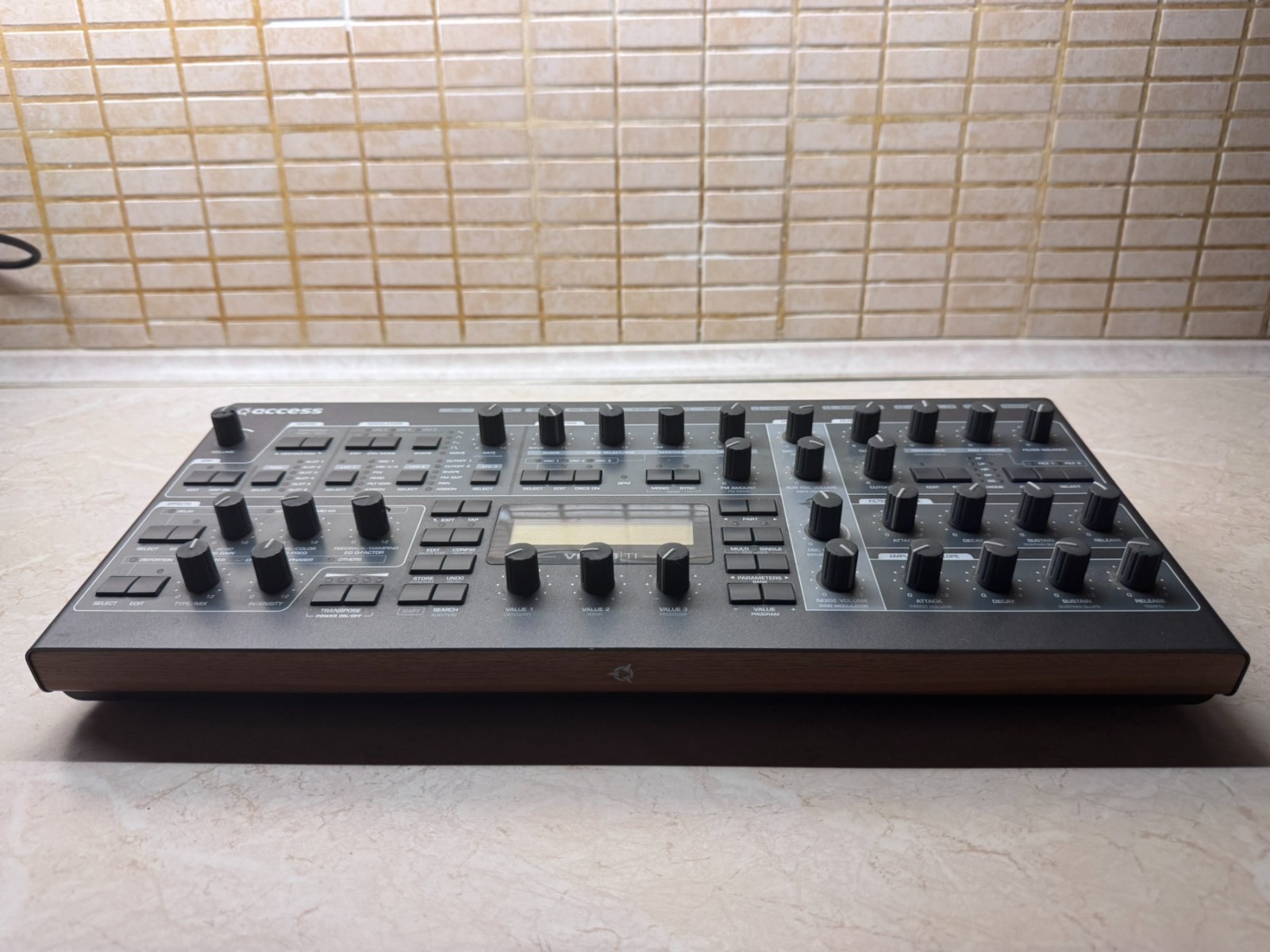
Slip the Virus TI Snow onto your desk and you’ll swear someone miniaturized a synth with a shrink ray. It’s barely bigger than a laptop power brick—28 cm wide, 15 deep, 5 high—and yet it houses the full sonic fury of Access’s flagship TI engine. The wooden front panel gives it a touch of class, like a vintage radio reborn in cream paint and warm brown legends, but don’t let the polite looks fool you. This thing growls. It screams. It breathes fire through a filter section that can mimic a Moog’s snarl or carve ice with surgical precision. And it does it all while fitting in the gap between your monitor and coffee mug.
When Access dropped the Snow in February 2008, it wasn’t just shrinking the TI line—it was redefining what “affordable” meant for pro-grade virtual analog. The full desktop and keyboard models carried premium price tags, but the Snow brought the same dual-DSP architecture, 50-voice polyphony, and four-part multitimbral capability down to a size and cost that made it viable for bedroom producers and laptop warriors. It wasn’t a stripped-down toy; it was a surgical reduction. They cut the number of front-panel knobs, streamlined the back panel, and ditched the expansive control surface—but left the engine bay untouched. What you lose in hands-on immediacy, you gain in portability and integration. This is a synth built for the DAW era, where your mouse might be your primary controller, but the sound still needs to feel physical, visceral, alive.
And alive it is. The Snow doesn’t just play nice with ambient pads or crisp leads—it thrives on abuse. Crank the resonance past 90%, twist the filter into self-oscillation, and you’ll hear that signature Virus snarl, a harmonic feedback loop that borders on controlled chaos. Dial in the Hypersaw oscillator, stack 32 unison voices, and send it through the onboard distortion and tape delay effects, and suddenly your mix has a new centerpiece. It’s not subtle. It’s not polite. It’s the sound of a synth that knows it can outgun half the rack in the room despite weighing just 1.5 kg.
Specifications
| Manufacturer | Access Music GmbH |
| Production Years | 2008 |
| Original Price | $1465 / £850.99 |
| Polyphony | 50 voices |
| Multitimbral Parts | 4 |
| Oscillators | 3 oscillators + 1 sub oscillator + noise |
| Waveforms | Sine, triangle, sawtooth, pulse, supersaw, wavetable, granular, formant |
| Filter | 2 multi-mode filters (lowpass, highpass, bandpass, bandstop) with Moog-style analog cascade filter emulation (6 to 24 dB/oct) |
| LFO | 3 LFOs with multiple waveforms and modulation options |
| Envelopes | 4 envelopes (with OS5), 2 envelopes (earlier OS versions) |
| Effects | Reverb, delay (including tape delay), chorus, phaser, flanger, distortion, EQ, frequency shifter, character control |
| Modulation Matrix | 18 slots |
| MIDI | MIDI In, MIDI Out |
| USB | USB 1.1 (audio and MIDI interface) |
| Audio Inputs | Stereo analog input (¼" jacks) |
| Audio Outputs | Stereo output (¼" jacks), headphone output (shared with left channel) |
| Keyboard | None (module only) |
| Display | LCD screen with parameter feedback |
| Controls | 6 rotary pots, 21 momentary touch buttons, 3 assignable soft knobs |
| Memory | 8 banks of 64 patches (512 total), half RAM, half ROM (rewritable with latest OS) |
| Weight | 1.5 kg |
| Dimensions | 28 x 15 x 5 cm |
Key Features
The Engine in a Matchbox
The real magic of the TI Snow isn’t that it sounds good for its size—it’s that it sounds indistinguishable from its larger siblings when you close your eyes. That’s because Access didn’t downclock the DSP or gut the oscillator section. You still get three full oscillators per voice, with FM, sync, ring modulation, and the legendary Hypersaw that defined late-’90s and 2000s trance and electro. The granular and formant oscillators open doors to organic textures and vocal-like sweeps, while the wavetable engine lets you morph through evolving timbres that feel more like a PPG than a virtual analog. And because it’s a Virus, every parameter is routable. The 18-slot modulation matrix isn’t just for envelopes and LFOs—you can modulate effects, filter balance, oscillator spread, even other modulation slots. Recursive modulation, where a parameter modulates itself, lets you create feedback loops that generate movement no sequencer could replicate.
Dual Filters with Bite
If there’s one reason the Virus sound cut through mixes like a scalpel, it’s the twin multimode filters. The Snow carries the full legacy: two independent filters that can be routed in series, parallel, or split across oscillators. You can set one to lowpass and the other to highpass, create a bandpass effect with surgical precision, or stack them for a 36 dB/oct roll-off that few analog synths could match. The Moog-style analog cascade filter emulation—modeled after the Minimoog’s 4-pole design—adds warmth and character when you need it, but the digital filters are where the Snow really shines. They’re fast, aggressive, and capable of harmonic distortion that borders on intentional clipping. Turn on the saturation module, crank the resonance, and you’ll hear why so many industrial and techno tracks from the era sound like they’re tearing themselves apart.
DAW Integration Done Right
In 2008, most synths treated USB as an afterthought—a MIDI pipe with maybe a firmware update function. The TI Snow made it the centerpiece. Plug it into your computer and it becomes a 2-in/2-out audio interface, bypassing your sound card entirely. More importantly, the included VST/AU plugin acts as a full graphical editor. Every knob, every menu, every modulation routing is mirrored on screen. Want to tweak 16 parameters at once? Drag sliders in the plugin. Need to browse presets across all four multitimbral parts? Use the browser, not the 21-button grid. This wasn’t just convenience—it was a workflow revolution. The Snow assumed you’d be working inside a DAW, and it optimized for that reality. The trade-off? A steeper learning curve if you’re not using the software. But for those who were, it meant spending less time menu-diving and more time making sound.
Historical Context
The Virus TI Snow arrived at a turning point. By 2008, the digital workstation was the norm, and hardware synths were either boutique analog revivals or overstuffed flagship workstations. The Snow was neither. It was a focused tool—a sound module for the modern producer. Access had already proven the TI engine’s dominance with the larger desktop and keyboard models, but those were expensive, bulky, and aimed at high-end studios. The Snow democratized that power. It competed not with analog reissues, but with software synths like Native Instruments’ Absynth or Arturia’s Prophet V. And it held its ground—not because it was cheaper, but because it sounded bigger, more aggressive, more “real.”
Its closest hardware rivals were units like the Nord Lead 3 or Korg Radias—both capable, but neither with the same depth of modulation or effects integration. The Snow’s ability to process external audio through its filters and effects gave it an edge as a sound design tool, not just a synth. And while Access would follow up with the faster, more powerful TI2 in 2009, the Snow remained the most accessible entry into the TI ecosystem. It wasn’t just a smaller synth—it was a statement that high-end sound didn’t require a full rack space or a six-figure studio.
Collectibility & Value
Today, the TI Snow trades in a sweet spot between affordability and desirability. Units in good condition typically sell for $600–$900, depending on included accessories and firmware version. Those with the latest OS (5.x) and original packaging can command a small premium, especially if bundled with the original TI software. It’s not a rare piece—production was steady during its run—but it’s also not overproduced. Most units still in circulation have been well cared for, often pulled from professional setups.
Common issues are few but notable. The shared left-channel/headphone output is a persistent annoyance—if you’re monitoring through headphones while routing audio to an interface, you’re out of luck. Some owners report instability with older USB 1.1 drivers on modern macOS or Windows systems, though this is usually resolved with third-party driver tweaks or using it with a dedicated audio interface for I/O. The momentary touch buttons can wear out over time, especially the frequently used Bank and Part selectors, but they’re replaceable with standard components.
Before buying, check the firmware version. OS5 added the fourth envelope and improved multitimbral performance—worth the update if the seller hasn’t already done it. Also verify that the analog input works cleanly; some units developed grounding issues that cause hum when processing external signals. And test the headphone amp—while convenient, it’s underpowered for high-impedance cans.
For the price, the Snow remains one of the best values in vintage digital synthesis. It won’t replace a Jupiter-8 for warmth or a DX7 for FM clarity, but if you want a synth that can generate massive leads, gnarly bass, and evolving pads with surgical precision, it’s still a top contender. And unlike many digital synths of the era, it hasn’t been fully replicated in software—its character is tied to the original DSP implementation, which no plugin has perfectly cloned.
eBay Listings



As an eBay Partner, we earn from qualifying purchases. This helps support our independent vintage technology research.