Access Virus TI Polar (2005–2009)
The synth that made digital feel dangerous again—bright white, brutally capable, and loaded with sonic venom.
Overview
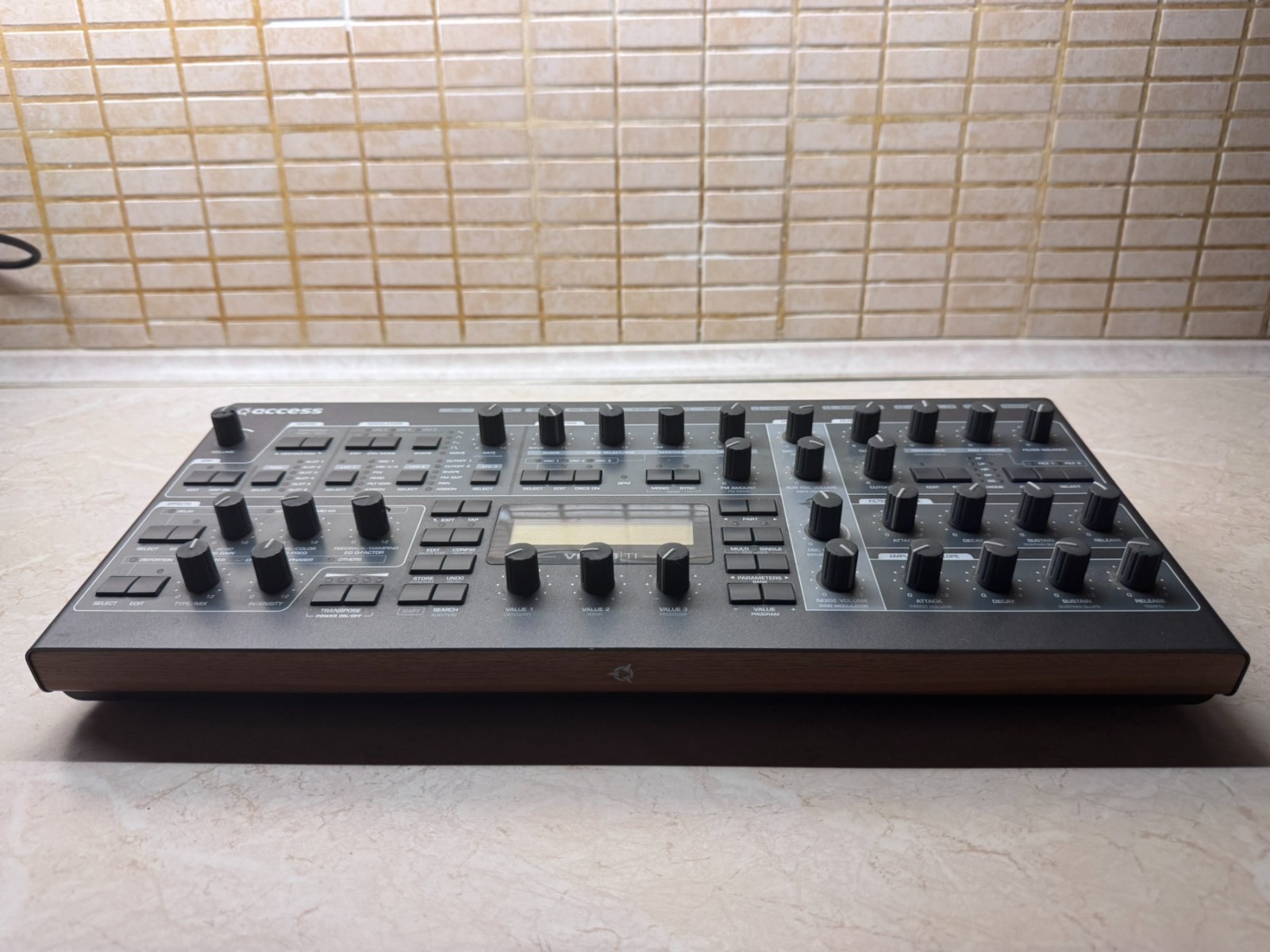
Flick the power switch on a Virus TI Polar and the front panel flares to life like a lab experiment gone wrong—blinding white LEDs, a crisp OLED display, and that glowing Access logo pulsing like a heartbeat under the hood. It’s not subtle. It’s not trying to be. This is a synth built for impact: the kind that arrives in your studio like a declaration of war on dull sounds. Released in late 2005 as the spiritual successor to the coveted Virus Indigo, the TI Polar wasn’t just another re-skin—it was Access Music’s full-throated embrace of digital synthesis as a high-performance weapon. With its 37-note semi-weighted Fatar keybed, compact footprint, and dual-DSP firepower, it split the difference between stage-ready agility and studio-grade depth. But more than specs, it carried an attitude: digital didn’t have to be cold, sterile, or predictable. In the hands of a techno producer or a cinematic sound designer, the TI Polar could snarl, howl, and shimmer with a kind of controlled chaos that felt almost analog in its unpredictability.
At its core, the TI Polar runs on twin Motorola 56362 DSP chips—the same architecture used in high-end pro audio gear of the era—which gave it the muscle to handle 80-voice polyphony, complex modulation routing, and a full suite of onboard effects without breaking a sweat. That kind of headroom was rare in 2005, especially in a synth that also doubled as a USB audio interface and VST/AU plug-in host. The integration wasn’t a gimmick; it was transformative. You could edit every parameter on-screen in real time, drag-and-drop patches, and even route external audio through the synth’s filters and effects—all while maintaining sample-accurate timing. For producers tethered to their DAWs, this was a revelation. But even standalone, the Polar held its own. Its interface, while dense, was a masterclass in thoughtful layout: three soft knobs, a 128x32 LCD, dedicated buttons for patch browsing, and a Shift key that unlocked deeper navigation without drowning in menus. It wasn’t as immediate as a Minimoog, but once you learned its language, it responded with surgical precision.
And then there’s the sound. Oh, the sound. The TI Polar doesn’t do “pleasant.” It does “menacing,” “hypnotic,” “industrial,” and “euphoric”—often all at once. Its oscillators span virtual analog, wavetable, granular, formant, and the infamous Hypersaw, which could stack dozens of detuned voices into a single note, creating pads that swallowed entire frequency ranges. The filters—dual multimode, with series/parallel routing—were where the magic happened. They could emulate a Minimoog’s warmth, a Roland TB-303’s squelch, or go fully digital with grainy, metallic textures that no analog circuit could replicate. Crank the resonance past 90%, and the synth would start to self-oscillate with a shriek that felt like feedback from the future. It wasn’t always pretty, but it was unforgettable. This was the synth behind The Prodigy’s most aggressive leads, the one that powered underground techno tracks with walls of modulated noise, the machine that made digital synthesis feel like it had teeth.
Specifications
| Manufacturer | Access Music GmbH |
| Production Years | 2005–2009 |
| Original Price | $2,999 USD |
| Polyphony | 80 voices |
| Multitimbral | 16 parts |
| Oscillators | 3 per voice + suboscillator + noise |
| Waveforms | Sine, triangle, sawtooth, pulse, supersaw, wavetable, granular, formant |
| Filter Type | Dual multimode: LP/HP/BP/BR, 1-/2-/4-pole analog emulations, grain table, comb, formant |
| LFOs | 3, with multiple waveforms and modulation targets |
| Modulation Matrix | 18 slots, recursive modulation capable |
| Envelopes | Amp, Filter, LFO-as-envelope option |
| Effects | Reverb, delay (tape, clocked, free), distortion (multiple types), chorus, phaser, flanger, EQ (3-band with Q), vocoder, analog EQ emulation |
| Arpeggiator | Up, down, random, chord, multiple patterns (editable via software) |
| Keyboard | 37-note, velocity and aftertouch sensitive (Fatar semi-weighted) |
| Display | 128x32 pixel LCD + OLED patch display |
| Memory | 512 RAM patches, 2048 rewritable ROM patches, 16 Multi Mode programs |
| Connectivity | USB 1.1 (audio/MIDI), MIDI In/Out/Thru, stereo audio I/O, headphone out, pedal inputs |
| Weight | 7.5 kg (16.5 lbs) |
| Dimensions | 600 x 260 x 70 mm (W x D x H) |
| Power | External 12V DC adapter |
Key Features
Dual-DSP Powerhouse with Total Integration
The TI Polar wasn’t just another digital synth—it was a hybrid command center. Its dual Motorola DSP chips didn’t just boost polyphony; they enabled Access’s “Total Integration” vision, where the hardware and software existed in perfect sync. Load the Virus Control plug-in in your DAW, and the synth became a sample-accurate virtual instrument with full parameter automation. But unlike most plug-ins of the era, this one had a physical brain. You could play the hardware, tweak knobs, and see changes reflected in real time on-screen. The USB connection handled MIDI, audio, and control data simultaneously, turning the Polar into a three-in-one device: synth, audio interface, and MIDI controller. For producers in the mid-2000s—when latency and driver instability were still real issues—this was a godsend. And because the DSP handled all sound generation onboard, CPU load in the host DAW remained negligible. It was a glimpse of the future, wrapped in white plastic and wood end-caps.
Hypersaw and Wavetable Chaos
If there’s one oscillator mode that defines the Virus TI Polar, it’s the Hypersaw. Not just a detuned stack, but a fully programmable swarm of up to 7 detuned sawtooth oscillators per voice, each with independent phase and spread control. Dial it in right, and a single chord could fill a room like a swarm of angry bees. But the real frontier was the wavetable and granular engines. With 63 spectral waveforms and the ability to scan, loop, and modulate through them in real time, the Polar could generate evolving textures that felt more like granular synths than traditional VA machines. Pair that with the formant oscillator—perfect for vocal-like sweeps—and you had a sound design playground that few hardware synths could match. These weren’t just add-ons; they were integrated into the modulation matrix, meaning you could route an LFO to morph between waveforms, or use envelope followers to trigger granular bursts. It was digital synthesis at its most unhinged.
Character Control and Sonic Shaping
Later firmware updates introduced the “Character” feature—a deceptively simple knob that applied analog-style saturation, filter curves, and instability to patches. Turn it to “Analog Boost,” and a sterile digital pad would suddenly warm up, with subtle pitch drift and filter nonlinearity. Set it to “Vintage A,” and it mimicked the behavior of a 1970s Moog; “Vintage B” leaned toward Roland’s smoother character. But the genius was in the extremes: “Lead Enhancer” added harmonic grit, “Pad Opener” widened stereo imaging, and “Stereo Widener” could turn a mono patch into a surround-sound experience. It wasn’t modeling in the traditional sense—it was more like applying a sonic filter that reshaped the output in musically useful ways. For producers who wanted digital precision with analog soul, it was a game-changer.
Historical Context
The mid-2000s were a strange time for hardware synths. Software instruments were rising fast, and many manufacturers were either downsizing or pivoting to modeling. Access Music, however, doubled down on hardware—and made it smarter. The Virus TI Polar arrived when digital synths were still fighting for credibility, often dismissed as “cold” or “lifeless” compared to analog. But Access didn’t try to hide its digital nature; it weaponized it. Drawing from their experience with the Pro Tools TDM and Powercore versions of the Virus, they built a synth that could exist both inside and outside the box. Competitors like the Nord Lead 3 and Korg Radias offered strong VA engines, but none matched the TI Polar’s integration, polyphony, or modulation depth. Even Roland’s JP-8080—once the king of digital—felt dated next to it. The Polar wasn’t just a synth; it was a statement that digital could be expressive, tactile, and musically dangerous. It found a home in electronic music studios worldwide, particularly in genres where sound design mattered more than vintage authenticity—techno, trance, industrial, and film scoring. By the time the TI2 revision arrived in 2009 with faster DSP and more effects, the Polar had already cemented its legacy as one of the most powerful digital synths of its era.
Collectibility & Value
Today, the Virus TI Polar trades between $1,200 and $1,800 depending on condition, with pristine units commanding top dollar. The white finish shows wear easily—scratches on the front panel, yellowing on the wood end-caps, and dimming OLEDs are common. The bright LEDs, while iconic, can be a nuisance in dark studios, but they’re adjustable in the menu. Reliability is generally good, but a few failure points exist. The most critical is the power supply—a failing 12V adapter can take out the motherboard, so replacements should be high-quality and properly regulated. The USB audio interface section can develop dropouts if drivers aren’t updated, though modern macOS and Windows systems handle it well with ASIO4ALL or similar. The Fatar keybed is durable, but after years of heavy use, velocity response can degrade. Some owners report “sticking” keys, usually fixable with contact cleaner. The OLED display is another weak spot—burn-in from static menus is possible, and full replacements are expensive. When buying, always test the aftertouch (it’s monophonic, so only the last note played responds), check all pots and switches for crackle, and verify USB audio functionality. Firmware should be updated to the latest version (OS 3.6) for maximum stability and feature set. Despite its age, the Polar remains in high demand—not as a nostalgic relic, but as a still-relevant sound design tool. It’s not the easiest synth to learn, but for those willing to dive in, it rewards with sounds that few modern plugins can replicate.
eBay Listings


As an eBay Partner, we earn from qualifying purchases. This helps support our independent vintage technology research.