Access Virus TI Desktop (2005)
German-built desktop synth module that functions as a VST/AU plugin, audio interface, MIDI interface, and control surface via USB.
Overview
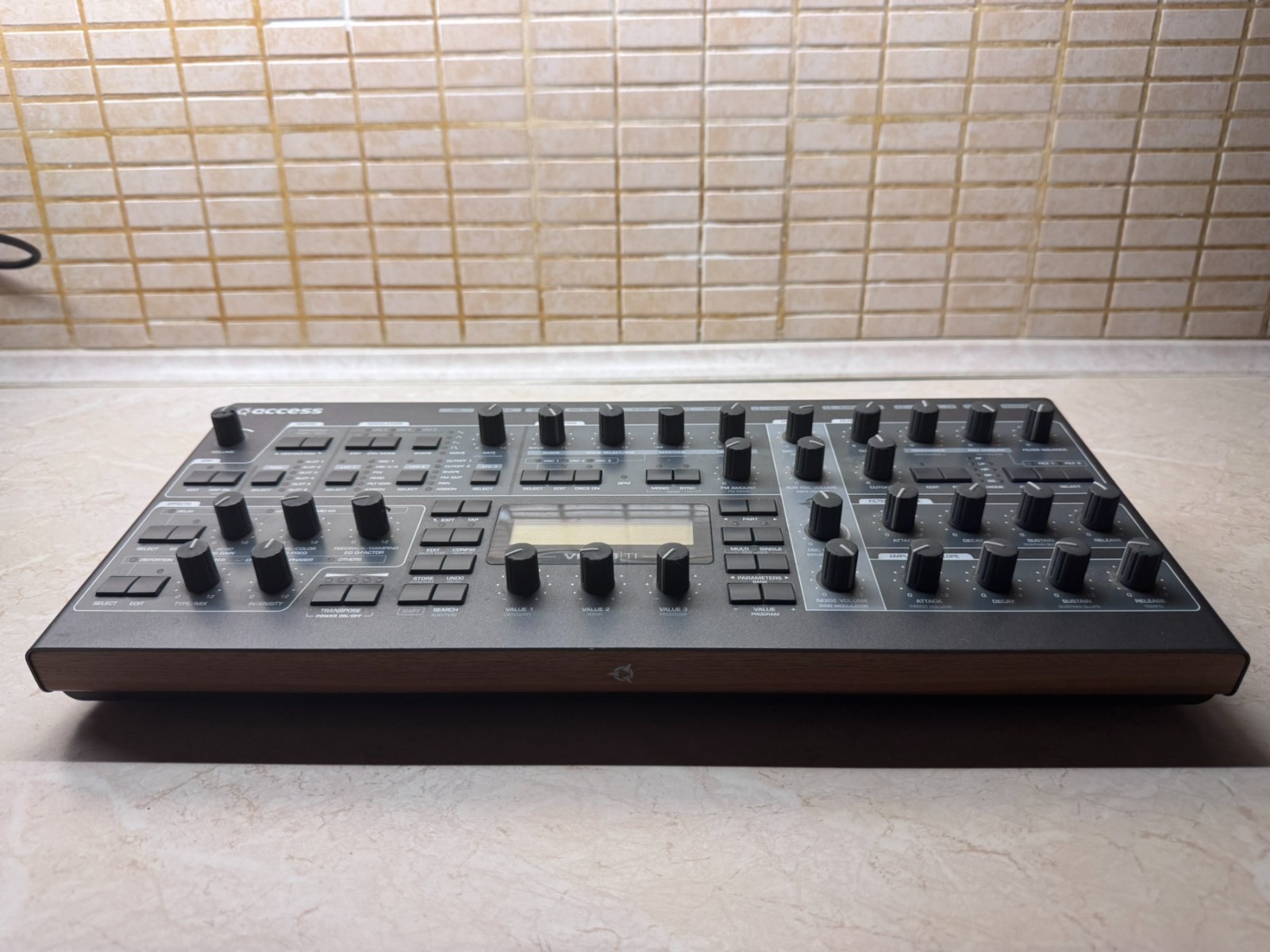
The Access Virus TI Desktop, made in Germany by Access Music GmbH, was released in 2005 as part of the Virus TI series. It is a virtual analog synthesizer with digital synthesis, combining virtual analog and wavetable synthesis. The "TI" stands for "Total Integration," reflecting its ability to function simultaneously as a hardware synth, software plugin, audio interface, MIDI interface, and control surface. It connects to a computer via USB1, using VirusControl software for sample-accurate VST/AU integration, two-way audio/MIDI streaming, and librarian functions. The desktop version features a metal-skinned, wooden-ended enclosure and includes a rack mounting kit, allowing for removal of the wood ends and 90-degree tilt of the I/O panel.
Specifications
| Type | Virtual analog synthesizer, desktop module |
| Synthesis | Digital, virtual analog, wavetable, FM, phase distortion |
| Oscillators | 3 osc + subosc + noise; Hypersaw, wavetable, formant, granular |
| Filters | Two per voice, dual LP/HP/BP/BR, 3- or 6-pole emulation, Minimoog 4-pole |
| Polyphony | Over 80 voices |
| Multitimbral Parts | 16 parts |
| Preset Banks | 30 banks × 128 patches, USB storage, free patchbanks from Access |
| Effects | Reverb, delay, tape delay, distortion, phaser, flanger, chorus, EQ, vocoder |
| Arpeggiator | Up, down, random, chord, editable via software |
| LFOs | 3 LFOs, 18-slot modulation matrix |
| Connectivity | USB1 (audio/MIDI/data), MIDI In/Out/Thru, S/PDIF in/out, 2 analog inputs |
| Audio I/O | 24-bit/96 kHz output, 192 kHz/24-bit D/A converters, dedicated headphone out |
| Control Surface | 32-user memories for custom controller maps, backlit LCD, three soft knobs |
| Power & Finish | Black finish, power cords for EU and US included |
Design
The Virus TI Desktop uses a dual DSP chip architecture with a digital brain and virtual analog topology. It features a triple-oscillator engine with 64 source waves, including Hypersaw and wavetable oscillators. Each voice has two programmable resonant filters that can be routed in series, parallel, or independently, with analog-style saturation and distortion. The front panel includes a backlit LCD and three soft knobs, and the unit supports recursive modulation via a 6-source, 18-destination modulation matrix. It includes optional soft limiting on all outputs and four input sensitivity settings.
Context
The Virus TI Desktop succeeded the Virus C (2002) and was succeeded by the Virus TI2 (2009). It was part of a series that included the TI Keyboard, TI Polar, and TI Snow—with the Snow being a single-DSP version. The TI series marked a shift toward bridging hardware and software, positioning itself against contemporaries like Clavia and Korg, though noted for its darker, more ominous sound compared to their bright, crisp tones. Reviewers called it "the best Virus to date" and "arguably the pinnacle of DSP-based digital synthesis."
Market
Rated 5 out of 5 stars by 62 reviewers, the Virus TI Desktop is praised for its sound quality, versatility, and durability. Customers highlight its long-term value, calling it "the Ferrari of synths" and stating they expect to use it for over a decade. It is described as a studio staple capable of lush pads, growling basses, searing leads, and complex arpeggios, with particular acclaim for its Hypersaw and wavetable engines.
eBay Listings


As an eBay Partner, we earn from qualifying purchases. This helps support our independent vintage technology research.