Access Virus TI (2005–2009)
The synth that made virtual analog feel dangerous again—bright, brash, and built like a tank with a brain full of fire.
Overview
Turn one on and the first thing you notice isn’t the sound—it’s the weight. The Access Virus TI doesn’t just sit on your desk; it stakes a claim. Cold aluminum, glowing blue LEDs, a front panel dense with knobs and buttons like a fighter jet cockpit—this thing was designed to be *used*, not just admired. And when you hit a key, it answers back with a snarl. The TI wasn’t just another VA synth in a sea of digital emulations—it was a declaration. After years of soft, forgiving virtual analogs that tiptoed around the raw instability of real analog circuits, the Virus TI charged in with distortion, hypersaws, and a filter section that could slice through concrete. It didn’t mimic vintage gear so much as it weaponized it, then added jet fuel.
Launched in 2005, the TI was the first major overhaul of the Virus line since the C series, and it showed. Where earlier Viruses were respected for their precision and reliability, the TI added ambition. Dual DSP chips meant it could handle far more complex patches, with up to 80 voices of polyphony—massive for the time, especially when you consider each voice could run three full oscillators, a sub, and a full effects chain. It wasn’t just powerful; it was *greedy*. And it expected you to be greedy too. This was a synth built for trance producers who needed walls of detuned saws, for industrial artists who wanted gritty, modulated noise, and for film composers who needed evolving textures that felt alive. But it wasn’t a one-trick pony. Dial it back, and it could do warm pads, punchy bass, and even convincing emulations of classic analogs thanks to its “Character” modes, which modeled the tonal quirks of synths like the Jupiter-8 or SH-101. But let’s be honest—you didn’t buy a Virus TI to play nice.
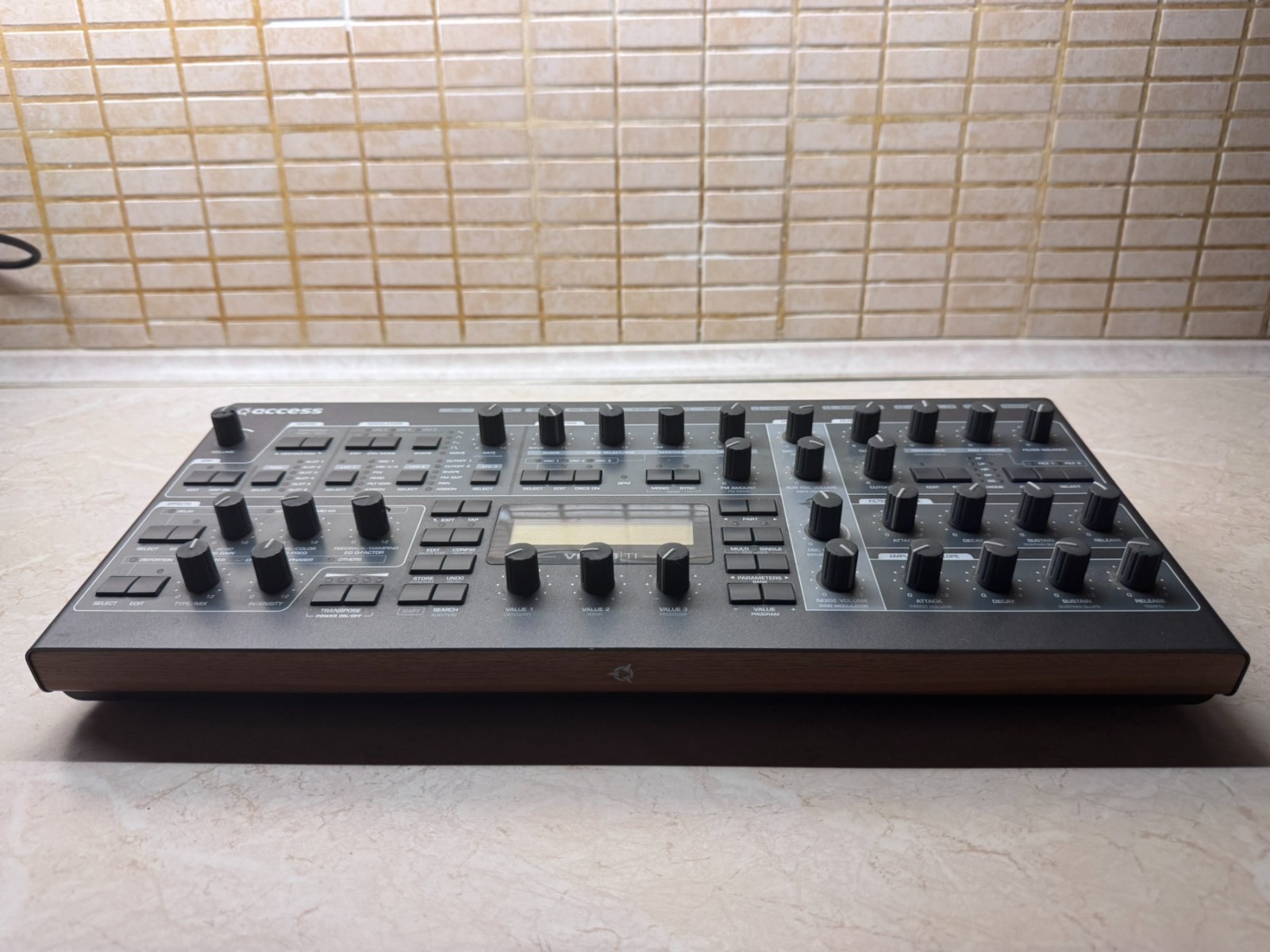
It came in three flavors: the full 61-key keyboard, the compact 37-key Polar with its striking white-and-aluminum chassis, and the desktop Snow module. All shared the same sound engine, which meant you weren’t paying extra for keys—you were paying for the form factor that fit your workflow. The Polar, in particular, became a cult favorite among touring DJs and live performers who wanted maximum firepower in a portable package. And despite its digital core, the TI felt analog in the best way: hands-on, immediate, with enough modulation routing to keep a sound designer busy for months. Every knob had a purpose, every button a consequence. No menu diving for basic functions. Want to tweak filter resonance while modulating it with an LFO that’s synced to tempo and being warped by a second envelope? Done. And it all happened in real time, with no lag, no stutter—just pure, unrelenting sonic control.
Specifications
| Manufacturer | Access Music GmbH |
| Production Years | 2005–2009 |
| Original Price | $2,999 (Keyboard), $2,499 (Polar), $1,999 (Snow) |
| Polyphony | Up to 80 voices |
| Multitimbral Parts | 16 |
| Oscillators | 3 per voice + 1 sub oscillator |
| Waveforms | VA (saw, pulse, sine, triangle), 63 spectral, hypersaw, wavetable, formant, granular |
| LFOs | 3 per voice, 68 waveforms |
| Filters | 2 multi-mode (LP, HP, BP, BS), Moog-style analog filter emulation, saturation stage |
| Envelopes | 2 ADSTR |
| Effects | 129 parallel effects including reverb, delay, distortion, phaser, chorus, flanger, ring mod, frequency shifter, 3-band EQ, vocoder, Atomizer |
| Modulation Matrix | 6 sources, 18 destinations |
| Keyboard | 61-key or 37-key with velocity and aftertouch (Polar/Keyboard models) |
| Memory | 128 patches per bank × 30 banks, USB storage support |
| Control | MIDI In/Out/Thru, USB, Total Integration with DAWs |
| Sampling Rate | 44.1 kHz or 48 kHz |
| D-A Converters | 192 kHz capable |
| Weight | 12.5 kg (Keyboard), 8.2 kg (Polar), 5.1 kg (Snow) |
| Dimensions | 980 × 335 × 110 mm (Keyboard), 670 × 335 × 110 mm (Polar), 482 × 335 × 110 mm (Snow) |
| Power | External power supply, 100–240 V AC |
Key Features
The Hypersaw That Changed Everything
The hypersaw oscillator wasn’t invented by Access, but the TI made it iconic. A single oscillator that could stack up to nine detuned sawtooth waves, each with its own sub oscillator and sync capability, the hypersaw was the engine behind the synth’s most brutal leads and pads. It wasn’t just about thickness—it was about movement. Even at rest, a hypersaw patch felt like it was breathing, shifting slightly with each note. Turn up the detune, add some LFO modulation to the spread, and you had a sound that could fill an arena. This was the oscillator that defined an era of trance and EDM, and the TI’s implementation was among the most stable and musical. Unlike some software emulations that could get flabby or phasey, the TI’s hypersaw stayed tight, focused, and harmonically rich. It wasn’t a gimmick; it was a tool, and one that producers relied on for years.
Filters That Could Kill
Two filters per voice, each with multiple modes and routable in series, parallel, or split—this was the heart of the Virus sound. But what really set it apart was the ability to chain them creatively. Need a 36 dB/oct low-pass? Stack a 24 dB and a 12 dB filter in series. Want to sweep a high-pass while keeping a low-pass static? Route them independently. The inclusion of a Moog-style analog filter emulation—modeled after the legendary 4-pole cascade—gave it a warmer, more organic character when needed, capable of self-oscillation and overdrive. And then there was the saturation stage, which could add grit, warmth, or full-on digital destruction. This wasn’t just filtering; it was sound sculpting at a surgical level. The filters could make a patch sound vintage, modern, or completely alien, often within the same performance.
Total Integration: The DAW Was the Synth
In 2005, most hardware synths still felt like standalone instruments. The Virus TI didn’t. With its USB port and “Total Integration” system, it could plug directly into Logic, Cubase, Live, Pro Tools, and others, appearing as a native plugin with full parameter automation. The VIRUSControl software wasn’t just an editor—it was a bridge. You could load the synth as a VST/AU, play it from your DAW, and have every knob on the hardware mirror the plugin interface in real time. And if you wanted, you could flip the synth into MIDI controller mode, turning its 33 knobs into assignable CC controls. This wasn’t just convenience; it was a paradigm shift. The TI wasn’t competing with soft synths—it was joining them, on their own terms, while still offering the tactile control that software could never match.
Historical Context
The mid-2000s were a strange time for hardware synths. Analog was still in the shadows, soft synths were gaining ground, and many manufacturers were scaling back. Access didn’t just resist the trend—they doubled down. The Virus TI arrived when most virtual analogs were still playing it safe, emulating the past with polite, clean sounds. The TI said no. It was loud, proud, and unapologetically digital in the best way. It competed with the Nord Lead 3, the Roland JP-8000’s descendants, and the Korg Radias, but it didn’t sound like them. Where the Nord was bright and punchy, the TI was dense and aggressive. Where the Radias was experimental and quirky, the TI was focused and powerful. It found its home in electronic music, especially trance, where producers like Deadmau5 and The Prodigy used it to build massive, evolving leads and searing basslines. But it wasn’t limited to EDM—film composers used it for sound design, industrial artists for noise, and even rock bands for texture. It was a synth that refused to be boxed in.
And then there was the software update culture. While most hardware synths shipped with a fixed OS, the TI kept evolving. Firmware updates added new effects, modulation options, and even sidechain capability—features that would normally require a hardware revision. By the time the TI2 arrived in 2009 with 25% more DSP power and 110 voices, the original TI already felt like a living instrument, not a static box. That commitment to long-term support was rare, and it built fierce loyalty among users. Even after production ended, the community kept it alive with third-party editors, patch libraries, and even DSP emulation projects when the chips became obsolete.
Collectibility & Value
As of 2024, the Virus TI is officially vintage—not just in spirit, but by timeline. Production of the TI2 ended in February 2024 when Access confirmed the core DSP chip was no longer available, marking the end of an era. That scarcity has driven interest, but prices remain surprisingly grounded. A well-maintained Virus TI Keyboard in good condition sells for $1,200–$1,600, the Polar $1,000–$1,400, and the Snow $800–$1,100. That’s a fraction of its original cost, which makes it one of the better vintage synth values out there—especially considering what it can do.
But it’s not without risks. The most common failure point is the power supply, especially on older units. Some owners report noise or hum when the PSU degrades, and replacements aren’t always easy to find. The Snow, being fanless, can overheat if used in poorly ventilated spaces, leading to DSP throttling or crashes. And while the build quality is excellent, the knobs and sliders can wear out after heavy use—especially on touring units. When buying, always test every pot, check for firmware updates (v3.0 added crucial features), and verify USB and MIDI functionality. Avoid units with cracked LCDs or sticky keys, and be wary of “untested” listings—this isn’t a synth you want to buy blind.
Still, for the price, it’s hard to beat. It’s not as warm as a Juno, not as raw as a Minimoog, but it does things neither of them can touch. It’s a synth for people who want power, flexibility, and a sound that cuts through a mix. And if you’re lucky enough to find a Polar in Dark Star edition—black chassis, pulsing red logo—you’ve got a modern classic. Just don’t expect it to be subtle. The Virus TI was never about subtlety. It was about presence. And it still has it.
eBay Listings


As an eBay Partner, we earn from qualifying purchases. This helps support our independent vintage technology research.