Access Virus Indigo 2 (2002)
A compact synth with the full Virus C engine under the hood — built like a tank, glowing like a spaceship, and ready to tear through trance, techno, or ambient with surgical precision.
Overview
Plug in the Indigo 2, power it up, and those blue LEDs ignite like a cockpit coming online — it’s not just a synth, it’s a statement. For a moment in the early 2000s, Access Music wasn’t just making synths; they were engineering sonic command centers, and the Indigo 2 was their stealth fighter. It doesn’t announce itself with flash or flamboyance, but with density — a 37-key slab of aluminum and circuitry that feels heavier than it has any right to be, like someone poured lead into the chassis just to prove a point. This isn’t the flagship Virus KC, nor the rack-bound XL — it’s the compact, road-ready evolution of the original Indigo, now powered by the full Virus C engine, and it hits a sweet spot between portability and raw synthesis muscle that still turns heads two decades later.
Sonically, the Indigo 2 doesn’t mess around. It’s a digital beast with analog instincts, capable of everything from glassy pads that shimmer like ice cracking under moonlight to basslines so thick they feel like they’re vibrating your ribcage. The engine delivers 32 voices of polyphony — a serious upgrade from the 24 of the earlier Virus B — and packs in three oscillators per voice, a sub-oscillator, and five distinct FM modes that open up a world of metallic, bell-like, and aggressively digital textures. The filter section is where things get interesting: dual resonant filters with lowpass, hipass, bandpass, band-reject, and serial/parallel routing options, plus saturation and overdrive for when you want to push the signal into grittier territory. It’s not a Moog, but with the right settings — especially using the “Moog modeled” filter option introduced in later OS updates — it can get convincingly warm, though its natural voice leans toward the precise, the polished, the slightly cold. That’s not a flaw; it’s a character. This is a synth that excels at clarity, definition, and the kind of surgical control that makes it a favorite for producers who need sounds to cut through dense mixes.
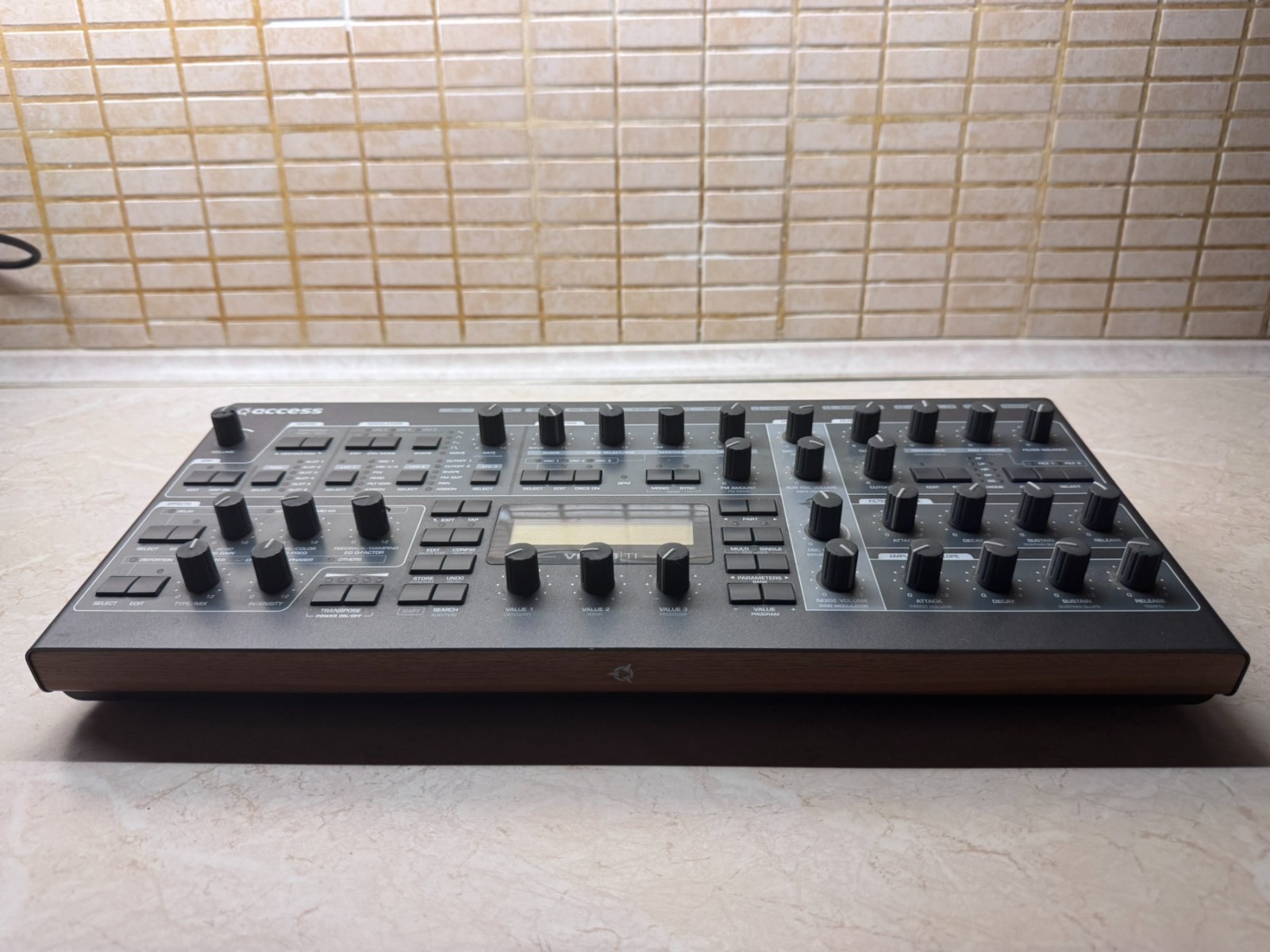
Despite its compact size, the front panel is surprisingly hands-on. It’s not quite as densely populated as the Virus KC, but it puts critical functions within reach — oscillators, filters, envelopes, LFOs, and effects all have dedicated knobs or buttons, reducing the need for endless menu diving. That said, don’t expect full knob-per-function control; some deeper parameters still live in the LCD-driven menus, which can feel like navigating a labyrinth if you’re not familiar with the layout. But once you learn the flow, the Indigo 2 rewards exploration. The arpeggiator alone is a performance powerhouse, with 16 independent instances, real-time swing control, and the ability to modulate parameters on the fly. Stack that with the 32-band vocoder (yes, really), 98 simultaneous effects, and full 16-part multitimbrality, and you’ve got a synth that’s not just a sound source — it’s a full production environment in a 3-octave box.
Specifications
| Manufacturer | Access Music |
| Production Years | 2002 |
| Original Price | $1,699 USD |
| Technology | Virtual Analog / Subtractive Synthesis |
| Polyphony | 32 voices |
| Oscillators | 3 per voice + 1 Sub-Oscillator |
| Oscillator Waveforms | Sawtooth, variable pulse, sine, triangle, oscillator sync |
| FM Modes | 5 modes, 64 digital FM spectral waveforms |
| LFOs | 3 per voice, 68 waveforms |
| Filters | 2 independent resonant filters; lowpass, hipass, bandpass, band reject, parallel, split, 2 serial modes up to 36dB/oct (6-poles) |
| Filter Overdrive | Yes, with saturation |
| Envelopes | 2 ADSTR (Attack, Decay, Sustain, Time, Release) |
| Modulation Matrix | 6 sources, 9 destinations |
| Effects | 98 simultaneous effects: 16 Phasers, 16 Choruses, 16 Distortions, 16 Ring Modulators, 16 Parametric EQs, Delay, 32-Band Vocoder, Surround Sound |
| Arpeggiator | 16 independent arpeggiators, real-time parameter control, swing, note length modulation |
| Vocoder | 32-band, programmable |
| Keyboard | 37 keys, velocity and aftertouch sensitive |
| MIDI | 16 multitimbral parts, full MIDI implementation |
| Memory | 1024 programs (256 User, 768 ROM, 128 Multi) |
| Operating System | OS 6 compatible (Moog filter emulation, USB support in later models) |
| Construction | Aluminum side panels, metal chassis, blue LED interface |
| Weight | 7.5 kg (16.5 lbs) |
| Dimensions | 610 x 280 x 85 mm (24 x 11 x 3.3 inches) |
Key Features
The Virus C Engine in a Compact Frame
The Indigo 2 isn’t a scaled-down version of the Virus C — it’s the full engine in a smaller body. That means all 32 voices, the expanded modulation matrix, the upgraded effects, and the refined oscillator architecture are present and accounted for. This was a big deal in 2002, when many compact synths sacrificed polyphony or multitimbral capability to save space. The Indigo 2 doesn’t. It’s a full 16-part multitimbral workstation, making it just as viable for studio layering as it is for live performance. The 37-key keyboard, while not full-sized, is velocity- and aftertouch-sensitive, and the aftertouch implementation is particularly expressive — ideal for modulating filter sweeps or adding vibrato in real time. It’s not meant to replace a piano-weighted 88-key controller, but it’s more than enough for sketching ideas, playing leads, or triggering arpeggiated sequences on the fly.
Deep Modulation and Real-Time Control
Where the Indigo 2 truly shines is in its modulation architecture. With six modulation sources and nine destinations, plus a visual mod matrix displayed on the front panel, it’s far more immediate than the menu-heavy Virus B. You can route LFOs to filter cutoff, envelopes to pitch, aftertouch to resonance — and see it all at a glance. The arpeggiator isn’t just a pattern generator; it’s a performance tool. Each of the 16 arpeggiators can have its own swing, note length, and direction, and those parameters can be modulated in real time via MIDI or front-panel controls. This makes the Indigo 2 a favorite for electronic producers who rely on evolving sequences — psytrance, techno, and ambient artists have all found a home here. The inclusion of a 32-band vocoder, while not as intuitive as dedicated hardware vocoders, adds another layer of experimental potential, especially when processing external audio through the synth’s effects and filters.
Digital Precision with Analog Soul
The Indigo 2 walks a tightrope between digital clarity and analog warmth, and it does so with intention. Early firmware versions leaned heavily into the “digital” side — some users report a colder, more clinical tone compared to the Virus B. But with OS 6, Access introduced a “Moog modeled” filter option that added a layer of analog-style saturation and resonance behavior, softening the edges and giving the synth a more organic character. This update alone changed the perception of the Indigo 2 in the collector community. It’s still not a true analog, but it doesn’t try to be. It’s a virtual analog that knows its strengths: precision, stability, and the ability to produce sounds that are both massive and meticulously detailed. Whether you’re layering pads, designing aggressive leads, or crafting complex rhythmic textures, the Indigo 2 delivers with surgical accuracy.
Historical Context
The early 2000s were a transitional period for synthesizers. Analog was still in the shadows, overshadowed by the rise of software and digital workstations, but a niche market for high-end virtual analog hardware was growing. Access Music, a relatively small German company, had already made waves with the Virus A and B series, but it was the Virus C line — including the Indigo 2 — that cemented their reputation. Released in 2002, the Indigo 2 arrived at a time when producers were hungry for powerful, reliable hardware that could integrate seamlessly into digital setups. It competed with the likes of the Nord Lead 3, the Alesis Andromeda A6, and the Korg Z1, but stood out for its build quality, multitimbral depth, and aggressive sonic character.
Unlike many of its contemporaries, the Indigo 2 wasn’t trying to be a jack-of-all-trades. It was built for electronic music — specifically for genres that demanded clarity, punch, and the ability to cut through a mix. It found favor with trance, techno, and industrial artists, including Richard Barbieri of Porcupine Tree, who used it for its atmospheric textures and precise modulation. While the later Virus TI series would add more effects, larger keyboards, and USB connectivity, the Indigo 2 remains a purist’s choice — a no-compromise engine in a compact, road-ready format. It was never the most popular Virus model, but it was arguably one of the most focused.
Collectibility & Value
Today, the Access Virus Indigo 2 trades in a quiet but dedicated corner of the vintage synth market. It’s not as common as the Virus TI or the rack modules, but it’s not rare enough to be unobtainable — a used unit in good condition typically sells for $800–$1,200, depending on age, included accessories, and firmware version. Units with OS 6 pre-installed — especially those with the Moog filter emulation — command a premium. The build quality is excellent: aluminum side panels, a solid metal chassis, and high-quality potentiometers mean these units tend to age well, but there are a few known failure points. The most common issue is LCD degradation — the display can dim or develop dead pixels over time, though replacement is possible. The power supply is also a weak link; original units are prone to failure, and sourcing a compatible replacement can be tricky. Some owners report intermittent MIDI issues, often traced to aging internal cabling or connectors.
Before buying, test every knob, button, and key. Check for ghost notes, dead keys, or aftertouch inconsistencies. Verify the firmware version — OS 6 is essential for full functionality, including the Moog filter mode. If the unit hasn’t been serviced in years, consider a full recap and power supply check, especially if it’s been stored in humid or extreme conditions. Despite these quirks, the Indigo 2 is a durable synth. It was built for the road, and many units from the early 2000s still perform flawlessly. For the price, it offers more synthesis power than almost any other compact hardware synth of its era — a genuine workhorse that rewards deep exploration.
eBay Listings


As an eBay Partner, we earn from qualifying purchases. This helps support our independent vintage technology research.