Access Virus C (2002–2005)
That red-lit glow isn’t just for show—it’s the look of a synth that knows it can outwork, outplay, and outlast anything in your rack.
Overview
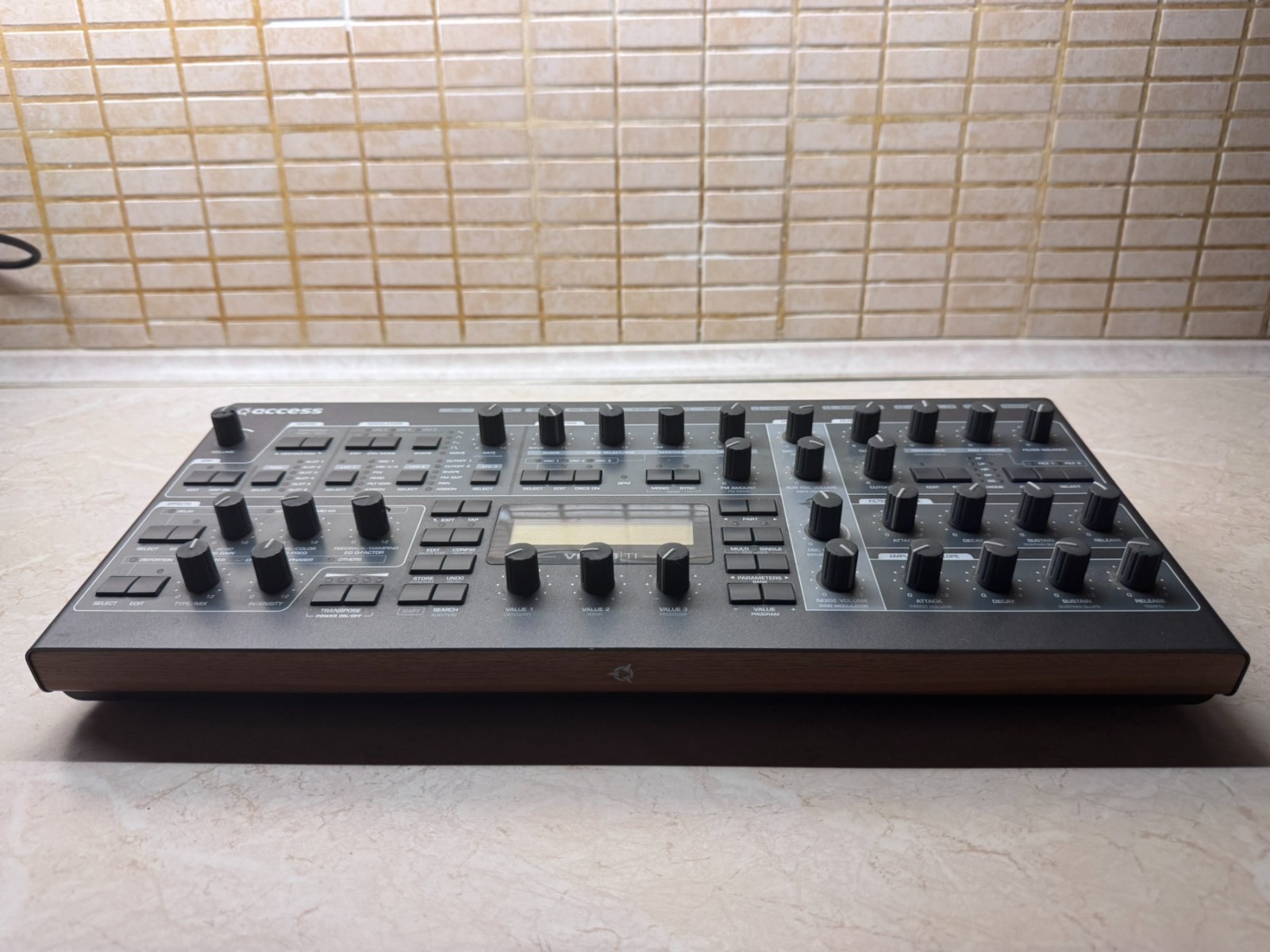
Fire up a Virus C and the first thing you notice isn’t the sound—it’s the light show. Sixty-nine red LEDs pulse and flicker like a digital heartbeat beneath a black casing that feels like it was forged in a tank factory. This isn’t some flimsy desktop module built to disappear behind your audio interface; it’s a statement piece, a synth that announces its presence before you even press a key. And when you do, you’re met with that signature Access voice: thick, dark, slightly menacing, and utterly commanding in a mix. The Virus C didn’t reinvent the virtual analog wheel, but it did refine it with surgical precision—more polyphony, smarter routing, better effects access, and a front panel that finally gives you real-time control over the chaos.
Coming after the Virus A and B, the C wasn’t just an incremental upgrade—it was a recalibration. Access listened to the complaints. Yes, the B had depth, but tweaking effects meant diving into menus. Want to tweak reverb damping? Hope you like scrolling. The C fixed that with dedicated knobs for delay/reverb and distortion/phaser groups, putting the most-used effects within immediate reach. The modulation matrix got clearer too, with a dense cluster of LEDs in the LFO/MOD section that actually show you what’s active. It’s a small thing until you’re knee-deep in a sound design session and you realize you don’t have to remember which LFO is modulating filter cutoff because the lights are telling you. That kind of thoughtful ergonomics separates the C from its predecessors.
And then there’s the polyphony bump—from 24 voices on the B to 32 on the C. That might not sound like much, but in practice, it’s the difference between a synth that chokes on big chords with unison and one that eats them for breakfast. Of course, it’s not unlimited. Use Oscillator 3, and you start losing voices—up to six in multitimbral setups, or an extra third of a voice per note in single mode. The 32-band vocoder also hogs resources, but only while it’s active, and the synth smartly frees up those voices 10 seconds after the input signal stops. It’s a thoughtful implementation, not just a spec sheet flex.
Patch count also got a boost. The C launched with OS 5.0 and supported an optional 1024-patch soundset downloadable from Access, expanding the ROM banks from the original six to twelve (Banks C through H). That brought total storage to 256 user patches, 768 ROM patches, and 128 multis. For owners who actually used their synths, not just collected presets, this was a godsend. The expanded effects engine didn’t hurt either—98 effects including multi-band compression, vocoding, and lush reverbs that could turn a simple pad into a cathedral-sized drone.
Still, the C isn’t perfect. The rear panel jacks are soldered directly to the board, not chassis-mounted, so any lateral stress on a cable can crack the traces. And while the front panel layout is better, it’s still not exactly intuitive. Want to solo Oscillator 3? Too bad—there’s no way to do it without muting the others manually. The two soft knobs moved from the left side to the bottom center, now sitting right under the display, which allows for on-screen labeling. You can name them “attack,” “cutoff,” or even “fear” or “hype” if you’re feeling dramatic. It’s a small touch, but it turns those knobs from generic controllers into personalized sound-shaping tools.
Specifications
| Manufacturer | Access Music GmbH |
| Production Years | 2002–2005 |
| Original Price | $1,495 (desktop module) |
| Polyphony | 32 voices (reduced with Oscillator 3 or vocoder use) |
| Oscillators | 3 per voice, plus 1 sub oscillator |
| Filters | 2 independent multi-mode filters (12dB/oct and 24dB/oct) |
| LFOs | 3 per voice |
| Envelopes | 2 ADSTR envelopes |
| Arpeggiators | 16 |
| Vocoder | 32-band |
| FM Synthesis | 5 modes |
| Multitimbrality | 16 parts |
| Effects | 98 built-in (distortion, phaser, chorus, reverb, delay, compression, vocoding) |
| Modulation Matrix | 6 sources, 9 destinations |
| MIDI | In, Out, Thru |
| Audio Inputs | 2 (for vocoder and external processing) |
| Audio Outputs | 2 main, 2 assignable |
| Weight | 5.5 kg (12.1 lbs) |
| Dimensions | 482 x 270 x 75 mm (19 x 10.6 x 2.95 in) |
| Operating System | Version 5.0 (upgradeable) |
Key Features
The Red-Lit Brain Trust
That sea of red LEDs isn’t just for goth ambiance—it’s functional. The LFO/MOD section uses status LEDs to show modulation activity in real time, which is invaluable when you’re deep in a sound and need to know whether LFO2 is modulating pitch or if the envelope is driving the filter. On earlier models, you’d have to dig through menus or rely on memory. The C shows you. It’s a subtle but meaningful shift toward transparency in a synth that’s otherwise a labyrinth of routing options. And the backlit display, while not huge, is sharp and responsive, making navigation less of a chore.
Effects Front and Center
One of the biggest usability upgrades on the C is the dedicated effects section. No more hunting through menus to tweak reverb time or distortion mix. Now you’ve got two knobs shared between distortion, phaser, and chorus (cycled via a button), and below them, a full set for reverb/delay: send, time, feedback/damping. Each group has an edit button to dive deeper, but the immediate access means you can shape the character of a sound on the fly. This is where the Virus C starts to feel like a performance instrument, not just a tone generator. Want to add grit to a lead? Twist the distortion knob. Need to swell a pad into infinity? Dial in delay feedback and let it breathe. It’s fast, tactile, and satisfying.
Oscillator 3: Power at a Price
Oscillator 3 is both a blessing and a resource hog. It adds serious sonic flexibility—more waveforms, more modulation options—but every patch that uses it eats into your 32-voice polyphony. In single mode, a three-note chord can consume four voices. In multitimbral setups, it can reduce total polyphony by up to six voices. It’s not a flaw, but a trade-off, and one that forces you to think about voice management. This isn’t a synth that hides its limitations—it makes you negotiate with them. And honestly, that’s part of the charm. You’re not just programming sounds; you’re optimizing them.
Historical Context
The early 2000s were a battleground for virtual analog supremacy. Korg’s Z1 and MS2000, Roland’s JP-8000 and SH-32, Novation’s Supernova, Clavia’s Nord Lead—all were vying for the title of digital synth king. Access entered the fray in 1997 with the Virus A, and by the time the C arrived in 2002, the company had already built a cult following, particularly in the trance and electronic scenes. The Virus wasn’t the first VA, but it was one of the most powerful, with a raw, aggressive character that cut through dense mixes. While Clavia leaned bright and musical and Waldorf went cerebral and complex, Access went dark and punchy—perfect for basslines that shook clubs and leads that sliced through reverb tails.
The C arrived at a time when software synths were gaining traction, but hardware still ruled the stage. Access didn’t try to compete with plug-ins on price or convenience—they doubled down on build quality, sound character, and real-time control. The C was part of a broader hardware refresh that included the Indigo 2 and Rack XL, all sharing the same upgraded engine. It wasn’t just about new features; it was about proving that hardware could evolve without losing its soul. And for a few years, it worked. The Virus C became a staple in professional rigs, praised for its reliability, depth, and that unmistakable sonic signature.
But it also arrived just before the next leap: the Virus TI in 2005, with USB integration, “Character” modes, and even more polyphony. The C, for all its improvements, was still MIDI-only, with no computer integration beyond standard SysEx. No editor/librarian software like the TI’s Virus Control. No USB audio interface functionality. It was the last of the “pure” Virus line—powerful, self-contained, and refreshingly free of computer dependency. For some, that’s a virtue. For others, it’s a limitation.
Collectibility & Value
Today, the Virus C trades in a sweet spot between capability and affordability. A working desktop unit in good condition typically sells for $600–$900, depending on mods and upkeep. Keyboard versions (KB) command a slight premium, usually $800–$1,100, but the desktop remains the most common configuration. The Indigo 2, its keyboard sibling, is rarer and often priced higher, sometimes creeping toward $1,200 if fully serviced.
The biggest concern for buyers? Power supplies and capacitors. Many C units are now over 20 years old, and electrolytic caps degrade. A failing power supply can cause random reboots, noise, or complete failure. Service technicians observe that recapping the power supply and audio output stage is often necessary for long-term reliability. Some owners report hum or ground loops—usually fixable with a ground lift or isolation transformer, but worth checking before purchase.
Another red flag: the rear panel jacks. Because they’re PCB-mounted, not chassis-mounted, any strain on a cable can crack solder joints. Units that have been rack-mounted and frequently plugged/unplugged are especially vulnerable. Check for loose jacks or intermittent signals—common signs of damage.
MIDI implementation is solid, but don’t expect modern conveniences. No USB, no patch dumping via USB, no software control. You can use third-party editors like SoundDiver (if you can find a working copy), but native integration stops at SysEx. For purists, that’s a feature. For producers deep in a DAW workflow, it’s a hurdle.
Still, the C holds its value well because it does one thing exceptionally: generate massive, detailed, aggressive electronic sounds. It’s not a jack-of-all-trades. It won’t do warm analog emulations or delicate acoustic textures. But for bass, leads, pads, and effects that need to dominate a mix, it’s still a top-tier choice. And unlike some vintage gear that’s valued more for nostalgia than function, the Virus C remains genuinely useful in modern productions.
eBay Listings



As an eBay Partner, we earn from qualifying purchases. This helps support our independent vintage technology research.